
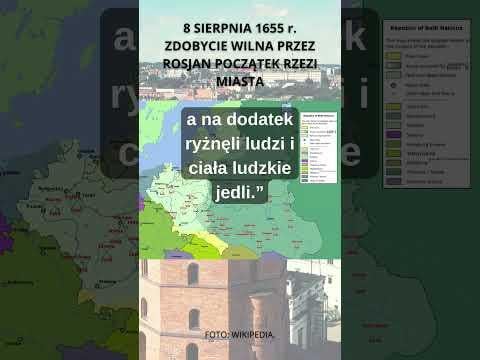
Calendar. On August 8, 1655, the troops of Tsar Alexei and Romanów, supported by numerous Cossack troops commanded by Ivan Zołotarenka, entered Vilnius. A few days earlier, at the beginning of August, they broke the defense lines commanded by Janusz Radziwiłł and Wincenty Korwin Gosiewski. The broken Lithuanian forces were unable to defend the city, which was left without real protection. On August 10, the tsar entered triumphantly to Vilnius, which for three days was a place of bloody slaughter. Russian and Cossack soldiers killed residents, robbed property, destroyed temples and palaces. At the same time, a huge fire broke out, which lasted seventeen days and consumed almost all buildings. Tenements, churches, warehouses and the monumental castle complex burned down. The destruction was so great that for many years Vilnius failed to return to its former glory. Before the mid -seventeenth century, about 45,000 people lived here, and at the end of the century, this number fell to just four thousand. The Russian occupation was extremely brutal. Reports from the era speak of universal hunger and extreme misery. Jan Cedrowski, an eyewitness to those events, wrote that “all cats, dogs dychlin people eaten, and in addition they fired people and the human bodies ate.” The city was under Russian control for five years, acting as a military and administrative base. It wasn’t until 1660 that the army of the Commonwealth under the command of the hetman Michał Kazimierz Pac managed to bounce Vilnius. The fights were fierce, and the reconstruction lasted a long time – many districts remained in ruins for years, and some of the destroyed buildings never regained its original appearance. Konoga from 1655 brought the end of one of the most magnificent eras in the history of the city. It was one of the most tragic episodes of the Polish-Russian war fought in 1654–1667. These events were remembered in the memory of residents and in historiography as an example of a disaster, which in a short time changed the fate of the great urban center. #Wilno1655 #historiapolski #WielkieStarstworylitewskie #wojnapolskorosyjska #baciewilno #sculptural #firefille #memory #memory #historialwy #edukacjahistoryczna #historiaeuropy #dzdzytwonarodowe
Posted by HistoricaDayAfterDay