
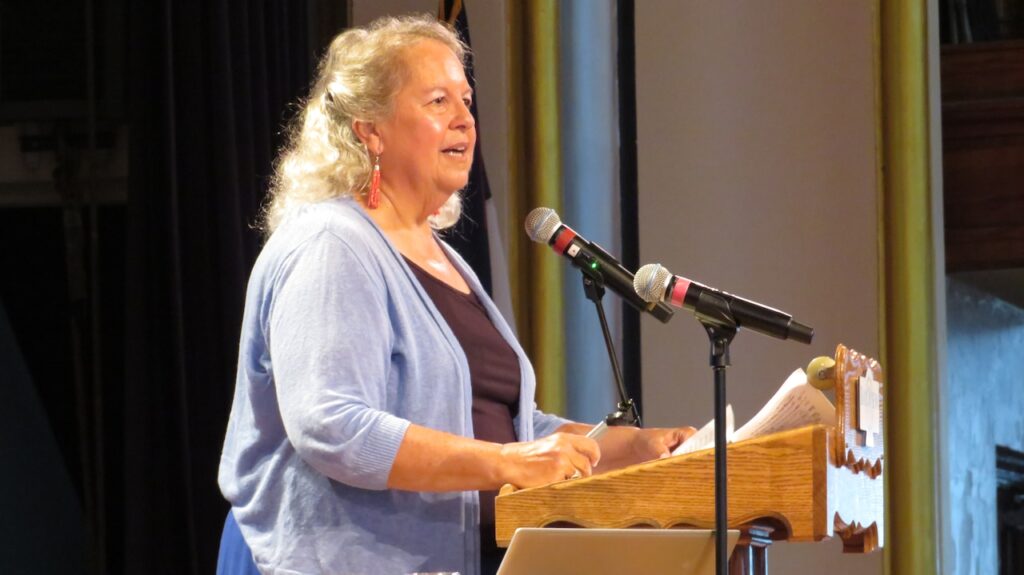
BAY VIEW, MI – Anishinaabe author Robin Wall Kimmerer came to Northern Michigan and called on all of humanity to take a lesson from the trees and get to work fighting climate change.
“In this year, which is the warmest ever recorded, when glaciers are melting, storms rising and hundreds of our fellow species are in grave danger, it’s important to recognize that we don’t have to innovate ourselves out of this dilemma alone because we have our plant teachers,” she said.
Kimmerer, a Potawatomi woman and environmental biology professor in New York, spoke Thursday, Aug. 7, to a crowd of more than 1,000 people at Bay View near Petoskey. She discussed the existential climate and ecological crises facing the world and called for a return of traditional ecological knowledge.
Related: More ‘good fire’ in Michigan restores Indigenous land practices
“There already is a system that pulls carbon from the atmosphere. It stores it for centuries; it has even more bells and whistles. It generates oxygen. At the same time, it builds soil, protects biodiversity, purifies water and makes us feel happy and peaceful. And it’s called a forest,” Kimmerer said.
The author argued that Indigenous ways of thinking will provide the most sustainable solutions to the warming planet and biodiversity losses. That humans must get busy with ecological restoration and restorative justice to save ourselves from the climate crises modernity created.
She said it’s time to stop cutting down trees and start planting them, instead.
“Plants know what to do about climate change. They do not dither in ineffectual policy meetings and debate carbon tax structures. They just get to work. They can be the model for the transformation that we need, because think about it, they have already converted to 100% solar economy,” Kimmerer said to raucous applause.
Kimmerer is the author of the wildly popular “Braiding Sweetgrass: Indigenous Wisdom, Scientific Knowledge, and the Teachings of Plants,” as well as “Gathering Moss: A Natural and Cultural History of Mosses.” Her latest book published last year is titled “The Serviceberry: Abundance and Reciprocity in the Natural World.”
Related: Local Indigenous educator’s legacy lives on through Grand Rapids street art
She told the crowd that humanity is at a metaphorical fork in the road with an important decision to make. One choice is to continue the notion of human exceptionalism, that “one species of the millions with whom we share planet was somehow more deserving of the richness of the earth than any other species,” Kimmerer said.
The other option is to embrace traditional ecological knowledge, based on the “recognition that we humans are not the top of some pyramid of life, but are members of a democracy of species bonded to one another through interdependence,” she said.
Kimmerer will continue her speaking tour in Michigan on Saturday in Traverse City as part of the National Writers Series. Tickets for the event at the downtown City Opera House are sold out, but online tickets remain available to watch the lecture livestreamed.
The author will return to Michigan next month for an event Sept. 4 at the First United Methodist Church in Ann Arbor.
- Detroit ranks as 3rd worst city worldwide for air quality amid wildfire smokeAug. 4, 2025, 4:00p.m.
- This beloved Michigan songbird’s numbers plunged over the last four yearsJul. 29, 2025, 3:37p.m.
- Traverse City interfaith vigil planned after Walmart stabbing spreeJul. 28, 2025, 6:55p.m.
- ‘It shakes you to the very core’: Traverse City looks to heal after mass stabbingJul. 28, 2025, 8:40a.m.
- Michigan is attempting something never done before in America’s nuclear industryJul. 25, 2025, 11:19a.m.
If you purchase a product or register for an account through a link on our site, we may receive compensation. By using this site, you consent to our User Agreement and agree that your clicks, interactions, and personal information may be collected, recorded, and/or stored by us and social media and other third-party partners in accordance with our Privacy Policy.