
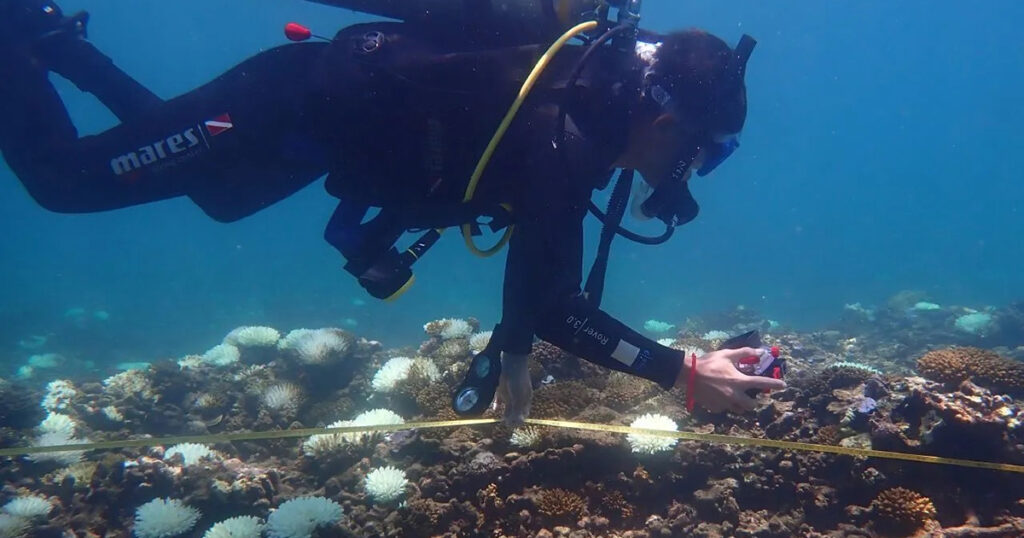
It standardizes data collected, analyzing coral reef composition with 80–90 percent accuracy, 700 times faster than traditional manual assessment, saving weeks and months of labor and freeing precious reef management resources.
AIMS Research Team Leader Dr. Manuel Gonzalez Rivero said ReefCloud brought together innovative approaches in AI, statistics, and data visualization to make monitoring faster, more efficient, and collaborative.
“ReefCloud results are summarized in a language that can inform decision-makers about how reefs are changing and to identify those that most urgently need protection,” he commented.
Timely Information
Coral reefs around the world are under threat from the impacts of climate change, including heat stress and the resulting mass coral bleaching, as well as other cumulative pressures.
The user-friendly, open-access platform democratizes knowledge, enabling the world’s coral reef monitoring community to work together at times when collaboration is critical. Users submit photos of reefs taken during their surveys. Facial recognition technology is used to identify around seven million parameters based on the colour, shape, and size of marine organisms.
ReefCloud enables the seamless integration of data to analyze how coral reefs are changing over time, providing comprehensive, standardized, and easily understandable reports that facilitate timely and informed decision-making to preserve the long-term resilience of coral reefs.
Many communities in the Indo-Pacific rely on coral reefs for food, income, and coastal protection. Dr. Gonzalez Rivero said helping to prevent further degradation of coral reefs depended on having timely and accurate information about their condition to inform conservation and management decisions.
“Reef monitoring across large expanses of ocean is expensive for nations with limited resources, and collating and integrating data from different formats and methodologies is labor-intensive and complicated,” he added. “ReefCloud is a fast and cost-effective way to get data about a reef compared with more traditional and somewhat cumbersome methods of reef monitoring.”
With support from the Australian Government, AIMS scientists have been working closely with nations in both the Pacific and Southeast Asia to identify knowledge gaps and priorities and help them design a reef monitoring program that meets their needs.
In the Pacific
ReefCloud’s inaugural international roll-out was to Pacific Island nations, in recognition of the vulnerabilities the region’s coral reefs face and the importance of coral reefs to the region’s health and prosperity. The Pacific is home to 27% of the world’s coral reefs.
AIMS worked closely with Palau International Coral Reef Center, Wildlife Conservation Society Fiji, the University of South Pacific, and the Maldive Marine Research Institute to test and fine-tune the platform. The project was also supported by Queensland University of Technology, Marine Ecology Consulting, C20 Pacific, Accenture, and Allen Coral Atlas.
ReefCloud was officially launched at the Our Ocean Conference in Palau in 2022. Over the past couple of years, AIMS scientists helped Samoa design a national coral reef monitoring program to standardize and integrate local monitoring efforts. In addition, they worked on a project to explore best practices, collaborating with local custodians and traditional knowledge holders in managing coral reefs.
This knowledge exchange project brought together Samoan communities and government officials, Papua New Guinea’s Sea Women of Melanesia reef managers, Australian Traditional Owners from Gidarjil Development Corporation and Conservation International – Samoa, in three intensive workshops held in Samoa and Australia.
It was co-facilitated by the Secretariat for the Pacific Regional Environmental Programme (SPREP). SPREP is the regional organization established by the Governments and Administrations of the Pacific, charged with protecting and managing the environment and natural resources of the Pacific.
In Southeast Asia
AIMS recently completed a three-year project working with government and reef monitoring professionals in Brunei Darussalam, the Philippines, and Vietnam, supported by the Australian Government’s Marine Resources Initiative (MRI).
The project developed a tailored and practical program for each nation using ReefCloud. AIMS scientists helped train ReefCloud’s machine learning to recognize the unique features of the local environments, such as adjusting for water clarity and considering local species. Dr. Gonzalez Rivero said the MRI project was co-designed with in-country partners, beginning with workshops to identify knowledge gaps and priorities.
A standardized coral reef monitoring framework was developed to guide image collection and ReefCloud use, as well as for data management, analysis, and reporting. This framework aligns with globally accepted methods for monitoring coral reefs. Many of the resources developed are now publicly available via the ReefCloud website.
The project partners reported that the shift from previously used methods reduced time and costs, enabling them to monitor more sites. Participants also reported improved taxonomic skills and more confidence in data analysis and interpretation.
In Brunei Darussalam, the MRI project catalyzed drafting the first National Coral Reef Monitoring and Management Plan. The Philippines Council for Sustainable Development formally adopted ReefCloud as the standard monitoring method, and ReefCloud data are used in reporting and to inform decision-making.
In Vietnam, six marine park authorities have committed to using ReefCloud and are applying the data to deliver evidence- based management.
Coral reefs are on the frontline of climate change. Collaboration and delivering practical science and knowledge are cornerstones for timely and informed actions. ReefCloud is rapidly evolving to support the collective power of monitoring endeavors to manage our reefs more sustainably.
This feature appeared in environment coastal & offshore (eco) magazine’s 2025 autumn edition Multidisciplinary Sampling & Monitoring, to read more access the magazine here.