
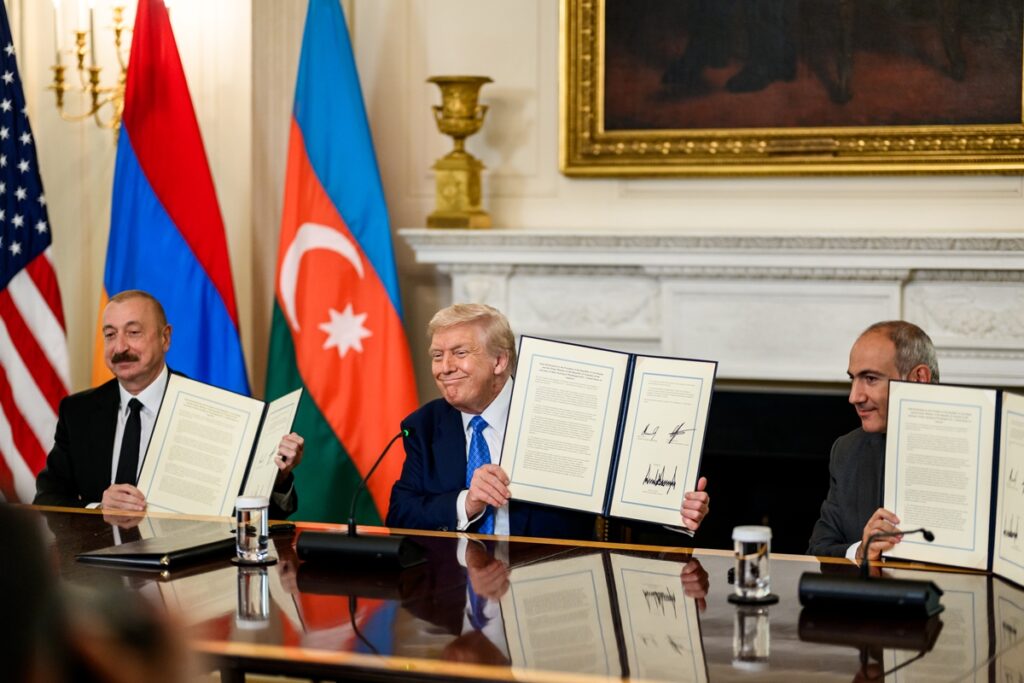
On Friday, President Trump facilitated at the White House a historic meeting that concluded with the signing of the Joint Declaration, a historic agreement that is set to bring peace, stability, and prosperity to the region after more than three decades. The landmark document signaled that the Azerbaijan-Armenia Peace Agreement is near completion, and announced the creation of a new regional corridor – the “Trump Route for International Peace and Prosperity (TRIPP).”
The parties initialed the text of the peace treaty between Azerbaijan and Armenia, confirming that they had agreed upon it. Although initialing is not the same as signing, it is nonetheless a significant step toward peace. It means that Azerbaijan and Armenia are now very close to achieving a final, sustainable peace. This Trump-brokered agreement holds significant potential to move beyond symbolism and become a genuine foundation for sustainable peace. Its strength lies in its ability to address the underlying political, economic, and connectivity issues that have fueled tensions for decades.
Why this time is different
Past efforts often focused narrowly on halting hostilities without addressing underlying political issues. This time, there is a stronger support by President Donald Trump on integrating peace with development and regional infrastructure, which makes it more comprehensive.
The Joint Declaration signed by the leaders of Azerbaijan and Armenia confirms that the two countries will jointly appeal to the OSCE Secretary General for the dissolution of the Minsk Group which was established in 90s to solve the conflict but played no role in both ending occupation and getting peace. At the same time, it recognizes the necessity of “taking further steps to achieve the signing and ratification of the agreement” once the remaining term is done. In other words, Friday’s meeting confirmed one of the main prerequisites for signing the final peace agreement – the necessity of amending the Armenian constitution.
Azerbaijan–U.S. relations have generally developed in a positive and constructive manner, grounded in mutual respect and trust. Officially established on February 28, 1992, these ties – especially through the invaluable efforts of National Leader Heydar Aliyev – were built on shared interests, with energy cooperation serving as a cornerstone. More than 80 state-level agreements have been signed over the years, clearly reflecting the current high level of partnership between the two countries.
The re-election of Donald Trump as U.S. President in 2024 gave a fresh impetus to bilateral relations. The two leaders exchanged phone calls and letters, with President Ilham Aliyev speaking favorably of Donald Trump in several speeches – particularly noting that no new wars began under his presidency and commending his commitment to family and traditional values.
President Aliyev’s significant diplomatic success
Against this backdrop, President Ilham Aliyev’s working visit to Washington, at President Trump’s invitation, marked a turning point. The trip signaled not only a new phase in bilateral relations but also progress toward lasting peace in the South Caucasus and the creation of new investment opportunities for multiple countries.
During the visit, a Memorandum of Understanding was signed to establish a Strategic Working Group for further development of the “Charter on Strategic Partnership between the Republic of Azerbaijan and the United States of America.” This agreement is pivotal for advancing cooperation in regional connectivity (energy, trade, transit), economic investment (including artificial intelligence and digital infrastructure), defense, arms sales, and counterterrorism.
It also paves the way for increased U.S. technological and financial involvement in Azerbaijan. Additionally, the Trump administration signed a document suspending the application of Section 907 of the Freedom Support Act – a congressional amendment from 1992 that unjustly restricted direct U.S. aid to Azerbaijan until it was repealed during Trump’s presidency.
And so, President Ilham Aliyev’s Washington visit has been a significant diplomatic success. It has elevated Azerbaijan–U.S. relations to a strategic partnership while advancing the cause of peace, security, and stability in the region. Under President Aliyev’s leadership, Azerbaijan continues to strengthen its international standing while ensuring sustainable national development.