
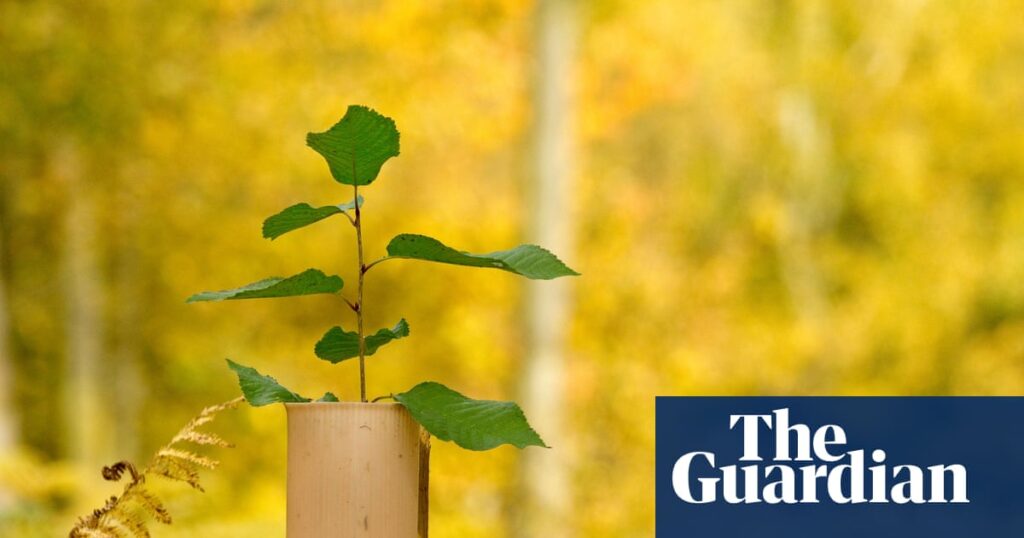
Entering the jungle, drizzle turns to rain. It’s muggy too, and within minutes I can feel my forehead prickling with sweat. Soon I’m soaked inside and out, and bothered by flies. Also, because of the dense foliage, I can barely see where I’m going. The ground’s uneven and every few paces I stumble a little. Stopping for breath, I hunker down and, through the stems, finally see my quarry: a spiral of white plastic wrapped around what I hope will prove to be a living tree, confirmed when I spot vibrant leaves bursting out of the tube’s crown.
Now I can get to work. Gripping the hilt of my long, narrow blade, I start slashing furiously around the sapling until my enemy lies on the ground in a wide circle of devastation. Then I plunge back into the bracken to look for the next one.
If there’s a list of plants we once valued but now despise, bracken is on it. In feudal times, the right to cut bracken was a valuable privilege. It provided bedding for animals, was used in thatch and could be burned to create potash to fertilise crops and, mixed with tallow, to manufacture soap. Now it’s a scourge, at least as far as graziers are concerned. Toxic to sheep, its relentless spread is a threat to pasture, especially as the herbicide for bracken, called Asulam, is now considered a health risk and banned in many places.
Bracken and heather meet on Eyam Moor, Peak District. Photograph: Graham Dunn/Alamy
Bracken, though, still has much to offer. Its presence can often indicate where woodland once grew. That’s likely the case where I’m standing, on the edge of a deep, steep-sided, bracken-choked clough running off the northern fringe of the moor. Lower down, there are mature trees thriving, so why not here? To that end, the landowner has planted a mix of hawthorn and oak, rowan and juniper. If they can grow tall enough, they’ll shade out the bracken, but right now the bracken’s winning. So I go to work again with my trusty blade to let the light back in.
Under the Changing Skies: The Best of the Guardian’s Country Diary, 2018-2024 is published by Guardian Faber; order at guardianbookshop.com and get a 15% discount