
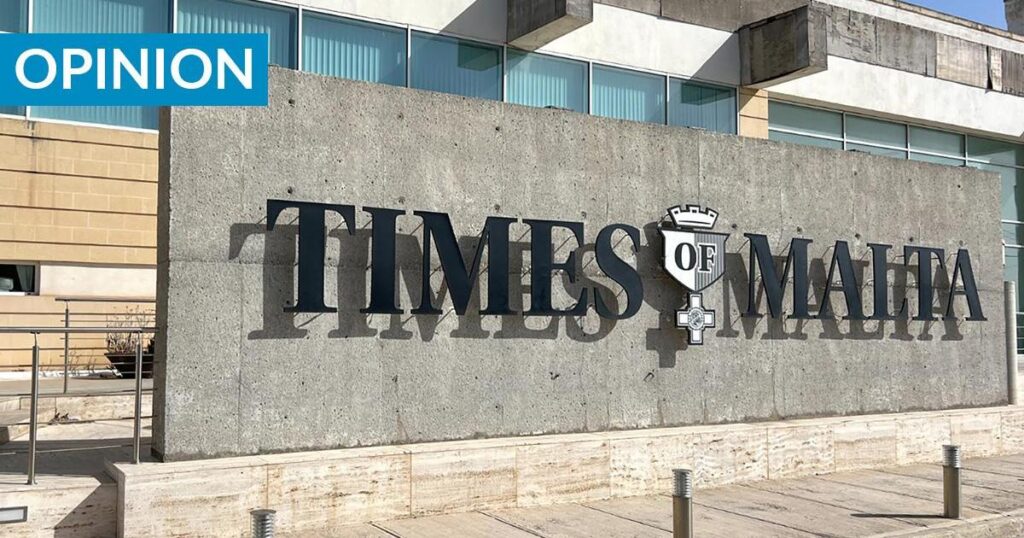
This year marks the 90th anniversary of the Times of Malta. As someone who spent many formative years in its different newsrooms, and who now observes the media landscape from the outside as a PR consultant, I find myself thinking about the role The Times has played and imagining what it might become in the next 90.
Times of Malta has changed my life forever.
I was just 22 when I first walked through those big green doors in Valletta’s Strickland House.
The deep drumming of the printing press thundering throughout the entire building, the rush of calling in hand-scribbled reports, the heated arguments, these are what defined my early years.
There was the thrill of locking down an ‘exclusive’ and of hearing those six most-intoxicating words: “It’s running on the front page.”
There were times I got it right, times I got it wrong.
And always, the immense privilege of bearing witness.
Because, for generations, The Times has been read over coffee, debated in parliament, clipped and stored in drawers, and shared over messenger apps and in group chats.
It has shaped not just public opinion, but our shared public memory.
Countless journalists have come and gone, but ‘the paper’ has always remained a constant in Malta’s national conversation.
The lessons I learned there, about integrity, fairness, and the power of a well-placed question, have stayed with me long after I swapped the newsroom for the boardroom.
Even back then, as we filed stories against print deadlines, we could sense the storm of relentless change ahead.
Today, Times of Malta is no longer just a newspaper. It’s a 24-hour digital newsroom, competing not just with local outlets but with a global information economy. Its journalists navigate social media squalls, shrinking attention spans, and the demands of insatiable digital audiences.
And yet, despite these pressures, its core mission remains intact: a pursuit of truth in the public interest. But what of the next 90 years? Where will Times of Malta be in 2115?
For me, the most enduring newsrooms of the future will not be those with the flashiest tech, but those with the strongest values
It’s tempting to imagine a science-fiction future where readers experience stories rather than read them. Maybe The Times will beam headlines into smart glasses or let subscribers step into virtual press conferences.
The format will certainly change, it already has, over and over again, from print to digital to social media.
The mission, however, must not.
Ninety years from now, the journalist’s job may not be to break the story first, but to confirm it’s real or generated.
With AI images, deepfake videos, and algorithms that amplify disinformation, the role of the newsroom has already shifted from being first to being certain.
This will only become more important.
Already today, the Times of Malta is not just a storyteller, but has become a fact-checker, a myth-buster, and a trusted filter in a rising flood of synthetic content.
Soon, Times of Malta will host an anniversary event asking questions about the future of journalism. For me, the most enduring newsrooms of the future will not be those with the flashiest tech, but those with the strongest values.
The Times has survived this long not because it was the most tech-savvy, or the first to jump onto Instagram or TikTok. It has survived because it has remained a constant.
In a world saturated with information, the role of trusted curators will only grow more critical. People will still crave context, investigation, and the reassurance that someone is keeping watch.
Humans are, at our essence, storytellers, and what greater story is there to tell than that of mankind and our collective journey?
This is where Times of Malta must continue to lead. Not by chasing clicks, but by continuing to champion that all-important mantra that is drummed into every rookie reporter: credibility matters.
In a future where trust is rare and truth is under siege, I believe The Times’ greatest legacy will be the standards it chooses to uphold.
Ninety years from now, Times of Malta may look and sound unrecognisable.
But if it is still giving voice to the voiceless, holding power to account, and telling Malta’s story with honesty and care, then it will still be doing exactly what it was founded to do.
If it can remain Malta’s compass, then in 90 years it won’t just be the country’s oldest newsroom.
It will still be its most necessary.

Ivan Martin is a former Times of Malta journalist and today is a PR and media consultant.