
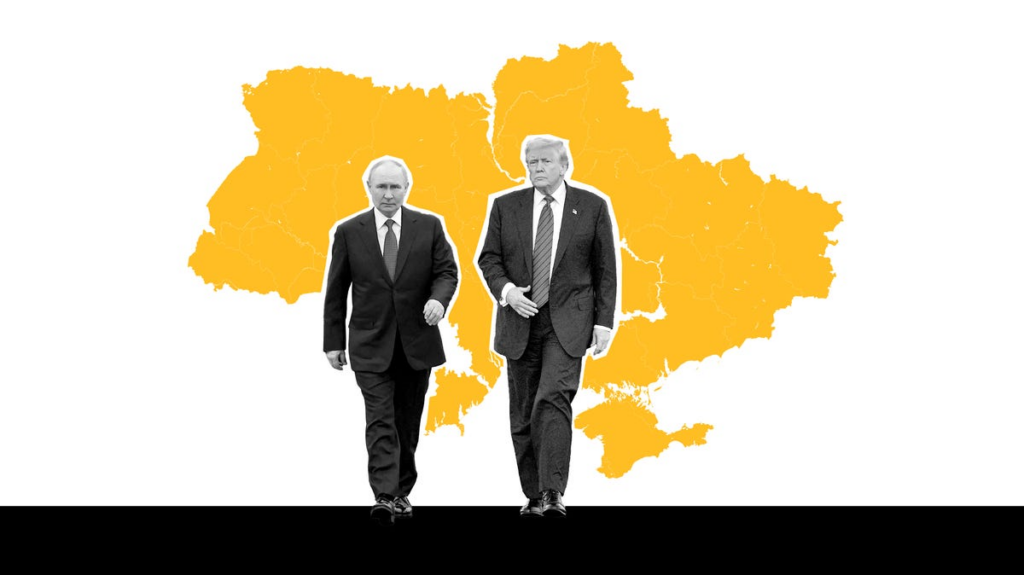
President Donald Trump and Russian President Vladimir Putin are scheduled to meet on Aug. 15, at a summit in Alaska to discuss potential pathways to end the war in Ukraine. But Ukrainian President Volodymyr Zelenskyy hasn’t been invited.
“I would say he could go, but he’s gone to a lot of meetings. He’s been there for 3 ½ years and nothing happened,” Trump said during a press conference on Aug. 11. In response, the European Union issued a statement Tuesday, endorsed by all member states except Hungary, saying: “the path to peace in Ukraine cannot be decided without Ukraine.”
Trump has raised the idea of a “land swap” between Russia and Ukraine, asserting that both countries would have to cede land to each other to end the war. But Zelenskyy has firmly rejected the idea of ceding any land to Russia. “Ukrainians will not gift their land to the occupier,” Zelenskyy said in a video posted on X on Aug. 9.
What land does Russia occupy in Ukraine?
Russia launched a full-scale invasion in February 2022, striking from the north, east and south. After failing to take Kyiv, it withdrew from northern Ukraine in April and refocused on the east and south. In fall 2022, Ukraine pushed back with major counteroffensives in Kharkiv and Kherson.
Since late 2022, the front lines have remained largely static, with neither side making major territorial gains. However, in recent months, Russia has intensified its offensive operations in eastern Ukraine.
Unable to view our graphics? Click here to see them.
Where Russia’s attacks are focused in Ukraine
The Russian military is pushing toward Dobropillya, a key logistics hub about 60 miles from occupied Donetsk. Its forces have recently seized nearby villages and are trying to cut off Ukrainian supply lines running through the area. Dobropillya sits near major highways that feed into Pokrovsk ‒ a critical Ukrainian stronghold. Pokrovsk has been attacked from the northeast and southwest and is in danger of being encircled.
Ukraine has been bombarded with record numbers of missiles and drones. In July 2025, Russia launched about 6,500 drones – the most in a single month since the war began. Cities such as Kyiv, Kharkiv, Dnipro and Odesa have been hit in recent attacks, causing dozens of civilian casualties. Over 1,600 people were killed or injured in July, according to the United Nations Human Rights Monitoring Mission in Ukraine. Most of these civilian casualties happened along the frontline in government-held areas, as Russia stepped up its attacks to seize territory.
Ukraine seized dozens of villages in Russia’s Kursk region shortly after its incursion began on Aug. 6, 2024. However, the Ukrainian military advances stalled after Russia sent reinforcements to the area. Fighting continues, with Russian forces conducting offensive operations.
Russia held referendums in 2022 to claim four Ukrainian regions ‒ Luhansk, Donetsk, Zaporizhzhia, and Kherson ‒ as its own, but it never had full control of those territories. The front line across much of the region has remained little changed during the past two years. Crimea was annexed by Russia in 2014.
Russia has eyes on Ukraine’s natural gas resources
On Jan. 1, Russia’s gas transit agreement with Ukraine expired, and Zelenskyy refused to renew the deal. Ukraine shut off the last pipeline carrying Russian gas to Europe via its territory, marking the end of a decades-long arrangement.”We stopped the transit of Russian gas. This is a historic event. Russia is losing its markets, it will suffer financial losses,” Ukraine’s Energy Minister German Galushchenko, said in a statement.While the European Union has significantly reduced its reliance on Russian gas since the full-scale invasion in 2022, countries like Slovakia and Hungary still depend on it. Russia can still supply them via the TurkStream pipeline, which runs across the Black Sea through Turkey.
Since then, there have been reports that Russia has increased attacks on Ukraine’s gas import pipelines, including an Aug. 6 strike on a gas pumping station in Ukraine’s southern Odesa region.
Mapping Ukraine’s crucial raw material deposits
Another major ongoing factor in the war is Russia’s interest in Ukraine’s mineral resources. With more than 5% of the world’s total mineral resources, Ukraine is a top 10 global provider because of its diverse geological zones.
Ukraine possesses an estimated $15 trillion worth of mineral resources, including some of Europe’s largest reserves of critical minerals essential for modern technology and the clean energy transition. Russia’s occupation of Ukrainian territories has given it control over a sizable portion of Ukraine’s rare earth minerals.
CONTRIBUTING: Francesca Chambers, Lauren Villagran, USA TODAY, and Reuters