
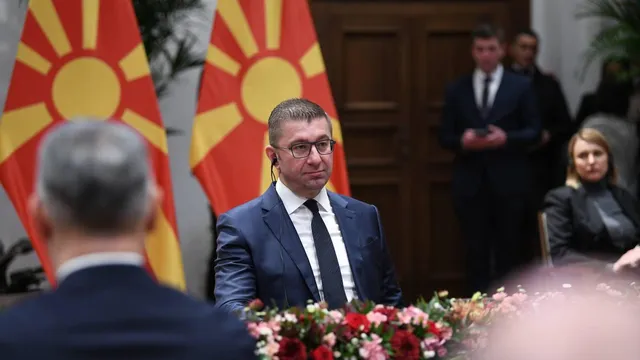
The “Mickoski” project is ruining the chance for integration into the European Union, pushing Skopje toward a union of authoritarian regimes in Europe, disillusioning the citizens of North Macedonia, and conveniently directing their anger toward their “eastern neighbor.”
The regime of Hristijan Mickoski is rapidly (and recklessly) distancing the Republic of North Macedonia from the European Union – the only guarantor of its survival outside the confines of the Yugoslav model and Belgrade’s iron grip.
If in the winter of January 1992 Bulgaria became the unconditional guarantor of an independent Macedonia, this August the authorities in Skopje are conducting a clumsy campaign to cover up their attack on the Negotiation Framework with the European Union, the 2017 Treaty on Friendship, Good Neighbourliness and Cooperation with Bulgaria, as well as the two protocols thereto, and in the specific case to be discussed below – the second one, signed in 2022.
Nevertheless, regardless of the year or season, North Macedonia is not functioning as an independent state that should be working tirelessly for a better future.
Mickoski attempted to conceal the path he is not merely walking but leaping along, with the energetic assistance of former MP Liljana Popovska, who was an ally of his political father Nikola Gruevski in the past and is the daughter of the patriarch of contemporary Macedonianism, Blaze Ristovski.
It was Popovska who launched an initiative to challenge the minutes of the second meeting of the Joint Intergovernmental Conference, signed by Ministers Genchevska and Osmani three years ago, at the time when the so-called “French proposal” was agreed upon.
It took only a few days for the Constitutional Court of North Macedonia to open proceedings to examine the complaint. Its lightning-fast reaction undoubtedly proved that the political elite is behind the arguments of the “ordinary citizen.”
Even the “Macedonian” media, financed by Viktor Orbán’s regime, which has taken Gruevski under its wing, are unable to hide the true purpose of this decision.
Liljana Popovska believes that the document is contrary to the Constitution, namely to fundamental freedoms and human rights.
The submitter argues that the protocol is inappropriate in form and content, that it goes beyond the scope of a legal act regulating a single article of an agreement between two states, and that it has harmful consequences for the identity of the “Macedonian people, language, and state.”
Popovska also considers the protocol to be unconstitutional because it has not been ratified by parliament and has not been published in the State Gazette, and she also claims that it is contrary to the Law on the Conclusion, Ratification, and Implementation of International Treaties. The former MP wants the Constitutional Court to annul the protocol.
The document in question actually stipulates that Skopje agrees that the next intergovernmental conference with the EU will be held after it includes Bulgarians among the state-forming peoples in the preamble and two articles of its Constitution.
In the same protocol, the government of the Republic of North Macedonia confirms its commitment that nothing in its constitution can or should be interpreted as a basis for interference in the internal affairs of Bulgaria with the aim of protecting the status and rights of persons who are not citizens of North Macedonia.
This clause means, de facto and de jure, that Skopje will not claim recognition of a “Macedonian minority” in Bulgaria.
The protocol also provides for countering hate speech against Bulgarians and Bulgaria, which enjoys enormous institutional and media support, rehabilitation of the victims of the communist regime in Macedonia, and opening of the archives of the Yugoslav secret services—all essential conditions that are sinking into oblivion on both sides of the border, while Mickoski frightens his fellow citizens that Brussels will steal their “centuries-old identity.”
Unfortunately for him, the Negotiating Framework obliges the European Commission to monitor the implementation of the conditions and report back to the Council of the EU.
The attempt to revise international agreements was met with a categorical “no” from Commission President Ursula von der Leyen and European Council President Antonio Costa, who recently emphasized in the company of Mickoski: “There is no plan B, North Macedonia must implement what was agreed in 2022, there is nothing to negotiate.”
Costa is clearly mistaken in thinking that for Mickoski, plan A means European integration. The real goal is becoming increasingly clear and transparent, as evidenced by the inclusion of the issue by Foreign Minister Timcho Mucunski:
“The initiative to assess the constitutionality and legality of the protocol before the Constitutional Court will confirm whether constitutional changes are the only obstacle to Bulgaria unblocking our European integration process,” he said, failing to mention the real problems facing his country, as described in detail in the European Parliament’s report: Belgrade’s dangerous “Serbian World” project, the destructive influence of Russia and China, foreign control over the media and strategic corruption in the country, along with the problematic loan of hundreds of millions of euros (yuan) from Hungary.
Here is Hristijan Mickoski’s plan A in one sentence…
The Bulgarian state must respond to Skopje’s unprecedented violation of international law, which has all the hallmarks of a first step towards potentially undoing all the progress made since 2017.
Skopje’s attempt to present Bulgaria and the international community with a fait accompli – that the existing agreements are not applicable under the Constitution and must therefore be revised – must be met with categorical opposition from both Bulgaria and the European Union.
The “Mickoski” project dashes any chance of integration into the European Union, propels Skopje toward a union of authoritarian regimes in Europe, disillusions the citizens of North Macedonia, and conveniently directs their anger toward their “eastern neighbor.”
Neither the rhetoric in parliament nor the empty declarations from the podium will suffice. It is high time that “informing partners” is replaced by a clear and categorical explanation from Bulgaria to its allies. | BGNES
—
Dimitar Ruskov, Head of the International News Department at BGNES