
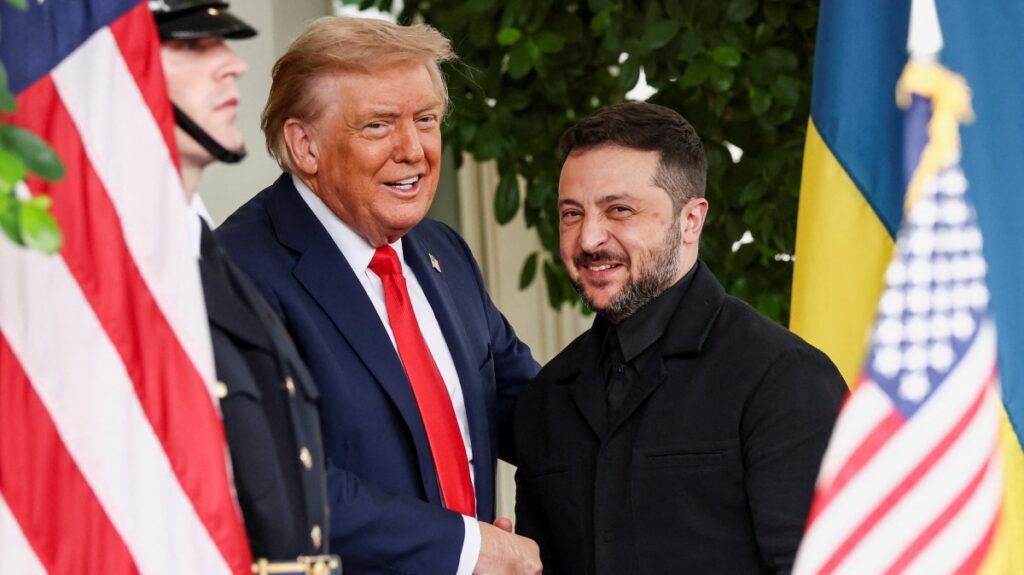
Vladimir Putin’s aides have been praising the Russian president for besting Donald Trump on home territory.
There is now, the Kremlin will be calculating, a sporting chance that Russia can win back the whole of the Donbas region of eastern Ukraine through diplomacy, which it has struggled to capture in more than 40 months of combat.
Such a request would leave the heartland of Ukraine open to the invaders. The political survival of Volodymyr Zelensky would be placed in grave doubt.
Above all, Mr Putin could, by hook and by crook, establish that a significant chunk of Ukraine falls within his sphere of interest.
• Read The Times View in full
Ukraine may have to concede to some of Russia’s demands to achieve peace, the Latvian foreign minister has said.
Baiba Braze said that Ukraine’s accession to Nato was “not really an issue at the moment” in an interview with Latvian television.
She said that the “de facto” occupation of territories by Russia may need to be recognised at some point in the interest of peace, according to the LETA news agency.
However, Braze, the former Nato assistant secretary general for public diplomacy, stressed that Latvia would not recognise the occupied territories as part of Russia.
She also questioned whether both Ukraine and Russia wanted peace.
Switzerland will offer “immunity” to President Putin despite the war crimes warrant issued by the International Criminal Court on the condition that he comes for a peace summit.
Ignazio Cassis, the Swiss foreign minister, said the immunity for the Russian leader would be granted if he “comes for a peace conference, not for private reasons”.
“We have clarified the legal situation. We could hold such a meeting and we know what needs to be done to ensure it goes smoothly,” Cassis said.
“We can do this despite the arrest warrant against Putin because of our special role and Geneva’s role as the European headquarters of the United Nations.”
The ICC issued the arrest warrant in March 2023 over the alleged war crime of the deportation and transfer of children from Ukraine.
“Putin is rarely to be trusted,” says Alexander Stubb
President Zelensky’s suggestion that obtaining American security guarantees will require Kyiv buying $90 billion of US arms, an Italian analyst has said.
Andrea Margelletti, the head of the Centre for International Studies, said: “That is not a guarantee but a purchase, which European countries may have to pay for.
“Trump wants to focus on China and can tell his electorate, ‘I am out of Ukraine and making money.’”
After months in which European Union officials had worked to build up Europe’s arms production capability and had tried to convince EU states to buy European arms, he said, any pressure to spend EU cash on American equipment for Kyiv would horrify Brussels.
“The problem is that the US has weapons Ukraine needs which the EU cannot supply. For example, the European Aster missile is not on a par with the Patriot,” Margelletti added.
Amid the optimism after the White House meetings on Monday, one Italian analyst was resolutely negative about the prospects of peace, claiming “war is still inevitable in Europe”.
Andrea Margelletti, the head of the Centre for International Studies, said that Putin would use a ceasefire in Ukraine to spend two years rearming for a future conflict on the continent.
“Right now he is using in Ukraine what he produces, so peace gives him a chance to rearm,” he said.
Margelletti dismissed the chance of security guarantees halting another incursion in Ukraine. “The only guarantee is to send tens of thousands of European soldiers into Ukraine and I mean combat troops with rules of engagement, not peacekeepers,” he said.

President Zelensky and President Trump at the Oval Office
MANDEL NGAN/AFP/GETTY IMAGES
Many questions on a future path to peace remain unanswered after the summit on Monday, with few concrete resolutions made despite a show of unity from all involved.
Nevertheless, the meeting represented a moment of progress in a conflict that has long been mired in diplomatic stalemate.
Here are five key takeaways from the President Trump’s meetings with the leaders of Ukraine, Germany, Britain, France, Italy, Finland, the European Union and Nato.
• Read in full: Five key takeaways from the White House visit
The Ukrainian security service and national police claim to have dismantled a Russian military intelligence network accused of directing air attacks on Kyiv and sabotage in southern Ukraine.
According to investigators, the cell consisted of four members: two direct agents, a “liaison” and the Russian GRU officer, Maksim Chachin.
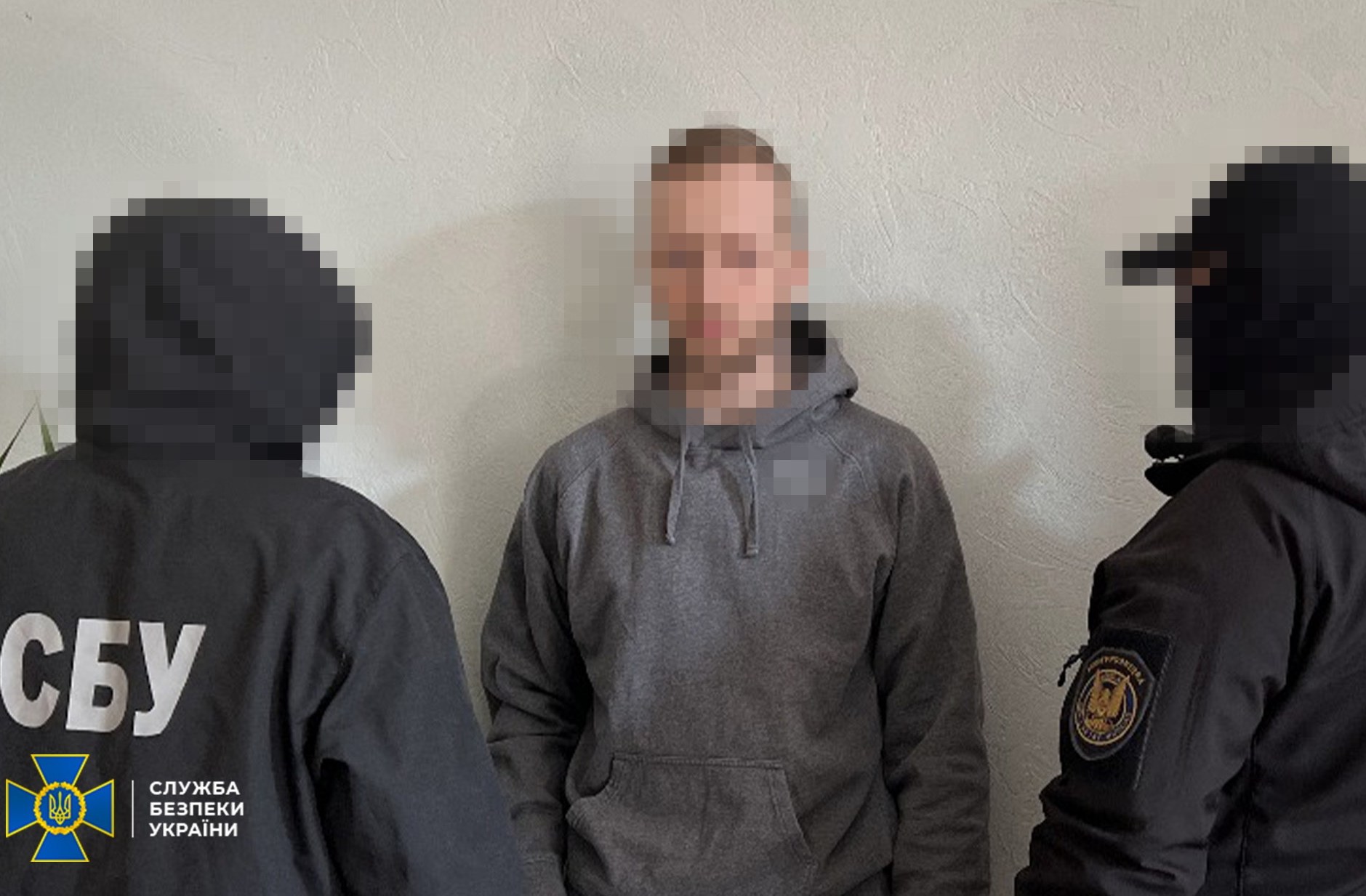
The suspects face life imprisonment
SECURITY SERVICE OF UKRAINE
Investigators said a former professor at a top Kyiv university recruited one of her students, a 27-year-old resident, into direct contact with Russian forces before later introducing him to a 40-year-old former serviceman with knowledge of Ukrainian military locations. The former professor left for Russia in 2021.
“Together they visited the relevant locations, marked them on Google Maps and sent the information to their handler to prepare missile and drone attacks on Kyiv,” the security service wrote on Telegram. Later the group moved to Odesa to lay low before receiving orders to set fire to two mobile communication towers and several power substations.

SECURITY SERVICE OF UKRAINE
“They also prepared to carry out bombings with improvised explosive devices, which the SBU [security service] prevented,” it added.

THIERRY MONASSE/GETTY IMAGES
Kyiv is now working on the content of security guarantees that Ukraine is seeking from allies and the conversation will continue between leaders on Tuesday, President Zelensky has said.
“National security advisors are also in constant contact now. There will be security guarantees,” Zelensky said.
The Russian foreign minister said that it was clear at the Alaska summit on Friday that President Trump and his team “sincerely” wanted to achieve a long-term and sustainable peace in Ukraine.
Sergey Lavrov said that the atmosphere at the summit with President Putin was “very good”.
“It was clear that the head of the United States and his team, firstly, sincerely want to achieve a result that will be long-term, sustainable, reliable,” he told Russian state television.
Lavrov contrasted what he said was the constructive US position with that of Europe. Referring to the White House summit on Monday, he said: “The Europeans had … insisted at every turn only on a cease-fire and that after that they would continue to supply weapons to Ukraine.”
Sir Keir Starmer describes the White House meeting on Monday with Presidents Trump and Zelensky
After the Italian prime minister, Giorgia Meloni, took credit on Monday at the White House meeting for coming up with the idea of offering Ukraine Nato-style security guarantees, one of her key advisors has explained how Rome believes the plan can work.
The cabinet undersecretary, Giovanbattista Fazzolari, said that the guarantee would be based on an “international deal between volunteering countries”.
As opposed to Nato, the resulting alliance would not hold exercises or station troops in Ukraine, he said. “This would make it more acceptable to Putin,” he said, according to Italian media.
Fazzolari added that Italy would not oppose French and British plans to deploy troops in Ukraine but would not take part itself.
Lithuania has outlined its plan to build a 30-mile array of defences along its borders with Russia and Belarus, including minefields, trenches and anti-tank ditches.
The fortifications are part of the Baltic Defence Line, which Lithuania and its neighbours Estonia and Latvia have begun constructing along more than 800 miles of their frontiers as a deterrent against a putative invasion.
The first layer will be about three miles deep, running from the existing metal border fences, through a ditch and a field of “dragon’s teeth” anti-tank obstacles to a series of defensive positions for infantry.
It will also feature a strip mined with explosives after Lithuania and several other frontline Nato members announced their withdrawal from the international convention prohibiting the deployment of anti-personnel landmines.
France, Britain and other European allies will lead a “reassurance” force with “several thousand” boots on the ground in Ukraine, according to European sources.
The force, mainly for training and logistics, would rapidly reinforce Ukraine in the event of a conflict and would be based in non-conflict lines or the frontline and not in disputed territories.
“It will be a presence of allied forces alongside Ukraine to show our fates are linked,” a French diplomat close to the talks said.
The main pillar of a security guarantee for Ukraine to prevent future Russian attacks after any future peace deal would be strong Ukrainian armed forces, dubbed a “steel porcupine”, supported with European military assistance.
Although Italy and Poland would not provide military personnel in Ukraine, a wider European coalition would be ready to support Ukraine if it was attacked.

President Trump has long expressed a desire to claim the Nobel peace prize
President Trump claimed on Monday to have ended or prevented “six wars”, while a list provided by the White House named seven.
Many of the conflicts have not been entirely resolved, however, and the wars in Ukraine and Gaza are ongoing despite his promises to end them.
The White House list comprises the wars between Armenia and Azerbaijan, the Democratic Republic of Congo and Rwanda, Israel and Iran, India and Pakistan, Cambodia and Thailand and two from Trump’s first term: the diplomatic dispute between Egypt and Ethiopia, which is not typically considered a war, and the tensions between Serbia and Kosovo, who signed a limited economic agreement broked by the United States in 2020.
The American president is known to be keen to win a Nobel Peace Prize, to match the one previously awarded to Barack Obama in 2009.
• Read in full: the background to his claim
President Zelensky says he is “ready” for a trilateral meeting with the Russian president
The mood in Ukraine is cautious after the meeting in the White House on Monday.
The Ukrainian political commentator Vadym Denysenko wrote that it was a “cold shower” for Donald Trump after criticism of his meeting with Vladimir Putin in Alaska by the American media.
Denysenko suggested that Putin would defer the proposed trilateral meeting for as long as possible, adding: “A meeting with Zelensky would mean that one of the main ‘trump cards’ he pulled out of his sleeve at the right time, namely the thesis of Zelensky’s illegitimacy, would be nullified.”
The prominent Ukrainian serviceman Kyrylo Sazonov wrote: “There are no reasons to uncork the champagne. There are no reasons to cry and consider this a defeat either.
“It is clear that the Kremlin will drag it out … the bunker rat expects that the front will collapse and we will quickly retreat… We will hold the front, strike and wait for the collapse of the Russian economy.”
Friedrich Merz, the German chancellor, has rowed back on a suggestion from his foreign minister that Berlin is reluctant to send troops to help secure a ceasefire in Ukraine.
After a summit in Washington with Presidents Trump and Zelensky and other European leaders, Merz said that Germany had a “big responsibility” towards Ukraine and he was prepared to consider obtaining parliamentary approval for a military deployment.
Thomas Röwekamp, a senior MP from Merz’s Christian Democratic Union party and chair of the Bundestag’s defence committee, said it was “probable” that Germany would put boots on the ground in Ukraine in the event of a ceasefire.
Russian attacks overnight show “how critical it is to end the killing, achieve a lasting peace and ensure robust security guarantees”, the Ukrainian foreign minister has said.
Russia attacked the central Ukrainian city of Kremenchuk with drones overnight, the largest attack so far in August, with 270 drones and 10 missiles, according to the Ukrainian air force.
Scores of blasts shook the city, targeting energy and transport infrastructure, leaving hundreds of people in the Poltava region without power.
Andrii Sybiha wrote on X: “In this sense, the future meeting of leaders of Ukraine, the US and Russia can bring a breakthrough on the path to peace.”
President Macron has called President Putin an insatiable “ogre” who wants to devour Europe, in an interview on French television.
After his session with President Trump, President Zelensky and the other European leaders in Washington on Monday, Macron told the LCI news channel that the Russian leader had never kept his word and had constantly sought to undermine Europe since he started trying to capture territory, beginning with Georgia in 2008.
“So, for his own survival, Putin needs to keep on eating. He is a predator, an ogre at our gates,” Macron said. “I’m not saying that France is going to be attacked tomorrow but he is a threat to Europeans. We shouldn’t be naïve”.
As a country that spent 40 per cent of its budget on its armed forces and had mobilised an army of 1.3 million personnel, “Russia is not going to come back to peaceful ways and a democratic system overnight”, he added.
The French president has been frustrated by widespread indifference in France to his warnings over Russia’s apparent belligerent intentions. Macron’s opponents in the hard left and hard right blocs are hostile to the United States and share much of the Kremlin’s view on the Ukraine conflict.
Europeans want a quick peace summit between Presidents Trump, Putin and Zelensky to be held in a neutral country in Europe, with Geneva in Switzerland emerging as a favoured venue.
Talks in Washington on Monday have given a two-week deadline for holding the summit and Europeans fear that Putin will use the lack of a ceasefire to intensify the Russian offensive and grab more land.
While the Kremlin has not publicly announced its agreement, a senior US administration official has said the meeting could take place in Hungary.
Europeans will reject pressure on Ukraine to give up Donbas regions, although Trump assured President Zelensky in Washington that he would not broker a land swap over his head.
António Costa, the president of the European Council, has convened a video call of the 27 European Union leaders at noon UK time, after a meeting of the coalition of the willing.
The EU is expected to impose harsher sanctions on Russia if Putin does not come to the table within a fortnight.
Trump overheard saying “I think he wants to make a deal for me” as Europeans discuss Ukraine
President Trump was caught on a hot mic telling President Macron that President Putin “wants to make a deal”.
The American president whispered to his French counterpart, “I think he wants to make a deal,” before adding: “I think he wants to make a deal for me, you understand that? As crazy as it sounds.”
Trump made the hushed remarks after a meeting with the Ukrainian president, Volodymyr Zelensky, in the Oval Office and before heading for talks with European leaders.
It was unclear when Putin may have indicated his intentions for a deal but Trump was reported to have interrupted the Washington summit to brief the Russian leader and discuss the next steps.
Americans are to join the coalition of the willing talks with a ten-day deadline to draw security guarantees for Ukraine, according to President Macron and senior European diplomats.
Sir Keir Starmer will chair talks this morning with Macron, according to the French leader. “We will then launch concrete work with the Americans to see who is ready to do what,” Macron told the French TF1 radio on Tueasday morning.
The prime minister told the BBC that “we’re now going to be working with the US on those security guarantees. We’ve tasked our teams, some of them are even arriving [today], to start the detailed work on that.”
President Trump’s promise to “coordinate” and to “be involved” in security guarantees is seen as a “breakthrough” by Starmer and others on the European side.
“We want to believe it,” a European diplomat said.
Macron said the European emphasis will be on “a robust Ukrainian army capable of resisting and deterring any attempt at attack. No restrictions on numbers, capabilities or armaments”.