
Countries sanctioned in the West, “friends” of Serbia

Express newspaper
23/08/2025 12:55
Official Belgrade has for years maintained ties with regimes in Russia, China, Belarus, Venezuela and Iran, prompting the European Union (EU) to criticize it, but only through statements.
On Thursday, August 21, two announcements arrived that confirm this direction of Serbia’s foreign policy.
Serbian President Aleksandar Vučić initially announced that a meeting of Serbian and Russian officials “at the highest level” would be organized soon, but did not provide further details.
If the meeting takes place, it would be the second of its kind this year, following Vucic’s visit to Moscow in May, which prompted warnings from Brussels.
That same day, the Serbian head of state announced that he had had a telephone conversation with Venezuelan President Nicolas Maduro, whom the EU considers to lack the legitimacy of a democratically elected president due to electoral irregularities.
Vučić, however, called him a “great friend” of Serbia.
The EU has not responded to Radio Free Europe’s request regarding the announcement of the meeting between Serbian and Russian officials, as well as Vučić’s phone conversation with Maduro.
Empowering regional powers
The position that Vučić’s Serbia has in the international space can be understood if it is analyzed from the perspective of the key principles of Russia and China’s foreign policy, which are summarized by the phrase: a multipolar world.
This is the assessment of Eric Gordy, professor of political sociology at the Department of Slavic and East European Studies at the University of London.
“This means that they are more oriented towards strengthening regional powers, rather than global ones. The aim is to dilute the power of the strongest economic states such as the US and European countries. This has also been promoted by Vučić and the right-wing parties in Serbia, when they speak of themselves as supporters of sovereignty,” Gordi assesses.
In the “embrace” of Russia
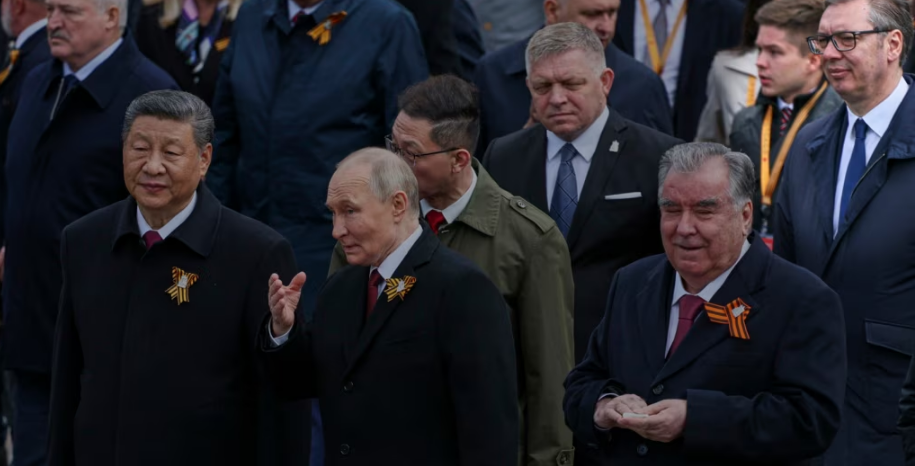
Despite calls from Brussels not to travel to Moscow, the Serbian president participated on May 9 in the marking of Victory Day over fascism in World War II.
This was Vučić’s first visit to Russia since it began its invasion of Ukraine in February 2022. According to the UN, the death toll has since passed 12.000.
Apart from Vučić, the only European officials at the Moscow parade were the pro-Russian Prime Minister of Slovakia, Robert Fico, and the President of Belarus, Aleksandar Lukashenko.
Vučić also met with Russian President Vladimir Putin and thanked him for his “great support” for official Belgrade’s policy on Kosovo.
Russia is among the countries that have not recognized Kosovo’s independence, which was declared in 2008.
The EU, following Vučić’s visit to Moscow, stated that it “expresses deep regret” for the Serbian leadership’s trip to Russia and that Serbia must “convince” Brussels of its “strategic orientation towards the EU.”
Since May, Moscow has been sending mixed messages to Belgrade – from criticism of claims that weapons manufactured in Serbia end up in Ukraine, to messages of support for the suppression of the “color revolutions,” as Serbian and Russian authorities call the nine-month-long anti-government protests.
Although Serbia has repeatedly condemned the Russian invasion at the UN and supported the territorial integrity of Ukraine, including the occupied territories, it remains one of the few European countries that has not joined Western sanctions against Kremlin officials.
“Friendship of steel”
“Steel friendship” is the expression often used by Serbian officials to describe relations with the People’s Republic of China.
President Vučić calls his Chinese counterpart, Xi Jinping, “a great friend and brother.”
At the end of July, Vučić announced that he would meet with the Chinese president in Beijing on September 3.
The previous meeting between them took place in May in Moscow, during the Victory Day parade.
Xi Jinping last visited Belgrade in May 2024, where he was welcomed by thousands of citizens waving Serbian and Chinese flags.
Relations between the two countries are seen in many infrastructure projects of Chinese companies in Serbia, including the reconstruction of the Belgrade-Budapest railway, which tragically resulted in the deaths of 16 people after part of the roof of the Novi Sad Railway Station collapsed.
Due to the intensification of political and economic cooperation with China, official Belgrade has been criticized and warned several times by the US and the EU, where Serbia aims to join.
Supporting autocrats in Venezuela and Belarus
“Why not go to Venezuela? Serbia is not a country that takes orders from abroad,” was the response of the Speaker of the Serbian Parliament, Ana Brnabić, on January 15, when asked by REL about her presence at the inauguration of Nicolas Maduro in Caracas a few days earlier.
The European Commission stated that Serbia should refrain from actions that contradict EU foreign policy.
The US has imposed sanctions on Venezuela since 2006, which were extended to January 2024.
Maduro is accused by Washington of corruption, drug trafficking and violations of democracy and human rights.
He declared victory in the July 2024 presidential elections, which the opposition considered rigged, organizing massive protests across the country.
Among the few world officials who congratulated Maduro on his third term was President Vučić.
Likewise, when the authoritarian president of Belarus, Aleksandar Lukashenko, announced his seventh term in early 2025 – elections that the West considered rigged – one of the first congratulations was sent to him from Belgrade.
Former Deputy Prime Minister Aleksandar Vulin, known for his close ties to the Kremlin and Minsk, congratulated Lukashenko as a “friend of Serbia.”
Belarus is under EU sanctions for its role in the Russian invasion of Ukraine. Serbia only partially joined those sanctions.
The role of weapons
Erik Gordi emphasizes that it would be incorrect to say that Serbia necessarily cultivates proximity to autocratic regimes.
“Again, the level of interest is more related to economic reasons. Huge profits come from the sale of weapons and armaments around the world, mainly to countries that were once clients of Yugoslavia,” says Gordi.
Following the start of the Israel-Iran conflict, on June 23, Vučić declared that Serbia had suspended arms exports.
Since 2022, official data on arms exports from Serbia have not been published, although the law provides for it.
In late June, Russia’s Foreign Intelligence Service accused Serbia of its ammunition ending up in Ukraine via NATO countries. Belgrade has repeatedly denied this, saying it has no control over the final destination after the weapons are sold to third countries.
This issue also brought Serbia’s relations with Iran into the spotlight.
Although official Belgrade has claimed neutrality in the Israel-Iran conflict, trade data shows a greater bias towards Tel Aviv.
Again, Serbia has repeatedly failed to comply with EU decisions on sanctions against Iran, both for nuclear activities and human rights violations.
Why is the EU missing?
Erik Gordi links this to the “Jadar” lithium mining project by the Australian company “Rio Tinto”, which has caused major protests in Serbia.
According to him, this project cannot be realized in Europe due to environmental standards and public resistance, which is why the EU often “turns a blind eye” to Vučić’s violations of democratic standards.
The European Commission, on June 4, 2025, included the “Jadar” project among 13 strategic projects with critical raw materials, despite the uncertainty about its continuation.
The ISAC Fund’s analysis shows that Serbia’s compliance with EU foreign policy statements was 59% in 2024 – more than a year earlier, but still the lowest among candidate countries in the Western Balkans.
However, contacts with several criticized regimes have not cost Serbia, at least so far, serious pressure from the EU. /rel