
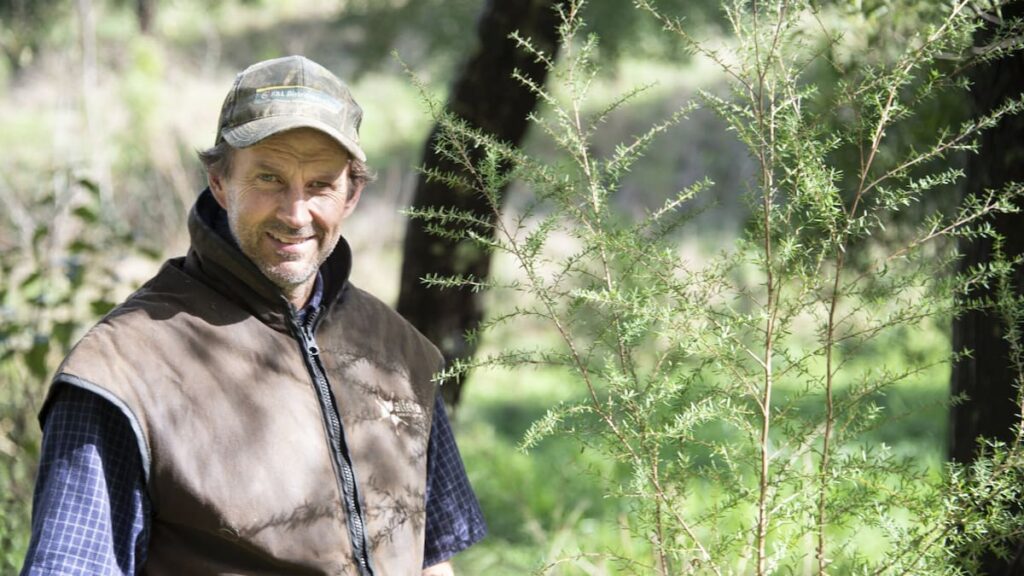
In 1996, the family bought a 100ha property across the road and converted both farms to dairy farming, with an underpass under the road connecting them.
“We sold the neighbouring property and went back to dairy beef in 2005, and we started spaced poplar planting under the Emissions Trading Scheme in 2008.”
Orlando-Reep was brought up on the property but followed a non-farming career path, obtaining a Bachelor of Commerce and then running an Auckland restaurant for several years with two mates.
He later married his wife, Joce, and they have two children.
Caring for the land
From 2016, Orlando-Reep returned home to the farm at weekends to set it up for his parents to easily manage the stock movement for the next week.
He and his family moved back to manage the farm full-time in 2018, and they moved into the main homestead in 2023.
“We were running 290 head of beef cattle, but found having 250 beasts run in smaller mobs resulted in faster growth and higher turnover and was also kinder to our land and the environment.”
Heifers and steers were bought in at 250kg and sold at 600kg.
Nowadays, Orlando-Reep favours the more traditional beef breeds such as Hereford, Angus and Charolais.
Beef production provides most of the farm’s income.
The balance comes from the 75ha registered under the NZ Emissions Trading Scheme.
This approach currently returns 40 tonnes of carbon per hectare per year, providing valuable income from marginal land.
A five-year plan has proved to be invaluable.
It outlines capital investment and the planting of native and exotic trees with the goal of increasing production by 10% a year for the next three years, while also focusing on sustainable land management practices.
Excellent land management and mapping focus on regenerative grazing practices and avoid cultivation and cropping.
“We do regular soil testing and carry out strategic winter grazing that minimises soil disturbance,” Orlando-Reep said.
“We use deferred grazing following Bill Garland and Katherine Tozer’s work and research.
“This approach allows paddocks to be rested and reseed themselves to establish again.”
Some recent improvements
Amongst the many improvements, Orlando-Reep has adopted the use of a virtual fencing system, which has reduced fuel use and labour time.
“Using an ANZ green loan, we’re considering solar energy for the reticulated water system pump and the house,” he said.
“We already have a hybrid SUV, and a hybrid ute will be next.
“The pump would be paid off in four years, and we will be reducing our fossil fuel use – it’s a no-brainer really.”
A Fresh Water Farm Plan, as part of the Farm Environment Plan, ensures the continuing protection of the waterways from stock and sediment loss.
“We have a big issue with both sediment and nutrient loss on the rolling contour of the farm,” Orlando-Reep said.
“Our critical source areas, such as troughs, gateways and drains, have been identified, and some areas are fenced off and planted with poplars and then natives at a later date.”
Orlando-Reep is proud that he has nearly met his goal to have a net-zero Greenhouse Gas number after the ETS Carbon Accounting Areas eligibility adjustment made by the Ministry for Primary Industries (MPI).
Being certified members of the New Zealand Farm Assurance Programme (NZFAP) and aiming for the NZFAP Plus is important to him.
“It’s all about telling our farm’s story.
“It helps us show we are careful stewards of the land and follow good farming and environmental practices.
“It gives consumers confidence when there is traceability right from the farm through to the end destination of the plate.”
Orlando-Reep believed the farm should be “open-day ready” at all times and strives to put that into practice.
Manawanui was also awarded the Waikato River Authority Catchment Improvement Award and the Norwood Farming Efficiency Award.