
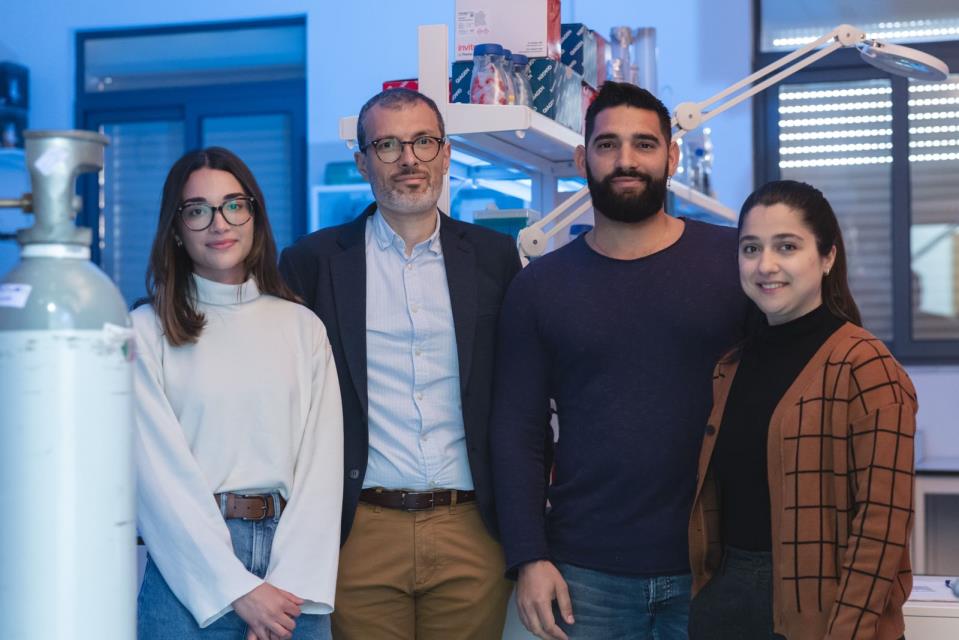
Project leader Professor Ruben J. Cauchi with ALS/MND Lab team members, including Sylvana Tabone, Paul Herrera and Rebecca Cacciottolo. Tabone is supported by a Tertiary Education Scholarship; Dr Cacciottolo is supported by Reach High II Scholarship (co-funded by ESF+ 2021–2027) and Dr Herrera is supported by the Ministry for Education, Sport, Youth, Research and Innovation through the Post-Doctoral Fellowship Scheme 2024

On average, Malta records one or two newly-diagnosed cases of ALS each month, with the incidence rate averaging out to around 2.5 cases of ALS per 100,000 individuals per year, Professor Ruben J. Cauchi, Professor of Neurogenetics at the University of Malta and lead investigator at the ALS/MND Research Lab, said.
The University of Malta has recently teamed up with the Shanghai Jiao Tong University on an initiative known as Project astrALS, with the project being funded by Xjenza Malta and the Ministry for Science and Technology of the People’s Republic of China under the SINO-MALTA Fund 2024 call.
The Malta Independent on Sunday spoke with Professor Cauchi about the project and about the research he and his team have conducted on neurodegenerative diseases over the years, particularly in regard to ALS.
Prof. Cauchi explained that through Project astrALS, researchers will develop animal models that replicate patients with a specific genetic risk factor for ALS. He said that the team is going to delve deeply into understanding the mechanisms at play in such patients in order to understand why motor neurons are dying. He commented that by discovering this mechanism, the researchers can arrive at a treatment which is broadly applicable. “As this mechanism is occurring in the majority of ALS patients, we can therefore have a drug that is beneficial in a large amount of patients,” he said.
With regard to how the collaboration came about, Cauchi said that in the context of the current global situation, countries such as the United States are “closing”, but on the other hand, China is “opening up” and contributing billions in funding for research. Cauchi noted that this situation has created the ideal opportunity to collaborate with a leading Chinese university.
Cauchi said that the ALS/MND Research Lab has been active at the University of Malta for 16 years and its main focus is ALS. He said that neurodegenerative diseases like ALS and others, such as Parkinson’s and Alzheimer’s disease, are gaining more notoriety in the public consciousness due to the ageing population. He commented that living longer comes with certain caveats, with those neurodegenerative diseases being among the caveats.
“ALS is a terrible disease. What essentially happens is that you slowly end up in a locked-in state. You don’t lose your cognitive function, but you gradually lose your ability to move, walk and eventually speak, ultimately losing your ability to breathe,” Cauchi said, as he added that it is that difficulty with breathing which leads to low oxygen levels and eventually causes people diagnosed with ALS to unfortunately die. He said that the average life expectancy following diagnosis of ALS is three to four years, though he noted that there can be some exceptions.
The professor said that the aim of the lab at the University of Malta is, first and foremost, to understand ALS and ultimately contribute to the development of effective treatments. He explained that the lab operates with two branches – the clinical arm and the preclinical arm – which overlap and share information with one another. Going over the two, he said that the clinical arm is the one which goes to patients and does the sampling to acquire relevant data to then analyse the DNA of patients due to ALS having a “very strong genetic component”.
Describing the preclinical arm, he said that it uses animal models, fruit flies in this particular lab’s case. Explaining why the lab uses fruit flies for its animal models, Cauchi said that these flies have highly conserved DNA, and continued that most of the genes found in ALS patients are also found in the flies, meaning that the flies can be used to generate models which mimic patients. He continued that an additional benefit to using fruit flies is that they age rapidly, which he remarked is significant when working to understand and research a disease of mid-age.
Asked to expand further on why fruit flies in particular are so important to the lab’s research, as well as what makes them so uniquely suited as animal models, he said that there is a high degree of genetic and biological conservation between humans and flies, and that the flies also have an accessible neuromuscular system which makes detecting certain defects or instances easier. “Obviously, it’s not only our lab that is using flies. We’re part of a community that started more than 100 years ago. Flies are being used by many, I can say hundreds of labs, around the world,” he remarked, adding that research on flies has contributed to various discoveries that were elevated to a Nobel Prize.
Cauchi said that due to the increasingly ageing population, the risk for neurodegenerative diseases such as ALS is broadly increasing and there is going to be a spike in such diseases among the population. It is said that cases of ALS are projected to rise over 20% across Europe, and over 50% in China over the next two decades.
Speaking further on this, Professor Cauchi added that previous studies and projects have shown that countries such as Malta have “greater genetic risk” due to their “isolation”. He said that as ALS has a significant genetic component, the Maltese society, as a genetically homogenous population, has a greater risk when compared to other mixed or genetically heterogeneous population such as the British or the Dutch.
The Malta Independent on Sunday asked Prof. Cauchi whether it is known if ALS risk is determined by environmental factors in addition to genetic factors, to which he replied that yes, there are environmental factors in his experience, although the genetic component remains quite significant.
Continuing on that, he said that identifying environmental factors is very difficult, which is why the ALS/MND Research Lab focuses on the genetics. He commented that while genetics are a constant in an individual, environmental factors are very difficult to pinpoint and are subject to change. With that said, he continued that the lab has done some work on environmental factors, and that in the case of Malta, one environmental factor which has stuck out has been physical activity. “Most of our ALS patients have a blue collar job. There is a correlation between strenuous physical activity and ALS, and this environmental factor has actually been confirmed in other studies on different populations.”
On the matter of Malta’s incidence rate of 2.5 people diagnosed with ALS per 100,000 per year, Cauchi said that this incidence rate is higher than the average across Europe, which he said is around 2.1 per 100,000. Using other countries as examples, he continued that the rate in Italy is around 2.1, in Greece and Cyprus around 1.3 and in Spain around 1.9.
Reiterating the goal of Project astrALS, Cauchi stated that, essentially, the goal of the project is to work towards discovering those mechanisms which are common to a wider group of patients. “It’s only by discovering those mechanisms that we can arrive at a therapy or a treatment that would be beneficial to all.” He commented that at the moment, there is only one drug for ALS patients, which he said was approved 30 years ago. “This drug is highly ineffective. It increases the survival of patients by a mere three months, and it has side effects, so whether it’s worth taking it or not, I don’t know.”
“The context here is that there are no effective treatments available, so it is imperative that we do these projects to discover new treatments. Every research entails risks. We might arrive there, or we might not arrive there. What I can say is that it’s good that this research is being conducted, as it provides guidance on the necessary steps to take,” Professor Cauchi concluded.