
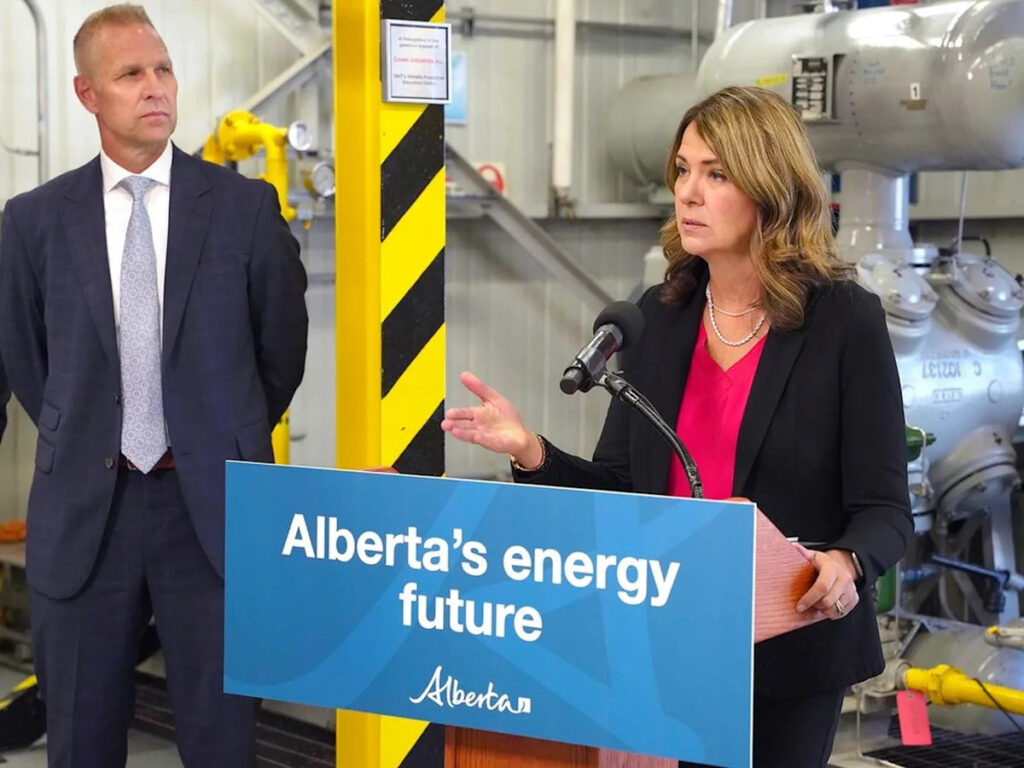
The Alberta government is exploring the potential of nuclear power to meet the province’s surging energy needs.
A newly formed panel of experts will engage with people across the province about the energy source, the provincial government announced Monday.
Albertans will also be asked for feedback on nuclear energy through a survey, which will help create a “road map” for developing the technology in the province.
On Monday, Premier Danielle Smith said Alberta’s growth comes with a “responsibility to secure the next generation of energy.”
Nuclear power could expand the grid, support new industries and keep pace with rising electricity demand, she said.
“It’s efficient, low cost in the long run and long-lasting,” Smith told reporters.
The technology is also nearly emissions-free and incredibly reliable — producing abundant baseload power, 24 hours a day, seven days a week — she noted.
“That means we’d be able to expand our economy with dependable, scalable, non-emitting power,” Smith said.
Chaired by Chantelle de Jonge, the affordability and utilities parliamentary secretary, the panel will gather input and deliver a report with recommendations on how Alberta could begin to develop a nuclear energy industry.
The panel has five other members with “diverse” experience in industry, academia and Indigenous government, according to the province.
The members are Deron Bilous, senior vice-president of Western Canada for Counsel Public Affairs; Tim Boston, principal at Boston Edge Strategies Inc.; Stephen Buffalo, chief executive of the Indian Resource Council of Canada; Rudiger Tscherning, fellow on nuclear law and policy at the University of Calgary; and Harrie Vredenburg, professor of strategy and global management at the University of Calgary.
“I look forward to working with each one of them in the months ahead as we embark on an important task of exploring how nuclear energy might power a better, brighter future for our province,” de Jonge said.
The province has put funding toward nuclear power-related initiatives in previous years, including $600,000 toward studying the conversion of a fossil fuel electricity generation site.
However, getting a large-scale nuclear facility into operation is likely to take at least a decade, Smith told an audience at the Global Energy Show in June.
“We couldn’t even have the first project built until 2035,” Smith said at the time.
The province is taking the next year to consult Albertans and Indigenous communities, Affordability and Utilities Minister Nathan Neudorf said Monday.
He estimated building a project and connecting it to the grid would take five to 10 years, assuming Albertans and other stakeholders are in favour.
“We still have an entire legislative and regulatory framework to establish,” Neudorf said.
The survey on nuclear energy in Alberta is open until Sept. 25.
Smith noted the province is not ruling out any technology for nuclear generation, rather looking to have a “robust conversation.”
“We are actively talking about adding nuclear to our power grid, both small modular as well as large, and we want to get the feedback on it,” she said.
Small modular reactors, as the name implies, are smaller than conventional reactors — SMRs produce up to 300 megawatts of electricity, while conventional large reactors produce upwards of 700 megawatts.
The smaller reactors are more flexible, allowing them to be deployed in more remote locations.
According to Smith, nuclear energy is “particularly attractive” for artificial intelligence data centres, which require large amounts of power continuously.
“With AI data centres, they want to have as low-emissions footprint as possible . . . so being able to bring on a project of substantial size with the kind of substantial proposals we’re hearing from AI data centres, I would suspect that that would be one of the largest future uses,” she said.
The next phase of the process will include in-person meetings and sessions with Indigenous communities, municipalities and industry. Those will begin later this year and continue into 2026.