
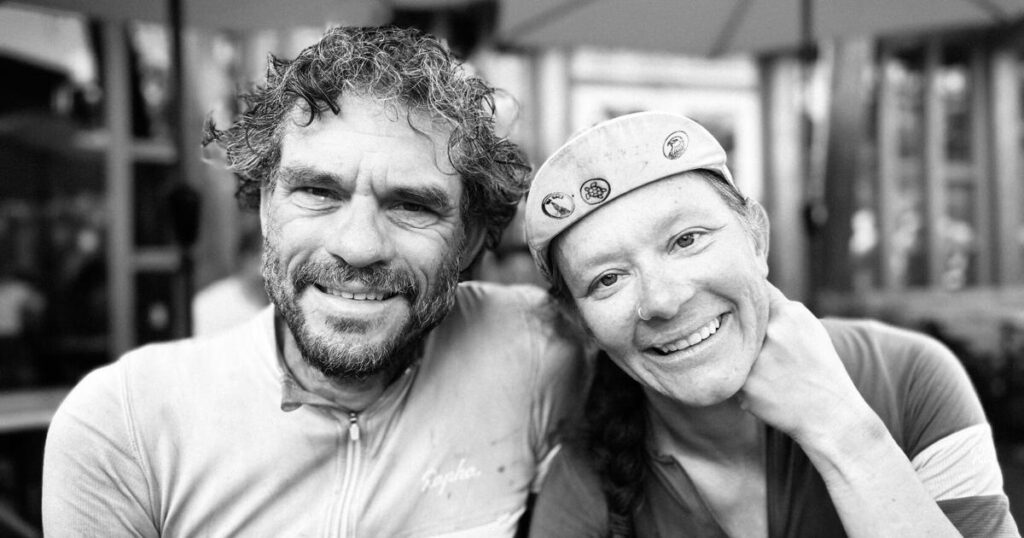
Connie Etter has come a long way and seen a lot since graduating from Cherry High School.
Etter and her husband Brent Olson have competed in bicycle backpacking rides and competitive events across the world.
They’ve ridden in Iceland, Scotland, Columbia, Spain, Andorra, Portugal, Bulgaria, Serbia, Croatia, Austria, Slovenia, France, Bosnia and Herzegovina, Switzerland, Belgium, Italy, North Macedonia, Albania, Greece, Germany, and the Netherlands.
They also ridden twice in a 350-mile race in Kansas and in the well-known RAGBRAI touring event across Iowa.
But as ultra cyclists competing in ultra endurance events, Etter and Olson as a pair recently achieved one of their biggest cycling accomplishments,
Sleep-deprived, calorie-deficient, and dealing with physical issues and the need to stay mentally focused, the pair completed a grueling 2,522-mile VIA 2025 bicycle race from Italy to the Netherlands.
“We crossed over the Alps and ended up in a small town near Amsterdam,” Etter, 44, a 1999 Cherry High School graduate said. “It’s relentless. Day after day you have to put in the miles. You’re sleeping as little as possible, you’re stopping as little as possible and you run into a convenience store and pick up something quick. It’s a lot of Haribo gummy bears.”
Etter said she and Olson rode about 156 miles a day.
It took Etter and Olson 15 days and nine hours to make it to the finish line.
Typically, the couple slept alongside the road in a sleeping bag with a lightweight sleeping pad to protect from the cold, Etter said.
“We would stop for only a few hours,” Etter said. “I would set my alarm for three hours and we would get up. In the beginning, the pattern was to go to sleep at midnight and get up a 3 a.m. and go.”
Some nights, they slept as little as an hour-and-a-half, Etter said.
The self-routed race started in Giovinazzo, Italy, the southern part of the country, and ended in Amerongen, Netherlands.
Etter and Olson totaled 124,827 feet of climbing, Etter said.
“There’s so much climbing,” Etter said. “We would climb an average of 8,000 feet a day.”
Ian To, VIA race founder, said Etter and Olson were impressive.
“The conditions were tough this year, with heat, cold, rain, and lots of elevation and days of headwind,” To said. “The tougher it got, the stronger Connie and Brent seemed to be going. Whenever we saw them, they were smiling and enjoying the adventure. It’s a testament to their teamwork and strength that they finished as the first pair in VIA Chapter II and the only pair to complete the course.”
Favorite times of the day were watching sunrises and sunsets while riding, Etter said.
Etter, a professor at Westminster University in Salt Lake City, Utah, and Olson, an associate professor at the university, train by riding in the Salt Lake City mountains as well as doing weight and stability training, Etter said.
But the VIA race was a major physical and mental test, Etter said.
“There are so many moments during the race when it feels impossible,” Etter said. “Sometimes, you’re so drowsy that you have to take a twenty minute nap because you can’t stay awake on the bike. I couldn’t image myself at the end getting through it. But you convince yourself to keep pedaling and that with every pedal stroke you’re getting closer. There’s some low lows and real dark moments when you’re body is hurting and it just feels impossible, but you have to work through that. You convince yourself to keep going and all of a sudden it’s the last day and there’s under 100 miles to go. It’s definitely transformational. You’re not the same after doing it as you were going in.”
Etter grew up in Zim and participated in volleyball, basketball, track, and softball at Cherry High School.
Etter went on to earn a B.A. degree at Concordia College in Moorhead, Minn., and an M.A. and PhD at Syracuse University.
Etter today is a professor of Cultural Anthropology with a position in Justice Studies and the honors college at Westminster University.
Etter said she got hooked on bicycling while working in Washington D.C., at George Washington University.
“I got a bike to commute seven miles into work every day,” Etter said. “Really, really soon I remember I started on the way home trying find longer routes because it was such a nice way to end the work day on the bike, get a good workout in and just relax. So I just started finding longer and longer routes and from there the baseline just kept shifting. I would go out for fun rides on the weekends. I started out at 30 miles and it just increased. I realized I was able to ride bike distances and enjoyed it.”
Etter and Olson, who was born in Iowa, went on to ride in RAGBRAI, the multi-day bicycle ride across Iowa.
They then expanded into bikepacking trips and ultra endurance biking in several European nations.
As part of her professorship, Etter also spent time doing research in Palestine with bicyclists there, she said.
But the VIA race was a big test for Etter and Olson.
Bicyclists can enter the VIA race as solo riders or as a pair.
Ninety-eight people started the race and 48 finished, Etter said.
Etter and Olson were the only pair to finish the race, Etter said.
“The thing about pairs racing and not a lot of people finishing is that ultra-bike racing is super niche and pair racing is far less popular because all the things that are difficult get multiplied by two,” Etter said.
Potential mechanical issues, mental stress and even bathroom breaks, are doubled in pair racing, Etter said.
“The danger is if someone gets down, it can bring the other person down,” Etter said.
Etter’s OBED RVR carbon-framed endurance road bike had a flat tire on the first day, but she and Olson repaired it with a bike repair kit they carried, Etter said.
Etter also crashed on day three, but the bike wasn’t damaged and she escaped with scrapes on a leg and hip.
To keep gear weight at about eight pounds, Etter said they carried only a sleeping bag, sleeping pad, medicines, band-aids, warm gloves, rain gear, and no extra clothes.
Early in the race, Etter endured right knee pain, neck pain and leg swelling, but made some adjustments to her shoe clips, seat height and cut off the halter part of her bibs to help with the neck pain, Etter said.
There were times during the race when Etter said she “didn’t want to do this again and I want to sell my bike when I get home.”
“But now, we’re talking about next summer and the next event we will do,” Etter said.
Bicycling, Etter said, has become a major part of her life.
“I’ve seen so much on my bike, covered so much ground and been in many countries and in places where tourists wouldn’t go to, Etter said. “So I feel very lucky to have seen the world at that pace. In one sense it’s fast and yet it’s slow. The beautiful and diverse scenery I’ve seen is just unforgettable.”
Etter has four bikes, a road bike, commuter bike, gravel bike, and what she calls an “older” bike.
“I just simply absolutely love bikes, whether it’s a two-mile commute or a 150-mile ride,” Etter said. “I think they are beautiful ways to move throughout the world. It’s fun to ride with friends and it’s fun to ride alone. It’s part of every aspect of my life from personal to fun to my everyday life. Bikes are the best.”
And after a ride, Etter’s roots in Zim are still there.
“As part of my training, I end all my training rides with a sauna,” Etter said.