
Kosovo and Serbia in their own troubles, envoy Sorensen is trying to create an atmosphere of dialogue – what was said in Belgrade

Express newspaper
27/08/2025 16:02
Danish diplomat Peter Sorensen spent almost half of his term without brokering a high-level Kosovo-Serbia meeting with his boss, Kaja Kallas. Elections in Kosovo – which failed to produce institutions on time – and protests in Serbia stalled the already stalled dialogue process. This month, Sorensen engaged in meetings with leaders in Pristina and Belgrade. He met with the Kosovar leaders in early August, while leaving the Serbian ones at the end of the month. He concluded his visit to the Serbian capital with a warning of “future dialogue meetings.”
Express newspaper
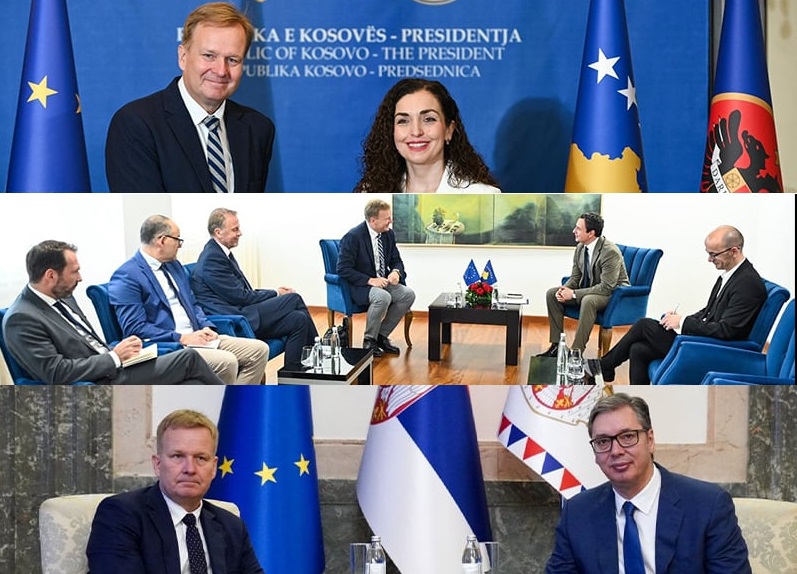
Dialogue Envoy Peter Sorensen yesterday concluded a visit to Belgrade with Serbian President Aleksandar Vučić, Serbian Chief Diplomat Marko Đurić, Minister for European Integration Nemanja Starović, and Chief Negotiator Petar Petković. Sorensen’s meetings with Serbian officials came 20 days after his meetings in Pristina.
In a post on X, Sorensen said that he was in Belgrade for preparatory talks for future dialogue meetings, while saying that he listened to his interlocutors attentively and that he emphasized normalization to them.
“Following my visit to Pristina in early August, I was in Belgrade today for preparatory talks ahead of the upcoming dialogue meetings. I listened carefully to my interlocutors and emphasized the importance of normalization for the sake of the people on the ground,” Sorensen wrote.
On the other hand, Vučić said that in the meeting with Sorensen he spoke about “the challenges we face when it comes to the position of the Serbian people” and about the “obligation” that Kosovo has to establish the Association.
“I emphasized that it is essential that the dialogue return to the fundamental principles on which it is based, mainly on the obligation to form the Association of Serb-majority Municipalities, as well as the protection of the rights of our citizens in Kosovo.”
Vučić did not miss the opportunity to complain to the European guest about the efforts to prevent Lista Srpska, the largest Serb party in Kosovo, which he supports, from participating in the October 12 elections.
“The attempt to ban the participation of the Srpska List in the upcoming elections confirms once again that respect for the fundamental rights and freedoms of political action of Serbs in Kosovo is at risk,” Vučić wrote on Instagram.
Vučić then claimed that his policy is “a policy of peace, strongly committed to seeking compromise solutions through dialogue”, but also to “a decisive and responsible war to preserve state and national interests”.
The Serbian head of state has been facing student-led protests and blockades in Serbia for more than eight months now. The main demand is to determine political and criminal responsibility for the deaths of 16 people in the collapse of a concrete shelter at the Novi Sad Railway Station.
It is not known whether the European Union will organize these meetings announced by Sorensen before Kosovo has a legitimate government to participate in the dialogue table in Brussels.
With the election of Dimal Basha as Speaker of Parliament, there were hopes that the protracted constitution of the Assembly would end, but the impasse began to arise again because the political parties in Parliament did not vote in favor of the candidate proposed by the Srpska List for deputy speaker – a position that belongs to the Serb community in Parliament according to the Constitution – after it was separated from the election of the deputy speaker of the non-majority non-Serb communities.
The Vetëvendosje Movement voted against, while there were attempts to make Nenad Rashiq vice-chairman. However, Rashiq, who did not receive the votes in favor of other parties in Parliament after the format of the lottery for the election of the speaker of parliament was changed.
In early August, Sorensen stayed in Kosovo where he met with the country’s president, Vjosa Osmani, acting prime minister Albin Kurti, as well as the three leaders of the parliamentary parties, PDK, LDK, and AAK.
Sorensen described the visit to Kosovo as productive while being more vocal in emphasizing the importance of implementing the Ohrid Agreement.
“In all my meetings, I stressed the urgent need to implement the Ohrid Agreement, now more than ever. The path to integration lies through meaningful progress in the Dialogue. It is time to move forward,” Sorensen wrote at the time.
On this occasion, he also mentioned possible delays, saying that “things can take time.”
“I’m here because of my mandate, to discuss how to implement the agreements, because the political situation here means that things may take longer. So this is a regular meeting. I’m happy to be here,” Sorensen briefly told reporters.
The Danish diplomat began his work as the Kosovo-Serbia dialogue envoy on February 1, with his primary focus set on the implementation of the Ohrid Agreement. He has an initial mandate of 13 months, and during these months there has been no progress towards the implementation of this agreement by the parties.