

What you should know before setting sail on your first cruise.
Prepare for your first cruise with these 10 essential tips to keep in mind.
- Montenegro, a small country on the Adriatic Sea, offers a rich history and diverse cultural influences.
- Kotor, a UNESCO World Heritage Site, boasts a charming Old Town with medieval architecture and Venetian piazzas.
- Activities in Montenegro range from exploring ancient city walls and natural wonders like the Blue Cave to enjoying local cuisine and wine.
KOTOR, Montenegro — I have to admit, when I first saw the itinerary for my sailing around southeastern Europe on Oceania’s newest ship, the Allura, Montenegro was one of the ports of call that didn’t speak to me. After being charmed by the small but mighty country during my cruise, I humbly admit my mistake now.
Before my July visit, I didn’t know much about the Slavic country. Slightly smaller than the U.S. state of Connecticut with a population that’s five times less, Montenegro is often overshadowed by other, more popular Adriatic Sea destinations, such as its northern neighbor Croatia or nearby Greece and Italy. (These places were also included on my cruise, and grabbed my attention more at first.)
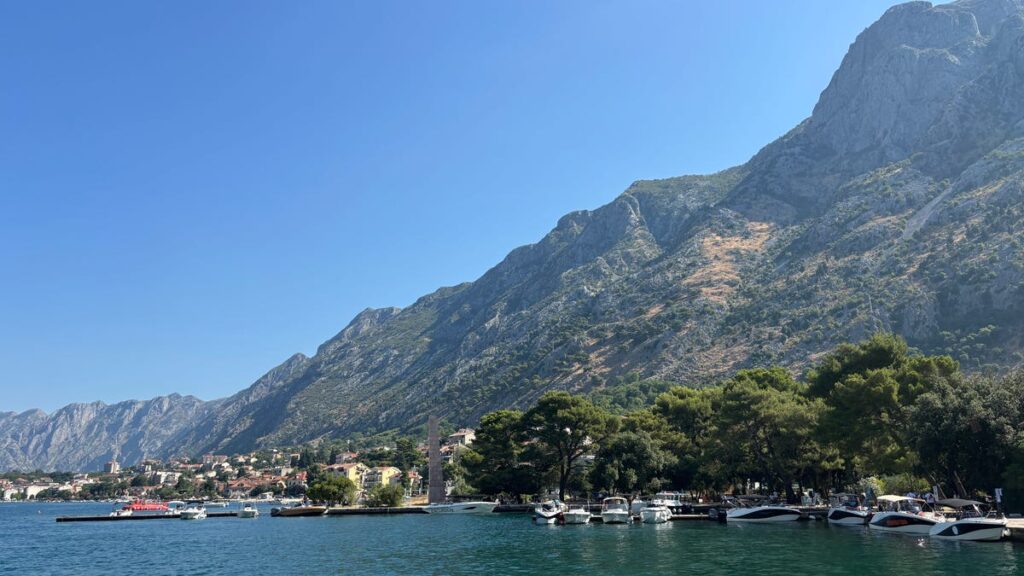
But once the ship arrived in the pristine Kotor Bay, where the water looked as still as glass and cliffside villages surrounded me, I felt an excitement to disembark and explore Montenegro’s oldest city, Kotor. It’s easy to get caught up in the beauty of this over 2,000-year-old region, but I quickly learned there’s so much more than meets the eye.
I started my day by venturing up into a village in the mountains named Mirac on an excursion with Oceania. I boarded a bus to travel up a twisty, windy road comprising switchbacks and close calls with other cars before reaching the locally owned winery Storia di Pietra.
Overlooking the coastline, this land has been in the hands of the Kašćelan family since the 18th century. This is where I had lunch, pairings of local cuisine such as a savory dish called rastan, made with collard greens and homemade smoked sausage, with wines – and a strong shot of rajika, or local grappa.
Later, I explored the ancient city of Kotor, a designated UNESCO World Heritage Site recognized for its rich history spanning the clashes of empires and mingling of cultures. Stepping through the ancient stone wall of the Old Town transported me into a storybook. Narrow, maze-like streets led to tiled Venetian piazzas, all framed by charming medieval architecture. My eyes looked up at a clock tower from the 15th century before tracing the intricate facades of the ancient churches and buildings with their iron balconies, decorative corbels and archways.
“It’s a beautiful country, full of diversity. It’s in the middle of Europe on the Mediterranean, which is, in a lot of (people’s) opinions, the most beautiful part of Europe in terms of climate, food, landscapes, way of life,” Rajan Milunović, my Montenegrin tour guide for the day, told me at the winery.
After my brief visit, I can safely say that this underrated coastal gem deserves a spot on every traveler’s radar. Here’s what travelers should know about Montenegro.
History of Kotor, Montenegro
Kotor may be small – you could easily walk the entire Old Town in about 10 minutes – but its history is expansive. The Illyrians and Romans are considered to be the first rulers of Kotor. Still, the city has been passed through multiple hands of power, also being conquered by the Serbians, Hungarians, Bosnians, Venetians, French, Austrians and Yugoslavians. It wasn’t until 2006 that Montenegro declared its independence.
Despite its politically turbulent history, Montenegro’s influences from other cultures are evident in its food, architecture, and even language. According to Milunović, most locals don’t call their home the Italian name of Montenegro but rather “Crna Gora,” meaning “Black Mountain” in Montenegrin and other Slavic languages and referring to the lush forests on Mount Lovćen.
The area has also survived multiple earthquakes, including one in 1979 when it was part of Yugoslavia. Dozens of people were killed and many historical buildings were destroyed, but many have been restored since then.
What to do in Montenegro
With its sprawls of undeveloped landscapes and relaxed pace of life, Kotor is all about slowing down and breaking away from the daily grind, which I experienced while cheering at the winery and aimlessly wandering through the Old Town. Other activities in Kotor include hiking up the Byzantine-era city walls for a view of the town and exploring more of Kotor Bay on a boat and swimming tour, like the natural Blue Cave.
While I didn’t have a chance to explore Montenegro’s stunning nature in-depth, Milunović said the country’s beaches, lakes, forests, and more are worthy of a visit all on their own, especially if you’re a traveler who likes to be active. “In general, we like to be outdoors, and the weather allows it for a pretty long period,” he said. “So it can be hiking, it can be swimming, it can be anything else in between.”
If you have the time, venturing out of Kotor seems like the way to go about it. About an hour away from Kotor is the postcard-perfect Lake Skadar National Park, where hills and water lilies surround the southeastern Europe’s largest lake. The country is also home to several beaches and seaside resort towns, including one at Lake Skadar and also Ulcinj, along the Adriatic Sea.
How to get to Montenegro
It’s not difficult to get to Montenegro, but it does require some legwork. There are two major airports – one in Tivat and another in the capital, Podgorica – but most travelers coming from the United States will need to connect through a larger hub such as Belgrade, Serbia. Alternatively, you could fly into Dubrovnik, Croatia, and do the two-hour drive across the border in Montenegro, according to Milunović. Some cruise lines, such as Oceania and Virgin Voyages, also stop in Montenegro, making a visit easy.