
One of the things that makes Guillermo del Toro’s monster movies so much fun is how often and how craftily he coaxes his audience onto Team Monster.
This free if faithful-in-spirit adaptation of Mary Shelley’s 1818 novel feels like the logical endpoint of the Pan’s Labyrinth and The Shape of Water director’s method. Not only is the creature played by Saltburn heartthrob Jacob Elordi, but in line with Shelley’s novel, he also narrates the entire second half of the story – once man has played God, his creation gets to play Man in response. As such, our sympathies are torn, and the classic English-tutorial clapback – “actually, Frankenstein wasn’t the name of the monster” – does not necessarily apply.
After all, Oscar Isaac’s Victor Frankenstein gets to be very monstrous indeed. But he’s also something of a Byronic pin-up, stalking and swishing through 19th century Edinburgh (which plays itself, beautifully), where he preaches his theories of reanimation in anatomy lecture halls. Del Toro’s screenplay wears its learning lightly, but its allusions to the notorious Burke and Hare serial murder case – in which two Edinburgh locals created their own supply of cadavers to sell to a prominent city anatomist in the late 1820s – is one of many historical and literary tidbits to be savoured by connoisseurs of the ghoulish.
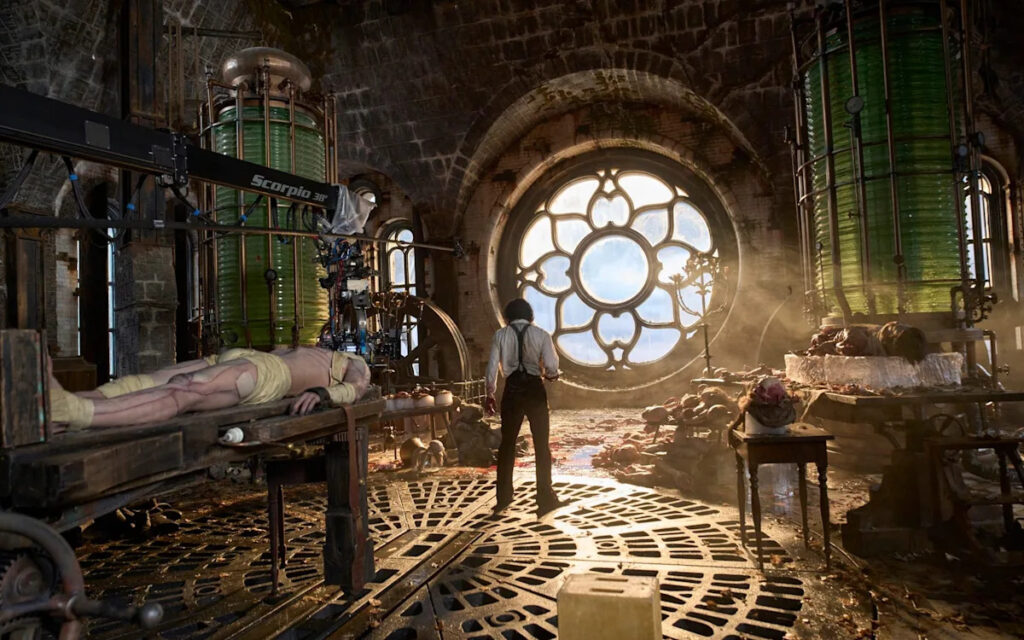
After attending one of Victor’s talks, a wealthy Viennese arms dealer (Christoph Waltz) offers to bankroll his experiments; meanwhile, the battlefields of Europe furnish him with infinite spare parts. Much hacking, slicing and slobbery compositing ensue – Alexandre Desplat’s score grows unnervingly chirpy here – then lightning strikes and the creature rises, sinewy, grey and immense. Elordi is 6’5”, and the 28-year-old actor’s lean physicality is put to supremely haunting use: his grace and beauty, shining through the horror make-up, somehow make the creature’s existence feel all the more blasphemous.
In certain lights, he resembles a William Blake illustration of Milton’s Satan: surely no coincidence, given the Paradise Lost-like rise and fall of Del Toro’s take on Shelley’s narrative. Beneath its cranked-to-11, Romantic trappings, this Frankenstein is a story of fathers who egomaniacally mould their sons in their image, only to be repulsed by the result. An early flashback featuring Charles Dance as the cold, controlling Frankenstein Sr serves as a grim template for Victor and his own creation’s relationship.
Over two and a half hours, the pop-gothic intensity can get a little much – at times I felt like a fire extinguisher was going off in my face – but you wouldn’t necessarily want to lose any of it; indeed, you’d feel conned if there wasn’t a shot of Mia Goth creeping downstairs in a diaphanous nightie while clutching a candlestick. (The Pearl star plays Elizabeth, Victor’s brother’s fiancée, and ends up taking a shine to the abomination lurking in her future brother-in-law’s undercroft.)
Pleasing, too, is Ralph Ineson’s brief appearance as an academic who savages Victor at a lecture, appalled by the younger man’s blurring of genuine scholarship with grisly carnival pizzazz. But he’s a Del Toro creation, after all, and that’s his maker to a tee.
Screening at the Venice Film Festival. In UK cinemas from Friday 17th October and on Netflix from Friday 7th November