
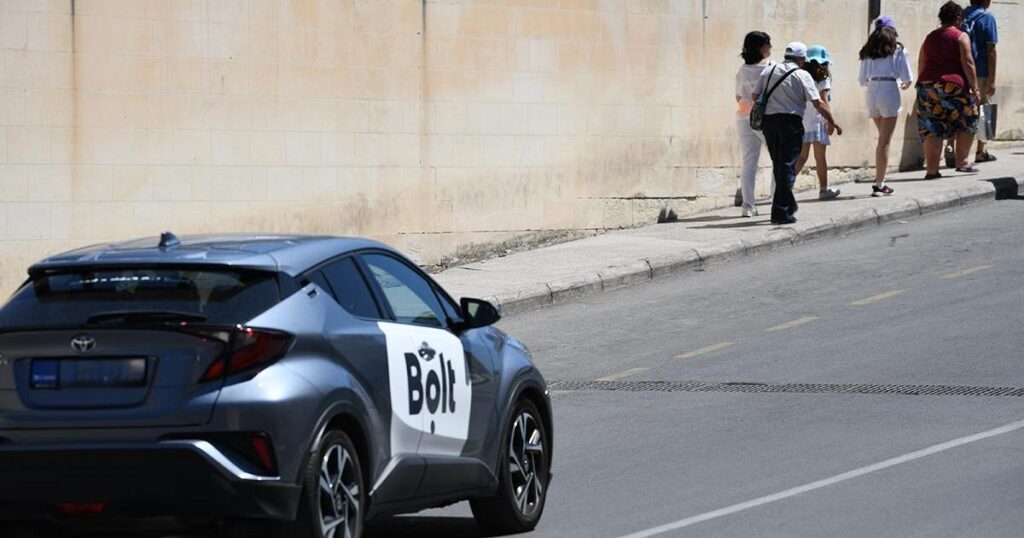
Cab platforms like Bolt, Uber and eCabs are expected to be barred from accepting cash payments for rides, under new plans to regulate the Y-plate sector.
The proposal is part of a broader plan to overhaul the sector, which will also see platforms pay massively higher yearly fees to Transport Malta, among other things.
Data gathered by transport authorities show that Malta sees some 55,000 cab trips per day. More than a third of those trips are paid in cash, government data seen by Times of Malta shows.
The government consultation document says that, besides the risk of theft and “management risks”, cash payments lead to “less transparency and more compliance challenges”.
The Transport Ministry plans to introduce measures limiting cash payments by the beginning of 2026, the document says.
While some Y-plate drivers are self-employed, most work for companies that operate fleets of vehicles. Malta’s largest fleets have more than 200 cars.
Platforms will also be required to introduce facial recognition
Cash payments are harder for regulators and tax authorities to track and make it easier to under-declare income.
In footage published by Times of Malta last year, officials from some of the country’s largest Y-plate operators could be seen telling would-be drivers that they would have to pay €150 monthly in taxes at most, even if they made €10,000 worth of trips.
Drivers who spoke to Times of Malta at the time said they were engaged on minimum wage contracts, despite pocketing as much as €4,000 a month, after splitting the earnings with the company and paying fuel costs and taxes.
“Whenever a customer pays cash, my employer tells me to keep it. The rest of the money is paid to me via Revolut,” one driver said.
Sources from Malta’s transport authorities also say that eliminating cash payments would go a long way towards eliminating the 50-50 model, a system through which employees get a cut of the revenue generated by their trips instead of a standard salary.
“Fleets get away with 50-50 in part because of cash payments. You cannot trace paper money like you can with digital payments,” they said.
 More than a third of daily trips are paid in cash. Photo: Times of Malta
Enforcing working time rules
The 50-50 model encourages employees to drive long hours and maximise their earnings. Last year, Times of Malta reported that some drivers would even drive up to 16-hour days, transporting passengers across Malta, raising concerns over road safety.
The reform being proposed would give Transport Malta the power to enforce existing working hours rules, which say drivers must get an eight-hour rest between shifts, which can be no longer than 12 hours.
The working time rules also state that workers must take a half-hour break every six hours, have a rest day at least once per week, and can work a maximum of 65 hours per week.
While those limits are already in place, the transport regulator currently has no way of monitoring drivers’ working hours or enforcing the limits.
In June, the Transport Ministry said it would transpose working time regulations into the law regulating Y-plates – the Light Passenger Transport Services and Vehicle Hire Service Regulations.
Transport Malta will then be given access to data of drivers’ working hours across all three ride-hailing platforms – Bolt, eCabs and Uber – to know how long a driver has been behind the wheel.
 The reform being proposed would give Transport Malta the power to enforce existing working hours rules. Photo: Shutterstock.com
More rules and expenses for ride-hailing apps
Those platforms currently pay just €200 a year to Transport Malta as a platform registration fee.
But the proposed reform will see that figure skyrocket to a maximum of €320,000 per year, depending on how many rides they serve.
Platforms will also be required to introduce facial recognition into their driver-serving apps and require drivers to re-authenticate their identity every three hours, to make it harder for unregistered drivers to use verified accounts to operate cabs.
Fleets will also face additional expenses through a new “congestion fee”. Y-plate vehicles that clock more than 80,000km per year will be subject to congestion fees ranging from 1c to 5c per additional km.
However, fines for on-street parking for longer than the established time limits will be reduced – at least for first offenders.
For the first four times that a vehicle is found parked on the street for longer than it should, the fine will be €100. That doubles for the fifth and sixth fines, jumps to €300 for the seventh and eighth, and reaches €400 for the ninth and tenth citation.
A fine of €500 will apply to those who are fined more than 10 times. Fines for every vehicle will reset every year.
All cars found parked without the Transport Malta parking clock will be fined €500.
Until now, vehicles can park on the street – whatever the time of day – for no longer than one hour. The government is now proposing to increase parking during the day (5am to 5pm) to two hours. On-street parking at night will remain limited to one hour, the government’s plan says.
It remains to be seen whether the reform will have an impact on cab fares, especially as the looming introduction of random drink and drug driving tests is expected to boost demand for taxis.