
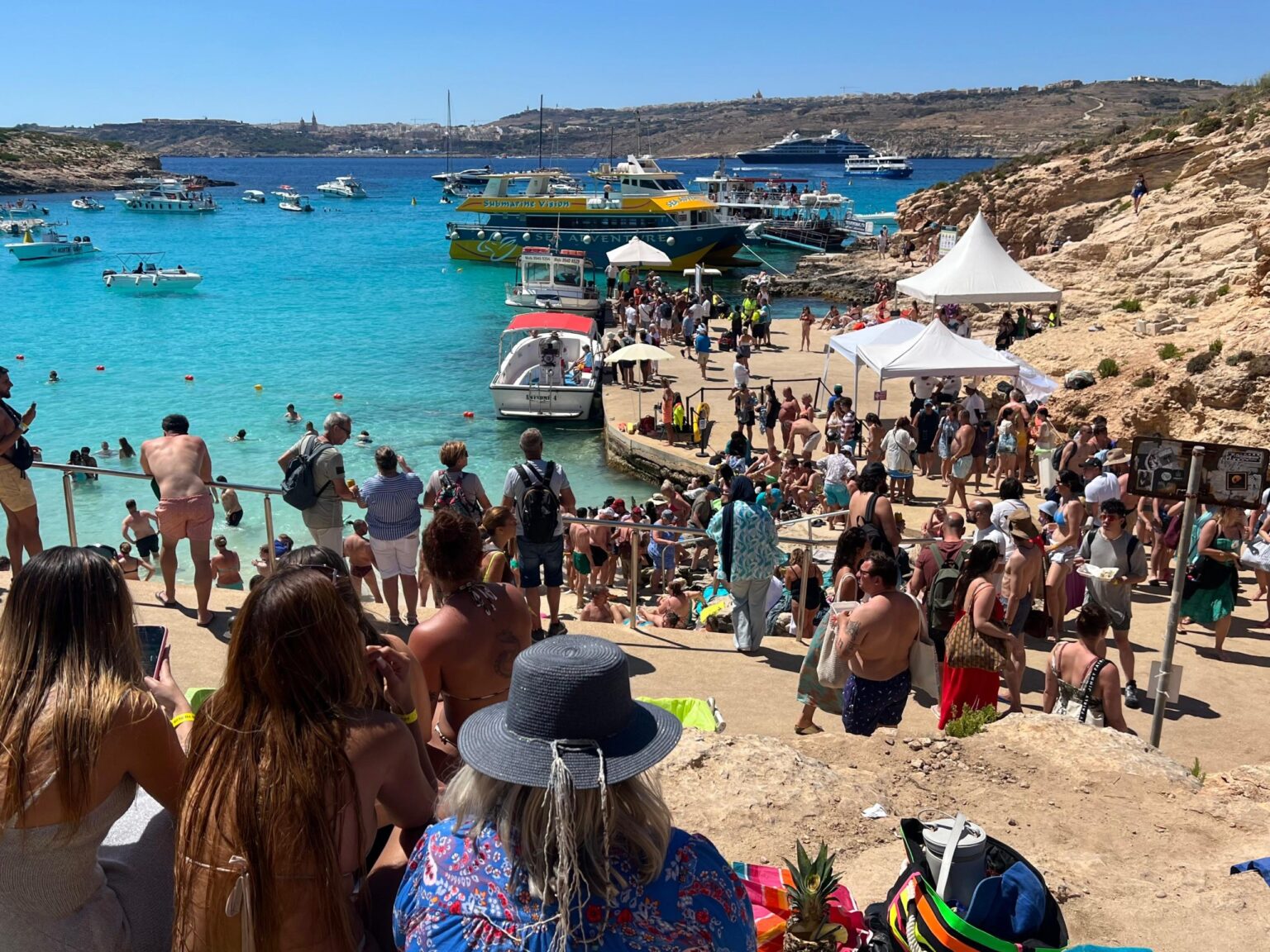
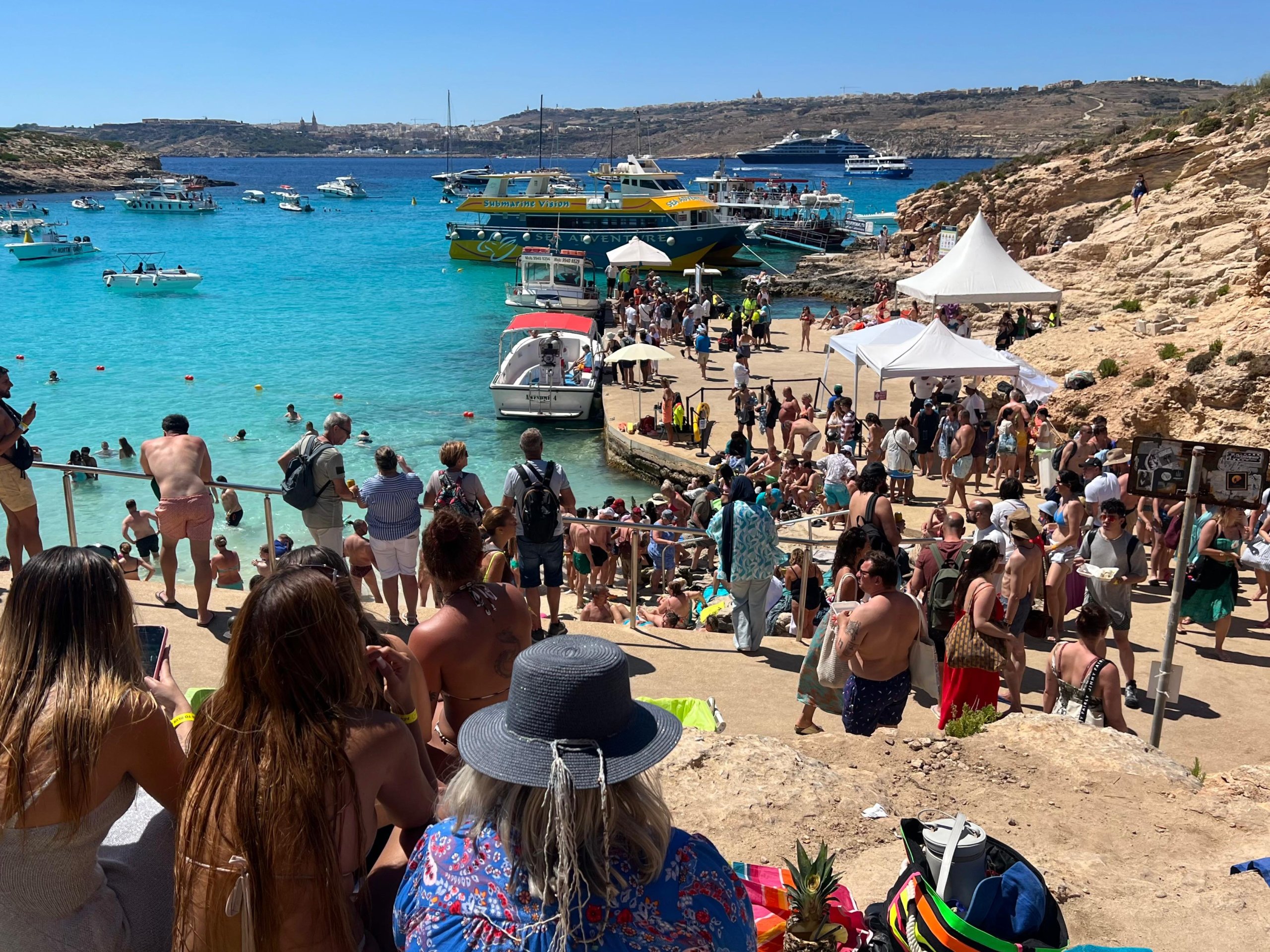
 Despite the visitor cap, the Blue Lagoon remains overcrowded — raising questions about actual enforcement (Photo: Miguela Xuereb)
The Malta Tourism Authority has claimed its new booking system reduced peak visitor concentrations at the Blue Lagoon by 68% this summer, though the agency provided no supporting data or evidence to verify these figures.
The MTA announced today that the highest recorded concentration of visitors at any one time during July and August was 3,830 on Friday 22 August, compared to peaks of up to 12,000 visitors recorded simultaneously last summer.
The authority claims the average number of visitors across the three daily time slots was 1,979, with only 34 out of 189 available time periods registering more than 3,000 visitors.
However, the claims come amid mounting evidence that the booking system introduced in May has failed to achieve meaningful crowd control at Malta’s premier nature reserve.
A Newsbook Malta investigation in June exposed fundamental flaws in enforcement, revealing that QR codes were not being scanned and time limits were not enforced, effectively rendering the 4,000-visitor cap meaningless.
The investigation found that visitors could overstay their allocated time slots without intervention from authorities, whilst generic 24-hour access codes were being distributed regardless of booked periods. Our reporter remained at the site two hours beyond her designated departure time without any official checks.
The Blue Lagoon, designated as a protected Natura 2000 site, continues to face pressure from commercial activities concentrated in its small area, with environmental groups arguing that unchecked operations have led to pollution, excessive noise, and ecosystem degradation.
Moviment Graffitti has consistently challenged the government’s approach, releasing footage in August showing how large commercial boats continue to transform the site from a tranquil morning location into an overcrowded tourist hotspot by afternoon.
The organisation documented over ten boats, each carrying several hundred passengers, docking simultaneously at the Blue Lagoon.
The activists argued that the booking system fails to address what they describe as the root cause of overcrowding: “unbridled commercial activity” by large tour operators ferrying mass tourism from Buġibba and Sliema directly into the fragile Blue Lagoon environment.
But on Monday, MTA CEO Carlo Micallef claimed the measures demonstrated the “effectiveness” of controls implemented by Team Blue Lagoon, stating the system was “helping us embark on a journey to protect the Blue Lagoon and give visitors a better experience.”
Deputy prime minister Ian Borg also chipped in and described the summer’s efforts as the “first tangible drive to improve sustainability” whilst acknowledging this was “just the beginning.”
The authority announced that internationally acclaimed Mizzi Studio has been appointed to deliver long-term rehabilitation proposals, which will be subject to public consultation in coming weeks. Team Blue Lagoon reportedly extended the swimming zone by 12%, doubled cleaning resources with over 12 cleaners assigned daily, and strengthened security with additional patrol teams and lifeguards.
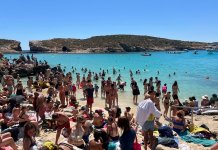
However, the MTA’s claims contradict earlier assessments by environmental groups who reported the Blue Lagoon remained “packed with thousands of tourists” causing “serious harm to the area’s ecology.” Moviment Graffitti had described Borg’s promises as a “complete failure” following the Newsbook Malta investigation.
The booking system faced immediate legal challenges from ferry operators who successfully obtained a temporary injunction in May, though this was later overturned by the courts. The Gozo Tourism Association criticised the rushed implementation, claiming it created unfair slot allocations and financial strain for operators.
Social media reports from visitors have consistently questioned the system’s effectiveness, with one posting on the Expats Malta Facebook group describing the site as “way overcrowded, maybe even more than without the booking system” while noting that “no one was checking” bookings.
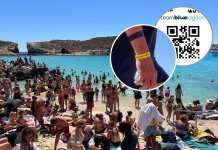
The enforcement gaps identified by Newsbook Malta revealed that authorities were distributing different coloured wristbands without clear explanation, with some visitors sporting multiple bracelets whilst others had none. Transport Malta officials were observed collecting printed QR codes at departure points without scanning the digital codes issued during online booking.
Environmental concerns about Comino’s management have gained international attention, with British newspaper Express highlighting “panic in Malta as beautiful island overrun with 10,000 tourists a day.”
Critics have questioned the coherence of government policy, noting that planning approval for the Six Senses Comino luxury resort project was granted just days before the booking system’s launch.
The contradiction between stated aims to limit visitor numbers while simultaneously expanding commercial development has been described as “incongruent” by environmental groups. Moviment Graffitti maintains that any sustainable solution must include a complete ban on large mass tourism boats accessing the nature reserve.

