
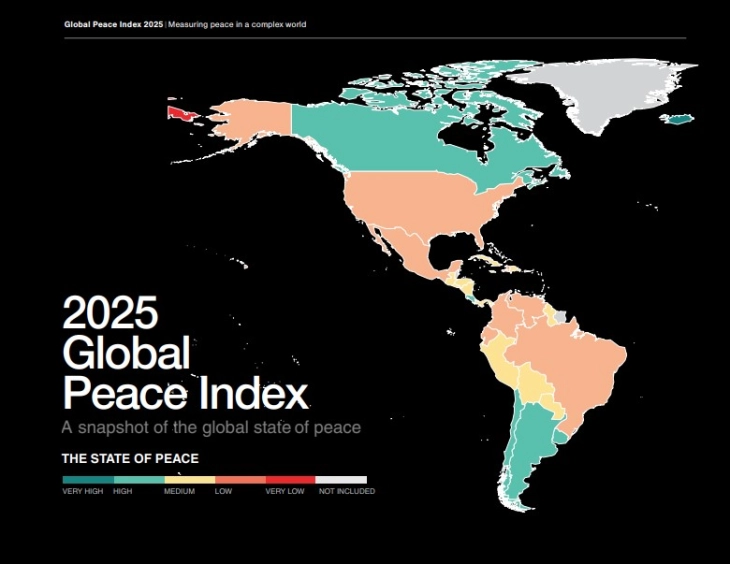
North Macedonia ranks 51st in the Global Peace Index for 2025

Express newspaper
01/09/2025 11:43
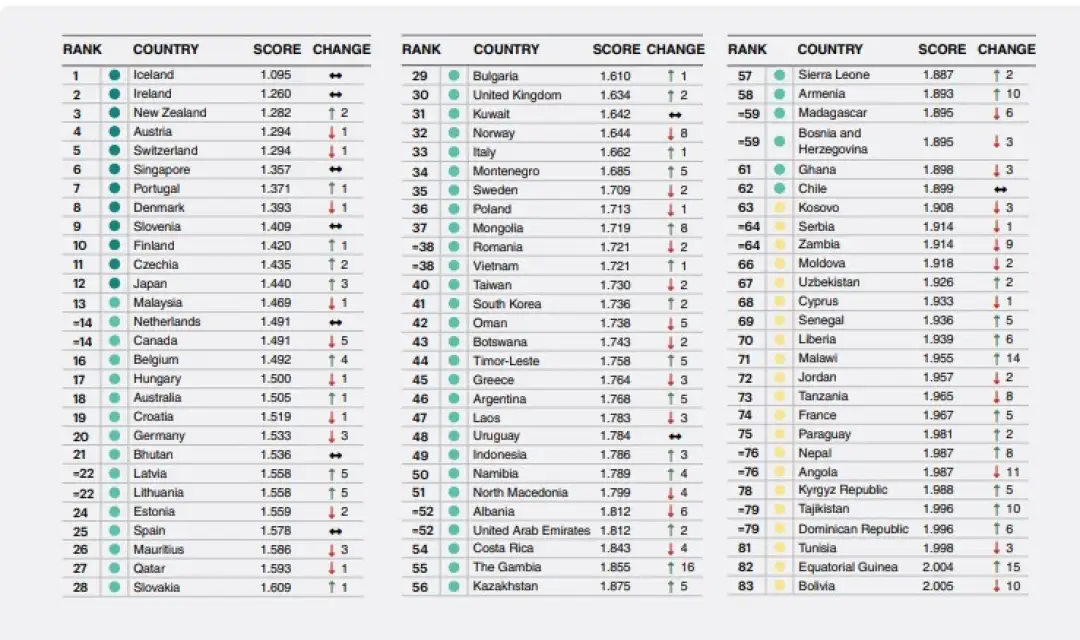
North Macedonia ranks 51st in the Global Peace Index (GPI) for 2025, with a score of 1,799, which is a drop of four positions compared to last year, according to a report by the Institute for Economics and Peace (IEP).
This position places the country in the middle of the list of 163 countries in the world, while it is within the Western and Central Europe region, which remains the most peaceful in the world, although it marked a slight decline of 0,57 percent last year.
In the Western and Central Europe region, other countries from the wider neighbourhood rank in the following positions: Croatia in 19th place (score 1,519, down 1 position), Bulgaria in 29th place (score 1,610, up 45 position), Greece in 1,764th place (score 3, down 52 positions), Albania in 1,812nd place (score 6, down 59 positions), Bosnia and Herzegovina in 1,895th place (score 3, down 63 positions), Kosovo in 1,908rd place (score 3, down 64 positions) and Serbia in 1,914th place (score XNUMX, down XNUMX position).
These rankings show that the Western Balkan countries generally remain in the middle range of the index, with moderate changes in their positions, mainly due to security challenges and militarization. The regional initiative for the control of small arms and light weapons in the Western Balkans, in which the countries of the region participate, continues to play a key role in reducing security risks.
Globally, the 2025 Peace Index shows that the world has become less peaceful for the 13th time in the last 17 years, with an average decline in peace of 0,36 percent. This is the sixth consecutive year of deterioration in global peace.
Iceland holds the title of the most peaceful country in the world with a score of 1,095, followed by Ireland (1,260) and New Zealand (1,282).
On the other hand, countries like Russia (3,441), Ukraine (3,434), Sudan (3,323), Democratic Republic of Congo (3,292) and Yemen (3,262) are among the least peaceful, affected by strong conflicts and humanitarian crises.
The greatest deterioration was observed in the area of ongoing conflicts, with a decrease of 1,3 percent, with 78 countries registering a deterioration due to the increase in the number of external conflicts.
In 2024, 46 countries were involved in more external conflicts than the previous year, with Russia, Bangladesh and Ukraine recording the largest declines in this area.
The militarization score also showed a decline, with 86 countries increasing military spending, with average military spending as a percentage of GDP reaching its highest level since 2010. Norway, Denmark and Bangladesh are among the countries with the largest declines in this area. In contrast to these trends, the security score shows modest progress, with improvements in 95 countries, particularly in perceptions of crime, political terror and violent demonstrations.
The report highlights that heightened geopolitical tensions, economic instability and high inflation, particularly in developing countries, create the risk of further escalation of conflicts. The global economy in 2024 was marked by slowing GDP growth (around 3 percent), high inflation (around 6 percent globally, with triple-digit figures in countries such as Sudan and Syria) and rising youth unemployment, particularly in regions such as the Middle East and North Africa. These factors, together with rising military budgets and trade restrictions, increase the potential for “conflict contagion”, where conflicts in one country can spread to neighboring regions, as seen in Eastern Europe and the South Caucasus due to the war in Ukraine.
The report notes that in 2023 there were 59 active state conflicts, the highest number since the end of World War II, while the proportion of conflicts that ended with peace agreements or clear victories has fallen significantly. This, together with the growing number of international conflicts (a 175 percent increase since 2010), indicates a growing risk of escalation in existing flashpoints, such as the recent conflict in Kashmir between India and Pakistan.
In conditions of increasing geopolitical fragmentation and limited resources for conflict prevention, the report calls for intensified efforts for peace initiatives and economic stabilization to prevent further deterioration of global peace.