
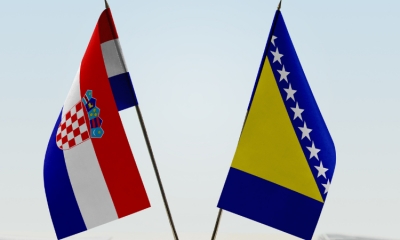
ZAGREB – A majority of Croatian citizens support further enlargement of the European Union, with the strongest backing given to the accession of Bosnia and Herzegovina, according to the results of a special Eurobarometer survey on EU enlargement published by the European Commission on Tuesday.
Croatia Above EU Average
The survey shows that 61 percent of Croatians are in favor of further EU enlargement, compared with the EU average of 56 percent. Respondents largely agree that candidate countries should join once they meet the necessary conditions, and they believe enlargement would also be beneficial for their own country.
Among EU member states, the highest levels of support were recorded in Sweden (78%), Denmark (75%), and Lithuania (74%). At the other end of the scale, support was lowest in France and the Czech Republic (43%), Austria (45%), and Germany (49%).
Croatians Favor Bosnia and Herzegovina
When asked about individual candidates, 74 percent of Croatians supported Bosnia and Herzegovina joining the EU – far above the EU average of 48 percent. Following BiH, Croatians expressed support for:
-
Montenegro – 69%
-
Ukraine – 66%
-
Kosovo – 62%
The lowest level of support among Croatians was for Serbia’s membership bid, backed by 51 percent of respondents.
At the wider EU level, Ukraine (52%) and Montenegro (51%) drew the most support.
Candidate Countries’ Views
The survey also polled citizens in candidate and potential candidate countries. The strongest support for EU accession was found in Albania (91%) and North Macedonia (69%), while the lowest was recorded in Serbia (33%).
In Eastern Partnership countries, Georgia registered the highest support at 74%, followed by Ukraine (68%) and Moldova (55%).
When asked about their perception of the EU, Albanians had the most positive view (82%), while sentiment was weakest in Serbia (38%). In Ukraine, 49% of respondents said they had a positive image of the EU.
Survey Details
The Eurobarometer research was conducted between February and June 2025 through face-to-face interviews across EU member states, as well as in candidate and potential candidate countries.