
More than a quarter of Norway’s 4,053,932 eligible voters have already cast their ballots ahead of Monday’s Parliamentary election, while those undecided are still visiting various party campaign booths and engaging in lively political debate. Public opinion polls are now so close that one election expert is calling it a real thriller.
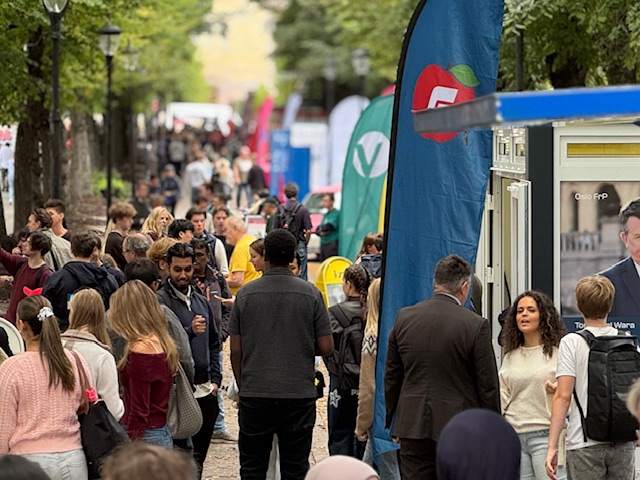 Lots of people were milling around Norwegian political parties’ campaign booths in downtown Oslo on Wednesday. The chance to chat face-to-face with top politicians is one of the hallmarks of Norway’s democracy. PHOTO: NewsinEnglish.no/Morten Møst
“It’s shaping up to be perhaps the most exciting Parliamentary election since 1945,” Johan Giertsen, who runs the volunteer “Poll of polls” website with Lars Øy, told newspaper Dagsavisen. The website literally polls the polls taken mostly by Norwegian media outlets, and Giertsen expects a very close race.
“Not even Alfred Hitchcock could have written anything more thrilling,” Giertsen said, given all the uncertainty around how Norway’s small parties will perform. They’ll play a crucial role in whether the incumbent Labour Party (Arbeiderpartiet, Ap) will win four more years in government, or whether a large conservative coalition will take over.
Labour remains Norway’s largest single party, with around 28 percent of the vote in most polls, but it will continue to need support from other parties on the left. There’s broad support in Parliament for the government’s defense build-up, support for Ukraine and other foreign policy issues, but there’s sharp debate over taxation, social welfare priorities, climate initiatives and many other issues. Labour will need backing from the Socialist Left party (SV), the Reds (Rødt), the Greens (MDG) and the Center Party (Sp) even if it opts to keep governing alone.
All told, the left side held 51.6 percent of the vote in the latest “Poll of polls” taken in August, which would give it 86 seats in Parliament, just three more than the Conservative side.
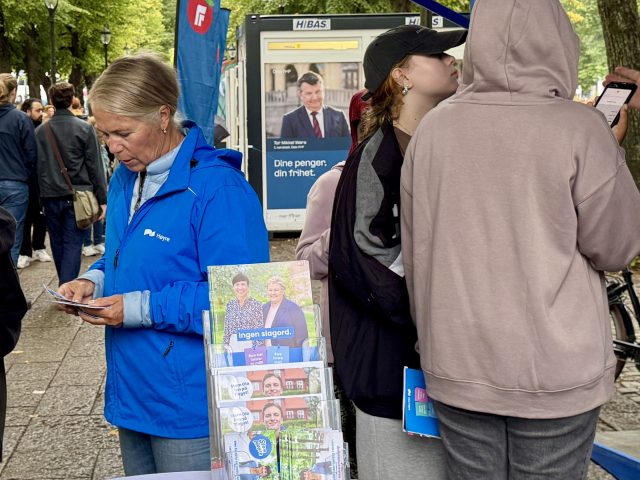 Norway’s Conservative Party (Høyre) is having trouble attracting voters ahead of this election, with the more conservative Progress Party hovering in the background and doing better with their slogan “Your money, your freedom.” Progress wants, among other things, to slash taxes. PHOTO: NewsinEnglish.no/Morten Møst
The conservative Christian Democrats (KrF) have suddenly become a force, though, appearing slightly bigger than the Liberal Party (Venstre, which means “left” in Norwegian but is actually on the conservative side of Norwegian politics). That could push the Conservatives (Høyre) and the more conservative Progress Party (Frp) over the top to form a new coalition on the right.
“Fewer voters are supporting the party they voted for in the last election (in 2021),” Giertsen said. “Voters are wandering more than normal at this point in the campaign, when it’s been more usual for the parties to claim ‘their’ voters.”
Progress, meanwhile, has continued to attract the most conservative voters and remains much bigger than the Conservatives, which has traditionally dominated the conservative side. They held 15.3 percent in the important August “Poll of polls,” down from 20.4 percent in the last election in 2021 which Labour and Center won. Progress, meanwhile, slipped but still performed much better and remained the largest on the conservative side with 21.2 percent.
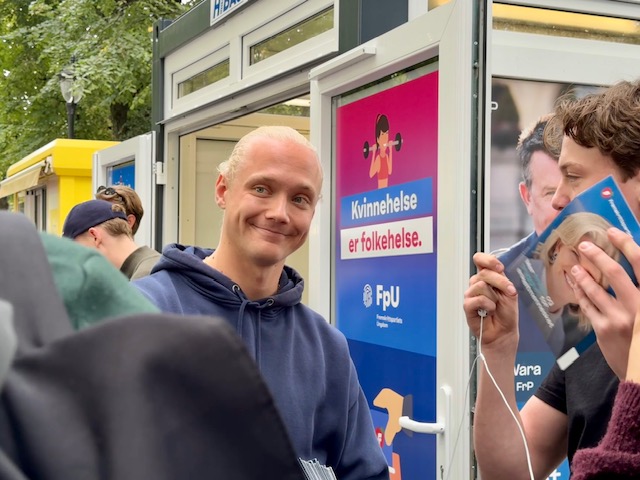 Simen Velle, leader of the Progress Party’s youth organization Fpu, could grin from ear to ear on Wednesday after Progress emerged as the party most favoured by high school students around the country. Velle called it “a clear message from the next generation,” which seems to be more conservative than students were earlier. PHOTO: NewsinEnglish.no/Morten Møst
Progress also swept the traditional election held this week at Norwegian high schools all over the country. It won 26 percent, up 12.1 points from 2021 and making it the biggest of all parties, ahead of the Conservatives (19.7 percent) and Labour, which won just 17.1 percent . The mock election result indicates new conservative tendencies among Norwegian youth, more known for being radically socialist.
“We’re going into the election on a platform of lower taxes and fees, more freedom within schools and perhaps the most important of all, a thicker wallet for all Norwegians,” Velle said after the election. “I think most youth agree with all that.”
Progress leader Sylvi Listhaug also hailed the school election result as “a clear message that they (young voters) want politicians who can pass on our society in better shape to the next generation.”
Listhaug, however, is not popular as a candidate for prime minister, nor has she seemed interested in becoming government leader. The Conservatives’ Erna Solberg seems the conservative side’s most likely leader if it can form a new government, but incumbent Prime Minister Jonas Gahr Støre is the clear favorite to continue as government leader. Fully 46 percent of those polled favoured Støre as prime minister, more than Solberg (with 24 percent) and Listhaug (18 percent) combined.
Early voting ends on Thursday, with official polling places opening both Sunday and Monday. Election results are expected late Monday night.
NewsinEnglish.no/Nina Berglund