
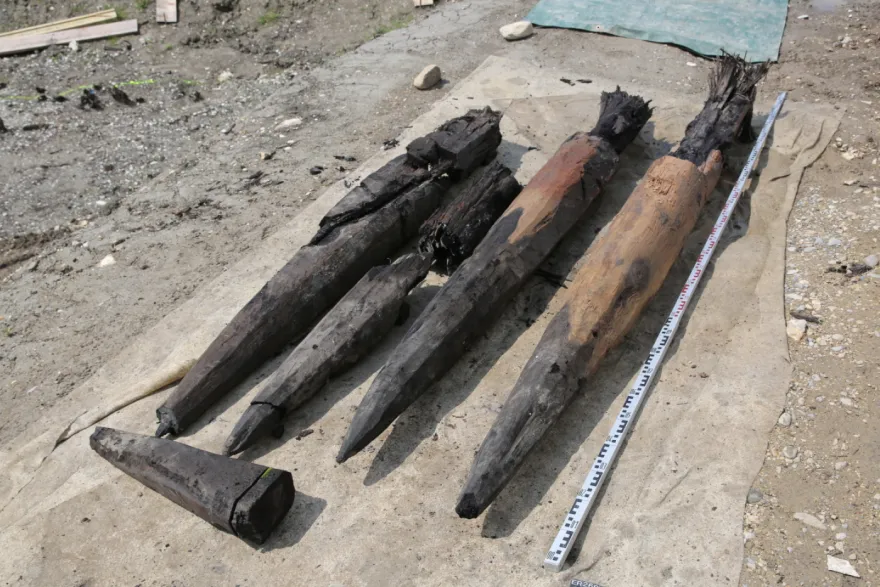
Archaeologists in Switzerland have uncovered the remains of a 2,000-year-old wooden Roman bridge during construction work in Aegerten, a municipality in the canton of Bern near the city of Biel/Bienne.
The discovery is considered one of the most significant Roman finds in the region in recent decades and provides a rare glimpse into how the Roman Empire connected and controlled its provinces.
Over 300 Oak Piles Preserved in Groundwater
The Archaeological Service of the Canton of Bern reported that more than 300 oak piles were found preserved in the groundwater at the site of the former River Zihl. These piles once supported a large wooden bridge that stretched across the river. Dendrochronological (tree-ring) studies confirmed that the bridge was built, repaired, and rebuilt multiple times over the course of several centuries.
The earliest sections date to around 40 BC, shortly after the Roman conquest of Celtic Helvetia, while the most recent parts were built in AD 369, during the reign of Emperor Valentinian I. This indicates that the bridge remained in continuous use for more than 400 years.
From Celtic Helvetia to Roman Province
Before the arrival of the Romans, the Helvetii, a Celtic tribe, inhabited the Swiss Plateau. In 58 BC, Julius Caesar defeated them at the Battle of Bibracte after they attempted a mass migration into Gaul. Following their return to their homeland under Roman oversight, Helvetia became increasingly integrated into the Roman world. By around 15 BC, the area was fully incorporated into the empire, and Rome began building roads, military outposts, and towns to secure its northern frontier.
The bridge at Aegerten, constructed only a few decades later, was a crucial part of this Romanization process. It linked settlements, military camps, and trade routes, ensuring that Roman authority and commerce could extend deep into Celtic territory.
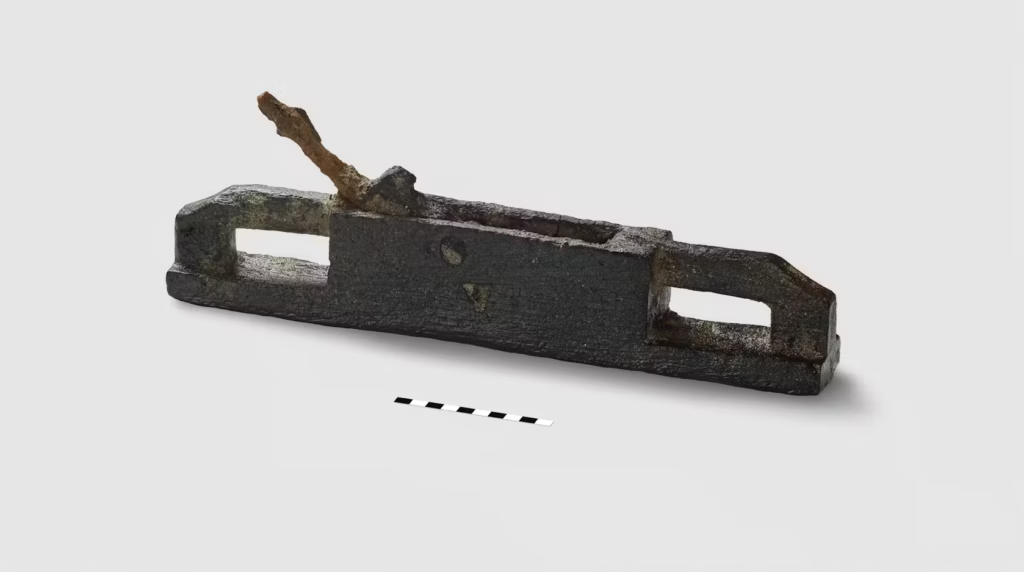 The fully preserved carpenter’s plane, carved from a single piece of wood and fitted with an iron blade, measures 41 cm in length, 7 cm in width, and 5 cm in height. Credit: Archaeological Service of the Canton of Bern, Daniel Marchand
Gateway to Petinesca – A Roman Crossroads
The bridge stood at the gates of Petinesca, a Roman town near present-day Studen. Strategically located, Petinesca served as an important crossroads of waterways and land routes. From here, travelers and soldiers could move across the Swiss Plateau toward Aventicum (modern Avenches), the capital of Roman Helvetia, or through the Taubenloch Gorge over the Jura mountains to Augusta Raurica (near Basel).
The bridge was part of the Roman Jura transversal, a major route that tied together the Aare, Zihl, and the three lakes at the foot of the Jura mountains. This network connected the region’s largest settlements and facilitated both trade and military movements. Without such infrastructure, the Roman Empire could not have effectively controlled or supplied its northern provinces.
Unique Finds in the Riverbed
The former riverbed at Aegerten yielded a remarkable array of Roman artifacts, many of which had either fallen from the bridge or been intentionally deposited into the water. Archaeologists recovered shoe nails, horse shoes, harness fittings, axes, a fishing trident, keys, and Roman coins.
One of the most striking discoveries was a large carpenter’s plane made of wood and iron, exceptionally well-preserved thanks to the oxygen-poor, waterlogged soil. Such tools are rarely found intact from antiquity, and this specimen provides direct evidence of Roman woodworking practices.
These finds, currently undergoing conservation, are expected to offer valuable insights into everyday life in Roman Switzerland—from craftsmanship and agriculture to travel and trade.
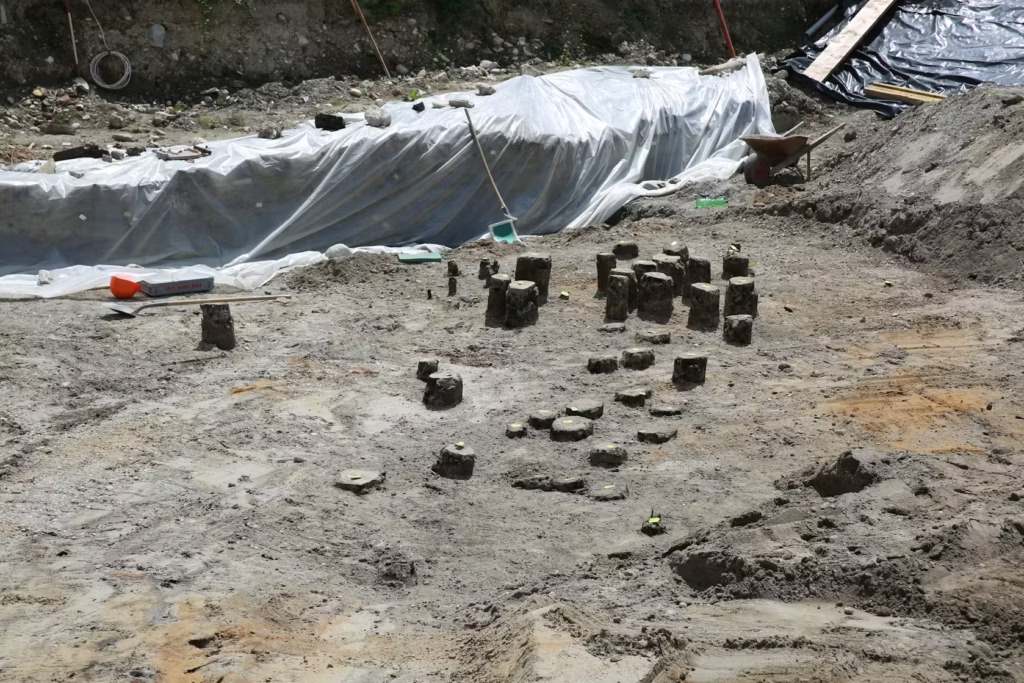 Excavation with closely spaced oak piles from the bridge piers. A sample was taken from each pile for age determination. Credit: Archaeological Service of the Canton of Bern, Joel Furrer
Archaeology Without Delays
Interestingly, the excavation caused no delays to the construction project. The archaeological team carried out their work during a scheduled pause, making it possible to preserve history while allowing modern development to continue on schedule.
A Bridge Between Eras
The discovery of the Aegerten bridge underscores the Roman Empire’s deep imprint on Switzerland’s landscape. Built shortly after the conquest of the Helvetii and used until the late Roman Empire, the bridge is a tangible symbol of how Rome transformed Celtic Helvetia into a fully integrated province.
According to the Canton of Bern, the find is not only a testament to Roman engineering but also a unique window into the daily lives of soldiers, craftsmen, and travelers who crossed this bridge for over four centuries. As studies continue, the site may yet reveal more about how Rome’s far-reaching infrastructure helped hold together an empire that stretched from the Atlantic to the Near East.
Cover Image Credit: Archaeological Service of the Canton of Bern, Joel Furrer