
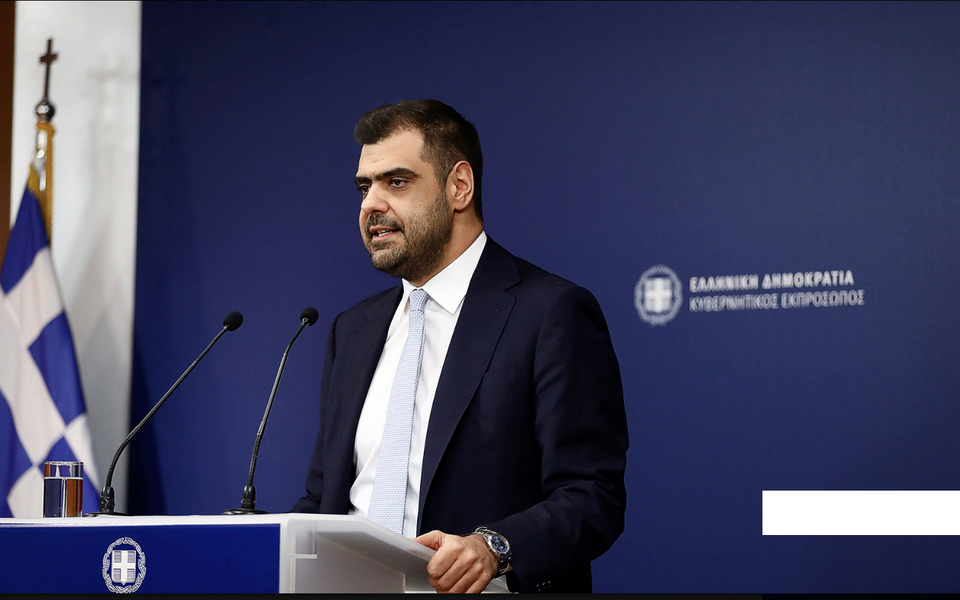
Government spokesperson Pavlos Marinakis said that the European Public Prosecutor’s Office (EPPO) has not contacted Greece regarding its probe into the Great Sea Interconnector (GSI), a planned subsea power cable linking Greece and Cyprus.
“The Greek government has not received any notification from the European Public Prosecutor’s Office regarding the GSI. The Greek side will obviously request further information from the Republic of Cyprus,” said Marinakis, when asked about President Christodoulides’ comments revealing an EPPO investigation into European funds used for the still-uncompleted GSI.
On Thursday, the EPPO confirmed that it has launched an investigation into the project, without disclosing further information. The 1.9 billion-euro project is co-financed with €657 million from European funds.
Marinakis noted that Cyprus has not provided Greece with the studies suggesting the project is economically unviable, while emphasizing that Athens remains determined to see it through to completion.
“The statements by the Cypriot minister, Mr. Keravnos, raise reasonable questions regarding the financial viability of the project. This is the issue we are discussing, financing and the fair allocation of costs,” he said, adding that the cost cannot be borne entirely by the Greek taxpayer.
“Beyond that, the feasibility studies mentioned by the Cypriot minister have not been presented to us. We are receiving mixed signals about the project’s implementation,” he added.
Greece’s grid operator, ADMIE, according to the public statements of its administration, has spent a total of around €300 million on GSI (€250 million for the construction of the cable and €50 million for its acquisition from the previous implementing body) without having recovered anything so far.
The main point of contention between Greece and Cyprus is the annual payment of €25 million over a five-year period (2025–2030), which Cyprus is expected to contribute to cover expenses incurred by ADMIE.
The project has stalled amidst geopolitical tensions with Turkey, which culminated in a 40-hour naval standoff in July 2024 off the coast of Kasos, triggered by the operations of an Italian research vessel conducting seabed surveys to prepare for the cable’s installation.