
Hungary and Serbia, with Russia’s support, are taking concrete steps towards deepening energy cooperation that is in direct contradiction with the EU’s energy policy direction. What are the implications for Romania?
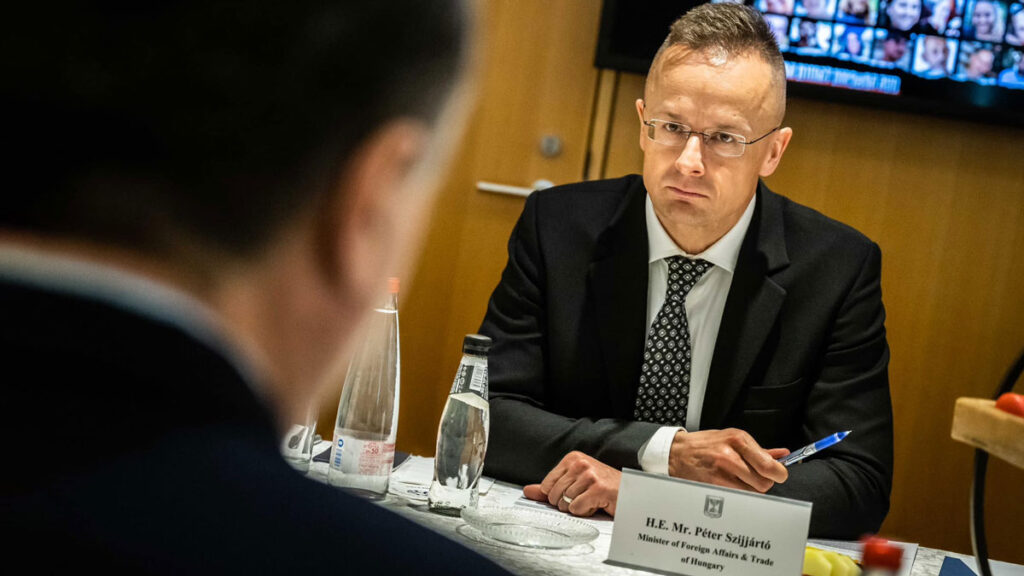
Hungarian Foreign Minister Peter Szijjarto’s (photo) announcement of a new oil pipeline linking Serbia to the Druzhba pipeline (‘Friendship Pipeline’) reinforces not only the region’s dependence on Russian energy, but also the strategic relationship between Budapest and Belgrade, at a time when the EU is stepping up efforts to decouple from Moscow.
Hungarian-Serbian pipeline bypassing Brussels
The project, planned to become operational in 2027, will connect Novi Sad to the Soviet Druzhba infrastructure, fully covering Serbia’s oil needs while ensuring continuity of Russian imports to Hungary. For Budapest, this is a tool to protect low utility costs, in contrast to European Commission policies, which aim to align with market prices and reduce dependence on fossil fuels.
Politically, the project is a clear manifestation of Hungary’s drive to build energy autonomy from Brussels, even at the cost of closer ties with Russia and Serbia, two countries outside the European mainstream.
Serbia, energy and geostrategic pivot
Serbia, already dependent on Russian gas, is becoming the hub through which almost 100% of gas destined for Hungary transits the region. This position gives Belgrade a powerful bargaining chip and, at the same time, an anchor in its partnership with Budapest.
The Serbhungas joint venture, set up in 2023 by MVM (Hungary) and Srbijagas (Serbia), marks a step towards the integration of energy markets. The expansion of Hungarian influence is also visible in acquisitions in the Serbian energy construction sector, as well as in joint electricity interconnection projects.
Energy thus becomes not only a security tool but also a geopolitical bargaining chip. Belgrade secures Hungary’s support in the face of European sanctions, while Budapest consolidates its access to essential resources, avoiding the constraints imposed by Brussels.
Romania, between Brussels and Budapest
For Romania, this context poses both risks and opportunities.
On the one hand, the energy rapprochement between Hungary and Serbia, with Russia’s backing, is shaping a regional bloc that could weaken European energy cohesion. Hungary is already using its geographical position and infrastructure to influence energy routes in the region.
On the other hand, Romania is involved in strategic projects that put it in a counterbalancing position: the interconnection with Hungary and Serbia through Transelectrica, and the Georgia-Romania-Hungary submarine cable, designed to bring renewable energy from the Caucasus. These initiatives could become essential to diversify sources and reduce Russian influence.
As such, the new Hungarian-Serbian pipeline is not just a matter of energy infrastructure but reflects a geopolitical repositioning in Central and Eastern Europe, where Hungary is increasingly visibly distancing itself from Brussels and moving closer to Serbia, with Russia as a key supplier and China as an infrastructure partner.
For Romania, the dilemma will be how to navigate between the imperatives of the EU’s common energy policy and the pressure to remain relevant in a region where Budapest is assuming a central role.