
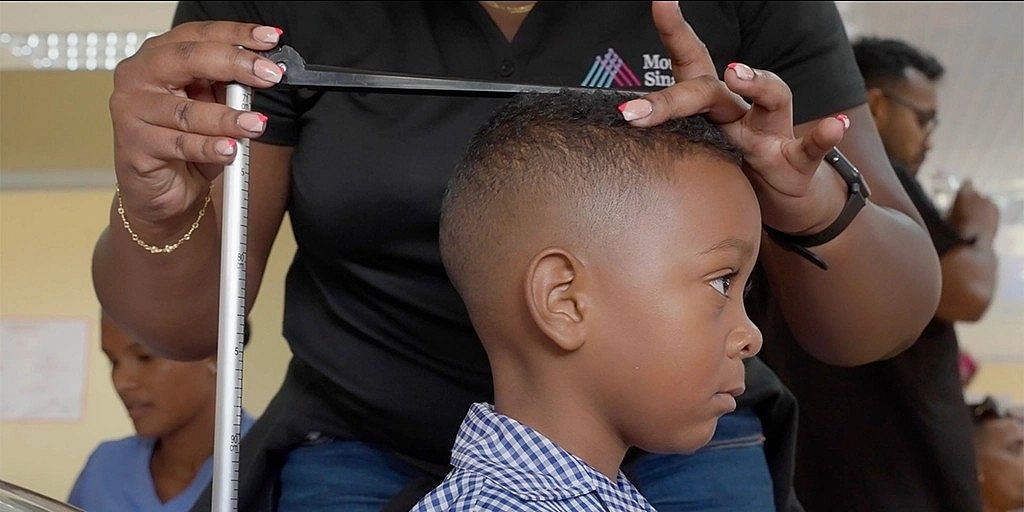
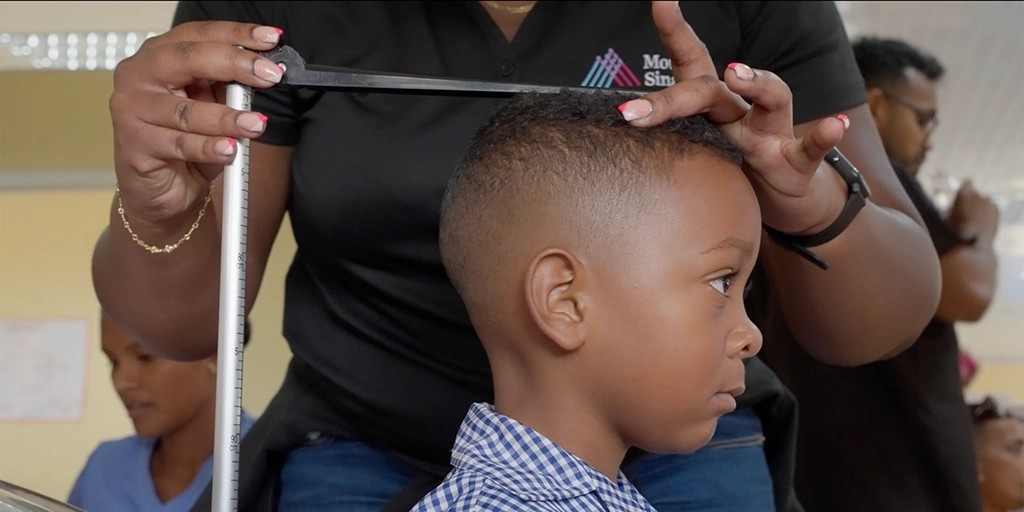
 C. Thomas Lewis has documented a partnership to improve health care in Guyana for all. Guyana’s Minister of Health, Dr. Frank Anthony, noted, “If we’re able to screen all the children in school, and determine if they have any medical issues, and solving that early, it would certainly have a big impact on learning outcomes.”
Luddy Indianapolis Teaching Professor C. Thomas Lewis makes films that help people to tell their stories – stories of hope, and resilience. One of his latest projects has taken him to Guyana, to document an ambitious effort to extend and improve health care for every one of the South American nation’s citizens.
Lewis has navigated the world of health care before. He’s received grants from Indiana University to work with people in their communities: in Africa, working with locals on narrative films about coping with the stigma associated with AIDS in Kenya; and in Indiana, on films about people recovering from drug addiction.
He’s also repeatedly visited the island of Paros in Greece during summer study abroad trips with IU students, including students from the Luddy School of Informatics, Computing, and Engineering in Indianapolis, who create videos documenting life on the island and promoting tourism.
Transforming public health
Lewis’s film practice extends beyond the films he makes in his role at IU. The health care films he produced in Guayana were made through his production company. In 2024 he made five short films to document a partnership between the Ministry of Health in Guyana and New York-based Mount Sinai Health System. The films have been combined to create “Inside A National Healthcare Collaboration: Transforming the Healthcare System in Guyana.”
This film examines the Guyanan government’s commitment to transform its public health system. The goal: Provide high-level health care services to all citizens, particularly residents in vulnerable communities.
“It was an honor to work with the Arnhold Institute for Global Health and Mount Sinai International to tell the story of the exceptional work they are doing with the Ministry of Health in Guyana,” Lewis says.
“This health care collaboration is yielding tangible results that are already impacting the well-being of the country’s citizens.”
Experience benefits Luddy students
Lewis traveled to Kenya in 2015 and created films that explored the stigma associated with HIV, thanks to a grant from IU’s New Frontiers in the Arts and Humanities seed funding program.
Next, with IU Associate English Professor Kyle Minor, he received a grant from the IU Indianapolis Arts and Humanities Institute to make films in 2018 and 2019 about how Indiana residents forged paths from addiction to recovery. (Learn more about the films here: http://opioidstories.org/)
At Luddy Indianapolis, Lewis teaches classes that include documentary filmmaking and filmmaking for social change. As he told News at IU in 2019, he believes it is important for students to realize the many opportunities that exist for young filmmakers to apply their talents to engage with community issues – something that he has been able to show by example.
Lewis has had plenty of experience with making films on small budgets and tight schedules—and improvising when things fail to go according to plan.
“Whether it’s about editing or how to shoot in environments with limited resources, I have already brought so many lessons learned from this work into the classroom,” he says of his experience working on the Guyana films.
Lewis keeps a blog that describes his experiences shooting films. On it, he chronicled how they shot footage of the main Guyanese participants in the health care effort, as well as of a diabetes patient at the clinic and their home, and of the pathology lab as it was under construction.
Improving the level of care
To document the health care partnership in Guyana for “Inside a National Health Collaboration,” Lewis filmed interviews with officials from Guyana, as well as Mount Sinai.
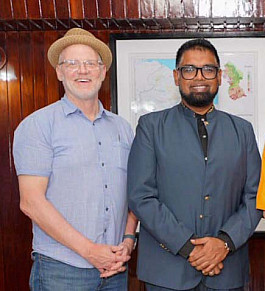
“Our intention is to develop a world-class health care system,” Guyana’s President Irfaan Ali, Ph.D., explains in the film. (Photo, from left: Lewis, President Ali.)
“We are partnering with Mt. Sinai in delivering justice, a modern health-care system.”
And in the film, Dr. Frank Anthony, Guyana’s Minister of Health, talks about the aspect of school health. “If we’re able to screen all the children in school, and determine if they have any medical issues, and solving that early,” he says, “it would certainly have a big impact on learning outcomes, and of course, keeping the children healthy, so that they move from childhood into adulthood being quite healthy.”
Nation shaping its future
To shoot footage for the five films about the health partnership, Lewis made two trips to Guyana. As Mount Sinai writes on its website, “ ‘Inside a National Health Collaboration’ chronicles the first phase of this ambitious effort—from the rollout of school-based health screenings to the launch of a cutting-edge pathology lab that has significantly reduced the time it takes for patients to receive a diagnosis and begin lifesaving treatment.”
The film also highlights new interventions in community-based diabetes care, to address the rate of the disease in Guyana. According to the International Diabetes Federation, more than 16 percent of Guyana’s total adult population has diabetes.
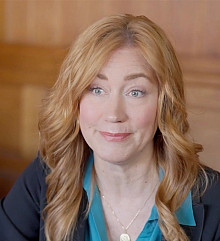
“We hope that this partnership in Guyana will be something that we can look back on and point to the ways in which it’s transformed this country forever,” pediatrician Rachel Vreeman (pictured at right) says in the film.
She chairs the Department of Global Health at Mount Sinai and is director of the Arnhold Institute for Global Health there. (As director of IU’s Center for Global Health, Vreeman worked with Lewis about 10 years ago when he was making his series of HIV-related films in Kenya.)
“It’s an incredible opportunity to collaborate with the government of Guyana in this way,” Vreeman says in the film.
“We actually get to be part of changing a health care system for an entire country.
“That looks like helping the Guyanese Ministry of Health to roll out services that are going to transform the health of the population, for the entire future—when kids get access to medical services for the first time, as the government is now making possible, when you’re able to get diabetes care right in the community where you live.”
A collaborative approach
Dr. Szabi Dorotovics, President of Mount Sinai International, cited the importance of working together on this health care effort.
“Our Guyanese collaborators are driven, and we are already making positive changes together,” he says in the documentary.
“We want the Guyanese health care system to be stronger than ever. We are talking reduced wait times, better access to critical services, and an overall health care system that the entire country can be proud of.”
On his blog, Lewis noted that his work on the five films about Guyana’s health care partnership “includes a compiled version of all the films with an intro at an hour and eight minutes runtime. The film was broadcast on Guyanese television in May.
Reflecting on the experience, Lewis says working on projects such as this is an education—and he takes what he learns from every film he shoots back to the classroom.
His work in Guyana, he explains, “is another example of how my students benefit from my work as a practicing filmmaker.”