

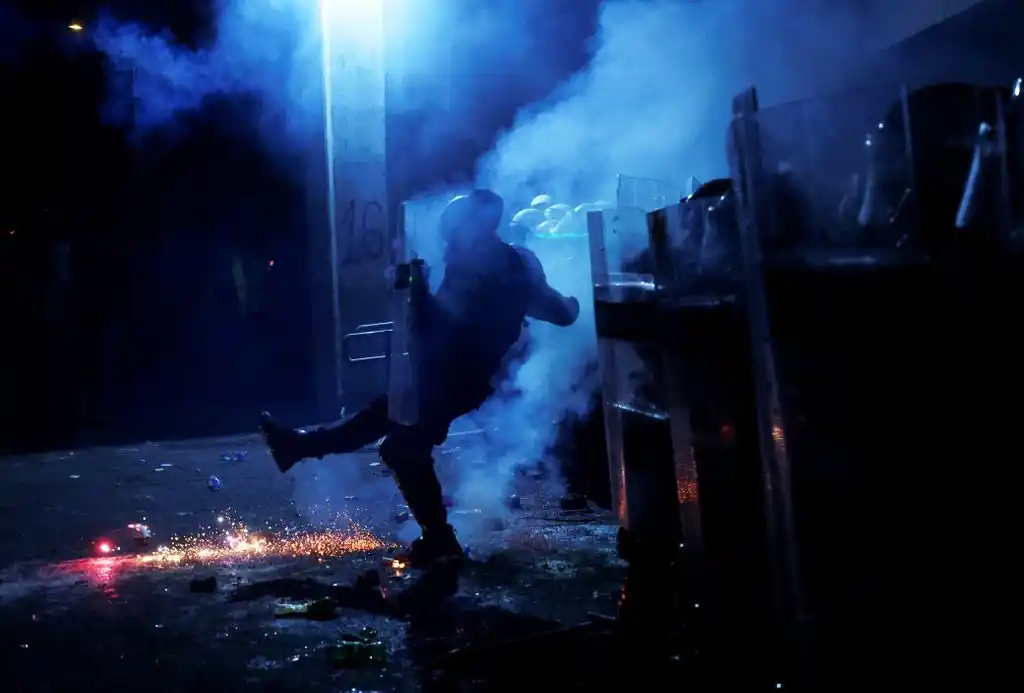
During clashes with anti-government protestors in Novi Sad, Serbia, on Friday, a riot police officer kicks aside an object emitting smoke and sparks. Zorana Jevtic/Reuters
On Friday, the Serbian police used tear gas and flash-bang grenades on the campus of a university in Novi Sad to disperse protesters who were demanding snap elections aimed at removing President Aleksandar Vučić and the ruling Serbian Progressive Party (SNS).
In the evening, thousands of people gathered on the state university campus. They held signs: “We do not want blockades, we want elections,” and “Students have one urgent demand: to call elections.”
The crowd chanted: “Vučić must resign.”
Protesters clashed with police in front of the Faculty of Philosophy and threw flares; then police used gas and flash-bang grenades to push back the crowd.
Months of protests across Serbia, including the blockades of state universities, were sparked by the deaths of 16 people in November last year, when the roof of a renovated railway station collapsed onto people.
The protests largely remained peaceful until August 13, when dozens of police officers and civilians were injured in clashes.
“The decision is to hold elections”
– Nebojša Korać
The protesters also allege corruption and ties to organized crime, the use of force against political opponents, and restrictions on freedom of speech; the authorities deny these claims.
“From our side, we want peace and democracy to prevail, and for political institutions to do their job. That means holding elections, and that will be the decision, because the government will change.”
– Nebojša Korać
Context of the confrontation and its consequences
Officials call for dialogue and calm, but Serbia’s streets continue to be an arena of debate between reform supporters and those who believe changes should come through snap elections. Experts note that such events heighten demands for transparency and accountability from the government, while also fueling divisions in society and the country’s political system.