
Commenting on the achievement, Jiří Jílek, Czech deputy ambassador in Luxembourg, said: “This innovative building, created with a unique 3D printing technology, clearly shows that Czech companies have considerable potential in the Luxembourg market with high-quality and modern projects.”
The 56 m² home was designed for young couples and features a kitchenette, living area, flexible room, bathroom, and hallway. Outfitted with solar panels and ten battery storage units, it can operate with near energy self-sufficiency. As part of a pilot project, the house is priced at around CZK 8 million (approx. €325,000), and demand has been immediate—more than 20 applications have already been submitted to live there.
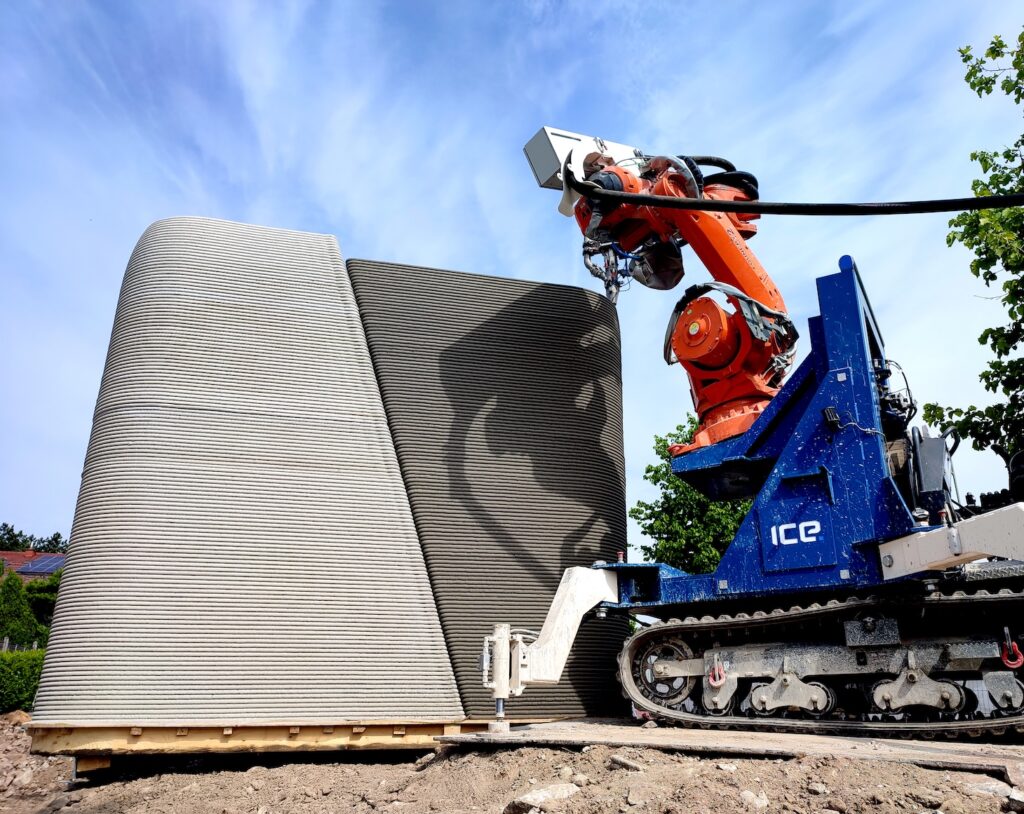 Luxembourg’s First 3D Printed Residence. Photo via ICE Industrial Services.
Czech Innovation in 3D Printed Housing
ICE’s construction system relies on locally sourced mineral materials, providing both flexibility and efficiency. Czech builders have been experimenting with 3D printed housing for several years—most notably with Prvok, a floating home unveiled in 2020 as the country’s first residential 3D printed building. Since then, the technology has also been trialed in various infrastructure projects.
With the Luxembourg pilot attracting international attention, ICE Industrial Services is positioning itself within Europe’s broader shift toward alternative and more sustainable housing solutions. Commenting on the achievement, Pavel Zelenka of CzechTrade in Belgium and Luxembourg said: “The uniqueness of this project lies in its incredible variability and efficiency in terms of time and cost. The fact that the Luxembourg side chose this project testifies to the quality of Czech technology.”
3D Printed Homes Around the World
ICE Industrial Services’ traction reflects a broader shift in the construction sector, as 3D printing gains momentum worldwide. In 2024, Portuguese company Havelar announced the completion of what it claims as Portugal’s first 3D printed house. Situated within the Greater Porto vicinity, the 80m2 two-bedroom house was produced within 18 hours using the BOD2 printer by COBOD. This swift printing process highlights the efficiency and speed characteristic of 3D printing technology in the construction sector. This 3D printed house was constructed with assistance from architects Aires Mateus, Glória Cabral, and Francis Kéré.
Similarly, automated construction 3D printing company VeroTouch completed Colorado’s first 3D printed homes in Buena Vista, supported by up to $618,000 from the state’s Innovative Housing Incentive Program (IHIP).
The 1,100-square-foot homes are part of the VeroVistas project, built using a proprietary 3D printing system designed for energy efficiency, durability, and fire resistance. Partnering with South Main, VeroTouch plans a 31-home development in Cleora to test scalability, automation, and material efficiency. The project aims to address housing shortages and enhance construction efficiency through additive manufacturing.
Registrations are now open for Additive Manufacturing Advantage: Energy on September 17th. Reserve your free ticket now! The call for speakers is also open for Additive Manufacturing Advantage: Automotive & Mobility on October 1!
Want to help select the winners of the 2025 3D Printing Industry Awards? Register to join the Expert Committee today.
Subscribe to the 3D Printing Industry newsletter to keep up with the latest 3D printing news.
You can also follow us on LinkedIn, and subscribe to the 3D Printing Industry Youtube channel to access more exclusive content.
Featured image shows Luxembourg’s First 3D Printed Residence. Photo via ICE Industrial Services.