
Norwegian election campaigns are known for being relatively short, civilized and even charming, with top politicians actively out meeting the public and even going door-to-door in an effort to win votes. This year’s Parliamentary election, however, has sparked concern over the record amounts of financial support given to conservative political parties by wealthy businesses and their owners, some of it anonymously.
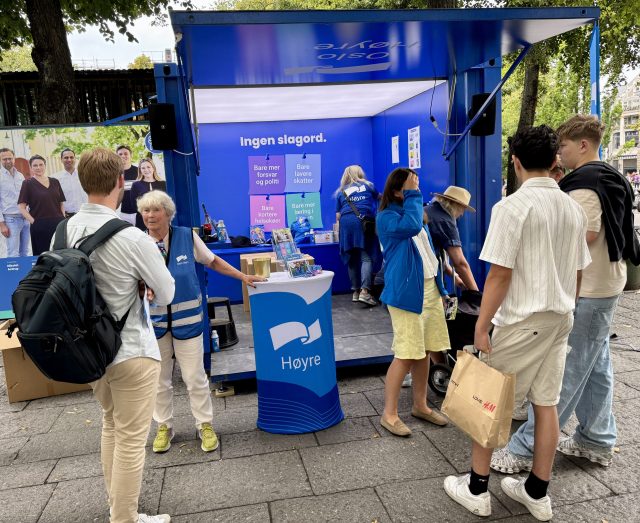 Norway’s Conservative Party (Høyre, literally “Right”) has attracted much more campaign funding prior to the Parliamentary election on September 8, as have other parties on the conservative side of Norwegian politics. Most of it has come from wealthy Norwegians seeking tax cuts. PHOTO: NewsinEnglish.no/Morten Møst
Never before have the parties raked in so much campaign funding, even when they arguably didn’t need it. Norway’s state statistics bureau SSB (Statistics Norway) reported in August that the parties reported a collective surplus of NOK 274 million last year, because of unusually large donations even in a non-election year. The parties reported donations totalling NOK 127 million in 2024, 87 percent higher than in 2022, the previous non-election year.
Most of them thus launched into the Parliamentary election year of 2025 with fairly full bank accounts as campaign spending began in earnest. Money continued to pour in, especially to the conservative Progress Party (Fremskrittspartiet, Frp) and, surprisingly, several of Norway’s small parties on the conservative side of Norwegian politics.
The Christian Democrats, for example, had received an astonishing NOK 9.6 million by mid-August, fully 9.2 million of it from business owners and investors, and only around NOK 400,000 from party members. The small Liberal Party (Venstre), also on the conservative side, received much more than usual, too, as did the Conservative Party (Høyre) itself.
The main reason: Wealthy Norwegians want to get rid of, or at least cut, Norway’s longstanding tax on net worth known as formueskatt (literally “fortune tax.”) Industrialist Christen Sveaas has been among the most generous campaign donors, handing out million- and multi-million gifts to the parties he views as most likely to cut or eliminate the wealth tax that’s often blamed for sending many wealthy Norwegians into tax exile in Switzerland.
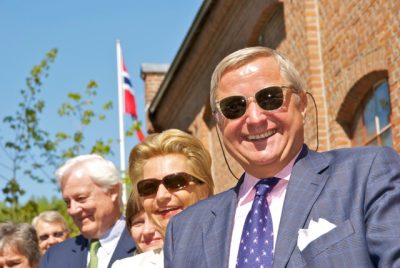 Investor and philanthropist Christen Sveaas, shown here at an exhibition opening at the Kistefos Museum he founded, has been among the most active campaign donors this year. His company Kistefos has itself also funded full-page newspaper ads urging voters to cast ballots for the conservative parties “and don’t let (Labour’s incumbent Prime Minister Jonas Gahr) Støre, the Socialist Left party and communists in the Reds decide for you.” PHOTO: NewsinEnglish.no/Morten Møst
“I think the Progress Party is the most business-friendly party,” Sveaas recently wrote in a message to newspaper Dagens Næringsliv (DN). He said he’s trying to fend off a “frightening scenario” in which “the socialists (Labour and SV) form a majority with the communists in the Reds.” Sveaas donated NOK 10 million (USD 1 million) to Progress last year and more this year, on top of giving NOK 5 million to the Conservatives and NOK 2 million each to the Liberals and the Christian Democrats.
Sveaas’ large donations to the Christian Democrats have attracted special attention, since the party otherwise is known for conservative “family values” and even wants to prohibit Pride flags from flying at public schools in Norway. Sveaas, who is gay, has long flown Pride flags from his office building at Aker Brygge in Oslo and doesn’t seem to agree with many of the Christian Democrats’ standpoints, except when it comes to taxation and wealth.
His large investments in Norway’s conservative parties (an estimated NOK 19 million by mid-August) may not pay off, since Labour once again seemed to have the upperhand in the latest polls taken just before Monday’s election. He’s far from alone, though, in donating heavily to parties in favour of lower taxes: Investor and former grocery chain founder Stein Erik Hagen, the investor and billionaire Øystein Stray Spetalen and shipowners Knut Ugland and Herbjørn Hansson are also among big donors on the conservative side, raising some concerns of “money-power vs. people power” in campaign financing. Most all point out, though, that Labour has long received millions from the trade union confederations and left-wing causes, with the investors and business owners simply trying to counter that.
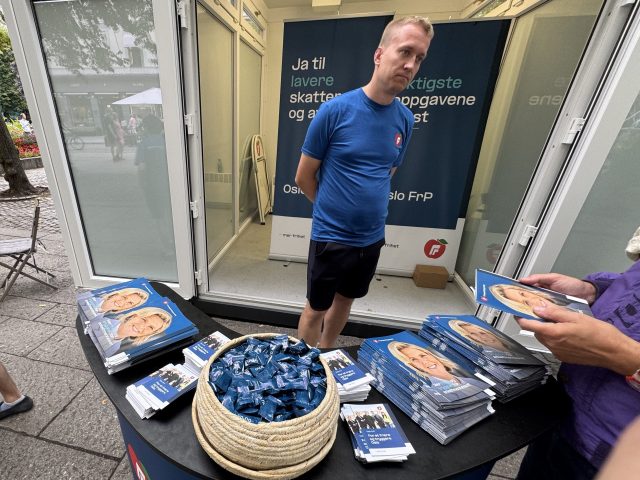 There have been plenty of donations this year to finance, for example, all the brochures, candy and other expenses to boost the campaign of Norway’s biggest right-wing party, Progress, and its leader Sylvi Listhaug. It’s major motto has been “‘Yes’ to lower taxes and fees.” PHOTO: NewsinEnglish.no/Morten Møst
The biggest concern this year, meanwhile, has been the sharp rise in anonymous donations that “can threaten democracy, also here in Norway,” according to Trygve Svensson, leader of the left-leaning think tank Agenda. There were howls of protests last spring when the small “Peace and fairness” party FOR suddenly blanketed public transportation in Oslo with their ads, ad intitially wouldn’t say where the money for them all came from. There were also lots of full-page ads in local newspapers from a group claiming to seek a non-socialist victory in the upcoming election, but it wouldn’t say where the group’s money was coming from either.
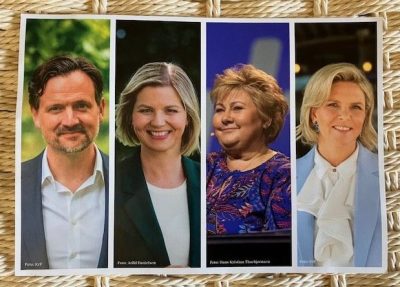 Cards showing the leaders of four of Norway’s non-socialist parties were dropped into 380,000 residential postboxes last week, urging voters to “vote tactically” for Krf and Venstre to boost chances for a new non-socialist government coalition …
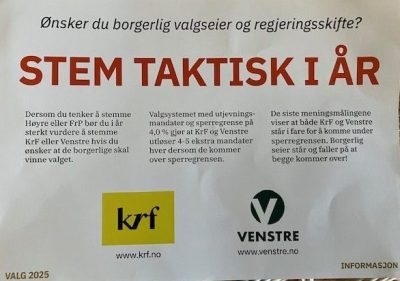 … but the parties themselves had nothing to do with the mass distribution. They were not pleased. FACSIMILE: NewsinEnglish.no
Just last week, hundreds of thousands of homes around Norway received cards in their postboxes urging them to vote “tactically” for the small Liberal- and Christian Democrats parties, in order to boost chances for a new Conservative majority in Parliament and a new government. Not even the Liberals or Christian Democrats, though, knew where the money came from for the anonymous last-minute campaigning on their behalf, and they didn’t welcome it: “We have not been informed about it and don’t known who’s behind it,” Ingunn Ulfsten, secretary general of the Christian Democrats, told newspaper Dagsavisen.
The cards looked like the parties were indeed behind it, featuring their logos and website addresses. “This can lead to distribution of wrong information and weaken our democracy,” said Ulfsten, adding that those sending out the cards “used our logo without permission.”
Grunde Almeland of the Liberal Party was also critical, claiming that “someone claiming to be us, or sending out information to either support or weaken us, is not acceptable. The Norwegian postal service Posten said a total of 380,000 cards were sent out but claimed it couldn’t reveal who paid for the distribution that cost around NOK 500,000.
This year’s election campaign has also been tarnished by some abusive ads sent out via “troll” accounts on social media. They’ve mocked some party leaders, called them “liars” and worse, but are also difficult to control. Norway’s national security authority NSM has had what newspaper DN called a “dialogue” with Facebook owner Meta, which has refused to answer questions from DN itself and other media. NSM has long sent out warnings regarding foreign efforts to influence Norway’s election.
DN and other newspapers have editorialized against all the anonymous election donors and creepy campaigning. Dagsavisen has called for more openness regarding financial gifts to political parties. A new law forbids political parties from accepting economic support from anonymous or foreign donors, but it didn’t take effect until July 1. Only the Progress Party voted against the new law in Parliament.
NewsinEnglish.no/Nina Berglund