
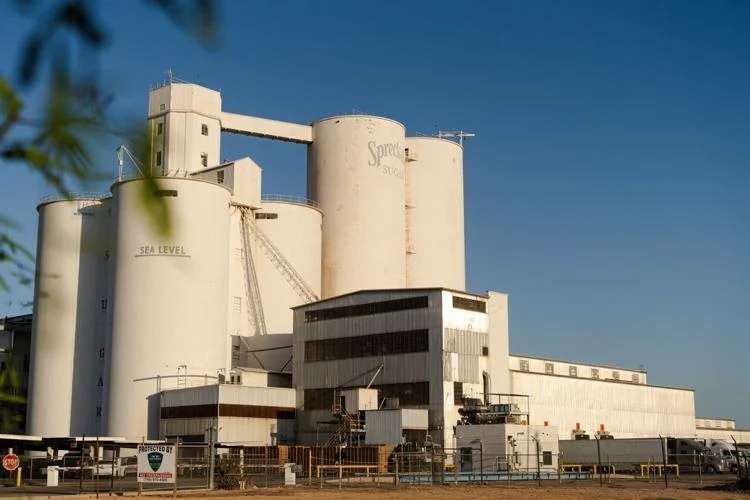
EL CENTRO — Imperial County leaders declared a state of economic emergency Tuesday, Sept. 9, in response to the closure of the Spreckels Sugar Co. plant, warning of severe impacts to the region’s farmers, workforce and tax base.
Board of Supervisors Chairperson John Hawk opened the press conference by describing the role agriculture plays in the county, saying their “harvest acres make up an industry that produces in excess of $2.5 billion in crop value.” He added that residents spend “countless hours braving some of the most brutal weather conditions to make sure that we bring food to the tables of the people around the world.
“For over 75 years, the facility known as Spreckels Sugar Co. has produced locally owned sugar beets, and has processed locally owned sugar beets into food-grade sugar,” Hawk said. “The sugar industry is unique in our region in that we not only grow raw products, but process it into a finished product. Ultimately, our 25,000-plus acres of locally grown sugar beets and finished-grade sugar become the soft drinks we consume and the candy and cakes that we enjoy.”
In April, the Southern Minnesota Beet Sugar Cooperative, which owns and operates the facility, announced it would close at the end of the processing year and move operations to Minnesota. Hawk said that decision was “devastating to local farmers and hundreds of families that rely on the wages they earn to feed their families.”
“The thing that I lose sleep over is when I think of the fact that there may be 400 to 500 families that will not have a job come next March,” Hawk said. “That hurts. That hurts all of us. That hurts our economy.”
County staff reported the plant directly employed 249 full-time equivalent workers, supporting more than 700 jobs when farming and processing were included. Its closure is expected to result in the loss of $16.7 million in annual payroll and more than $28 million in wage and operations-related activity.
 Imperial County Board of Supervisors Chairman John Hawk and Supervisor Peggy Price during the Sept. 9 press conference where the board adopted a resolution declaring a state of economic emergency after the closure of the Spreckels Sugar plant. | VIDEO CAPTURE
Economist Michael Bracken calculated the wider effects for the county, Hawk said, with more than 430 direct jobs lost, more than 700 total jobs affected, $35 million in lost wages to local residents, and $242 million in annual economic impact.
“This money is used to pay for mortgages or rent, transportation, health insurance and food,” Hawk said. “Overall, the annual economic impact to our region of sugar beets and processing is $242 million, a huge loss for our economy.”
Hawk said the Board of Supervisors acted Tuesday to call for “state and federal government, along with farmers, labor and community groups to work together to provide the necessary resources for folks to seek new employment opportunities and recover from this economic devastation.”
He also called on national leaders to increase domestic sugar production and provide an allocation of tariff rate quota to Imperial County.
“We call upon Congress to increase the level of domestically produced sugar and to provide a safe allocation of sugar, also known as the tariff rate quota, to Imperial County so that our farmers can work cooperatively to put back into production the sugar beet process,” Hawk said.
Frank Ruiz, district director for Rep. Dr. Raul Ruiz, told the crowd that the Congressman “stands in solidarity with you all, especially with the affected workers, growers and their families, local businesses, and supply chain impacted by the closure of the Spreckels Sugar Facility.”
He said Dr. Ruiz had met with union leaders, growers and USDA officials, pressing the cooperative to sell the facility locally. “While the outcome was not what we hoped for, he continues to fight for solutions that support workers and keep our agricultural economy strong,” Ruiz said.
He also said the Congressman worked with the county to organize a job and resources fair that brought “job trainings, apprenticeships, health and social services, all under one roof.”
Ruiz added, “His commitment is clear. Congressman Ruiz deeply cares about this community and will continue working alongside partners at the local, state, and federal levels to ensure that workers can keep earning, growers can keep planting, and the Imperial Valley not only recovers from this crisis, but thrives in a sustainable way.”
Guillermo Hernandez, district representative for state Sen. Steve Padilla, said Padilla had voiced concerns early in the process, writing letters to the cooperative and to the Sugar Beet Growers Association.
“Decisions made hundreds of miles away have real consequences here at home,” Hernandez said.
He emphasized the local roots of agriculture, saying, “Imperial County is built on the strength of its people. Agriculture is not only what we do, but it’s who we are. Every field and every harvest carries a weight of families. Parents working sun up to sundown, children depending on that paycheck, and grandparents whose entire lives are rooted in this land. That is what this fight is about.”
Hernandez recognized United Food and Commercial Workers Local 135, saying, “Their voice, their courage, and their advocacy made sure this did not go unseen. We stand with them and we thank them.”
He offered the senator’s office as a resource for unemployment claims and access to state programs, and closed by saying, “Imperial County matters. Our work matters. Our voices deserve to be heard at and respected at the highest levels of government.”
Tommy Lawton, a field representative for California Sen. Adam Schiff, said the closure “continues to send seismic waves throughout Imperial County.”
“Losing such a vital economic hub in Brawley is not just hundreds of millions of dollars in lost wealth for this community,” Lawton said. “It is the individuals, the workers, the community that will directly suffer, the hundreds that worked at this facility, and the many more who have had their own livelihood supported in some way by this cornerstone of the Imperial Valley.”
Assemblymember Jeff Gonzalez, who could not attend in person, sent a video message from Sacramento. “This industry is not just about crops,” Gonzalez said. “It’s about jobs, stability, stability for our families, and the future of our local economy. With unemployment in our county already over 20 percent, we simply cannot afford to lose another cornerstone of our agricultural base.”
He added, “California hasn’t always made it easy to do business, but here in Imperial County, agriculture is our backbone, and our beets remain a vital part of that story.”
Alex Cardenas of the Imperial Irrigation District said one in six jobs in the county comes from agriculture, a $2.5 billion industry. He said sugar beets have consistently ranked in the county’s top five crops, and in 2024 ranked in the top three.
“You can grow 50 tons of sugar beet per acre. There’s nowhere else in the country that you can grow 50 tons of sugar beets per acre,” Cardenas said. “Traditionally, you’re seeing 20 and 30 tons across the country. Here in Imperial Valley, you can grow up to 50 tons. So this is something that’s important for our community and something that we do need to take a stand.”
Cardenas supported pursuing a California sugar quota, saying it could help “bring back this industry.” He also suggested creating a new co-op to jumpstart local processing.
He highlighted the impact on truckers, saying, “3,000 acres of sugar beets probably represents about a $2 million to $4 million trucking industry. Those truckers right now are really concerned, and their future is uncertain because of this unfortunate circumstance.”
See also

Cardenas said the Imperial Irrigation District could help with competitive energy rates and potential public-private partnerships to attract processing facilities. “Obviously the next step is finding an offtaker for that sugar, and there’s plenty,” he said. “There’s a line that runs out this door for folks who want to put sugar back in some of these products.”
Javier Nuñez, a third-generation laborer, said the closure struck at the community’s identity. “I stand here before you not just as a laborer, but as a father, a neighbor whose community is hurting,” Nuñez said.
“For decades, sugar beets have been more than a crop. They’ve been a way of life, supporting families, schools, and local businesses,” he said. “Now, with the closure of the Spreckels Sugar plant in Brawley, the way of life is disappearing. Hundreds of jobs are gone, and the entire industry worth of millions to our economy is gone.”
He described the loss for farmers: “Without the processing plant, our sugar beets are worthless. Imagine putting months of work, money, sweat into the ground, only to see there’s no future to your crop. That’s the reality for farmers, and all jobs lost that we face today.
“We need support, new allocations, and investments to create opportunities so farmers can keep farming and families can keep working,” Nuñez said.
Shelby Trimm, executive director of the California Beet Growers Association, said she wanted to focus on action.
“The closure of Spreckels, as we know, is incredibly devastating to the Imperial Valley. You’ve heard about the negative impacts today, but I’m not here to reflect on loss. I’m here to call to action,” Trimm said.
She urged for “emergency resources, target investments, and policy flexibility” from local, state and federal partners. Trimm also introduced Jason Taylor, a fourth-generation grower from Brawley, noting he had recently set a world record for extractable sugar.
“Our county is continuously producing the best, most efficient sugar, and I think that’s really something worth protecting,” she said.
Taylor said he was speaking on behalf of other farmers and employees.
“I want to make sure that they keep working, and it hurts for me to think about laying people off, and that’s where I think a lot of us are, and we don’t want to be there,” Taylor said. “All I came to ask is everything that we ask for — exhaust all options, all options to keep this industry going. I mean, no one does it better in the world than right here with sugar.”
Supervisor Peggy Price, whose district includes the Spreckels plant, read the resolution declaring the state of economic emergency. It cited the loss of 249 direct jobs, $16.7 million in payroll, $28 million in annual economic activity, more than 23,000 acres of production valued at $57.21 million annually, and $549,000 in property tax revenue, of which $127,000 went directly to county services.
“The closure represents a sudden and severe economic disruption threatening the stability of Imperial County’s agricultural economy, workforce, and tax base,” the resolution stated.
The resolution was passed unanimously by roll call vote and signed Sept. 9, 2025.