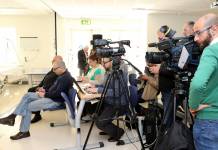
 Photo by Miguela Xuereb
Tista’ taqra bil-
Malti.
Malta has been singled out in a scathing Commonwealth report documenting the erosion of press freedom across member states, with the country identified as having the highest number of strategic lawsuits against journalists per capita in the European Union and facing serious allegations of spyware targeting.
The comprehensive study, “Who Controls the Narrative? Legal Restrictions on Freedom of Expression in the Commonwealth,” published by the Commonwealth Human Rights Initiative, Commonwealth Journalists Association, and Commonwealth Lawyers Association, presents Malta as an emblematic case of how democratic nations can systematically undermine media freedom whlle maintaining legal facades.
The report notes that while constitutions often guarantee expression, outdated colonial-era laws such as criminal defamation, sedition and blasphemy continue to undermine that right. Their vague wording enables governments to weaponise them against critics, with a chilling effect on journalism and civil society.
The report also highlights widespread misuse of civil defamation laws through SLAPPs, noting that the UK and Malta have been notorious hubs for such cases. Beyond legal threats, physical violence, intimidation and digital harassment against journalists remain endemic, with alarmingly high levels of impunity for attacks. The rise of restrictive digital laws and internet shutdowns further erodes information freedom, particularly in countries like India.
The report reveals that Malta “reportedly had the highest number of SLAPP cases per capita in the European Union,” referring to Strategic Lawsuits Against Public Participation designed to silence journalists through financial exhaustion.
These abusive lawsuits represent what the report calls “woefully inadequate” protections across Commonwealth jurisdictions, with Malta serving as a prime example of how legal systems can be weaponised against press freedom.
Perhaps most alarmingly, the document confirms that journalists in Malta have been targeted by sophisticated spyware tools including Pegasus and Predator, revelations that place the country alongside authoritarian regimes in terms of digital surveillance against media professionals.
The report directly links these attacks to the broader context of media intimidation following the 2017 assassination of investigative journalist Daphne Caruana Galizia.

While acknowledging Malta’s positive step of decriminalising defamation in 2018, the report notes that sedition remains a criminal offence punishable by up to four years imprisonment.
The Maltese Criminal Code still contains provisions allowing authorities to restrict “seditious matter,” whilst blasphemous expressions remain contraventions despite broader blasphemy decriminalisation in 2016.
The Commonwealth report arrives amid mounting evidence of Malta’s systematic failure to implement press freedom reforms promised following the Daphne Caruana Galizia public inquiry.
Last month, the Daphne Caruana Galizia Foundation delivered a devastating assessment concluding that “four years on, almost nothing has changed” since the inquiry’s damning recommendations.
The foundation’s analysis reveals that critical anti-corruption measures including Unexplained Wealth Orders remain unimplemented, whilst high-profile cases involving Mozura, Pilatus Bank, and Vitals/Steward Health Care have seen limited successful prosecutions. The government’s anti-SLAPP legislation was implemented via Legal Notice rather than parliamentary process, bypassing public consultation whilst ignoring EU and Council of Europe recommendations.
Earlier this month, a separate OSCE report exposed Malta’s failure to adequately protect human rights defenders, documenting “concerning instances of disparaging rhetoric and intimidation tactics used by political actors against activists and journalists.”
The OSCE assessment revealed that comprehensive legislative reform promised after the Caruana Galizia inquiry remains unimplemented, leaving Malta’s media landscape vulnerable to the same threats that culminated in Europe’s first journalist assassination in over a decade.
The Commonwealth report particularly criticises Malta’s media ownership structure, noting that political parties are legally permitted to own outlets, with one journalist describing the main parties’ media as “nothing short of propaganda tools.”
Freedom of Information Act abuses are highlighted, with the report stating Malta received a “high-risk score of 77% for the right to information” due to systematic delays and obstructionism.
The international pressure reflects broader concerns about Malta’s democratic trajectory. Between 2006 and 2023, 213 journalists were killed across Commonwealth countries with a 96% impunity rate. Malta’s inclusion in this grim statistic through Daphne Caruana Galizia’s assassination has become symbolic of the Commonwealth’s broader press freedom crisis.
The Commonwealth Principles on Freedom of Expression, adopted in October 2024, now provide what the report calls a “practical and actionable framework” for reform.
Its key recommendations include repealing or reforming restrictive laws, strengthening judicial independence, tackling impunity, safeguarding digital rights, and ensuring a safe environment for journalists and activists. It concludes that only through genuine reform and political will can the Commonwealth live up to its stated values of democracy, openness and accountability.
However, Malta’s track record suggests implementation will require sustained international pressure and genuine political commitment to reverse what critics describe as systematic attacks on democratic accountability.