
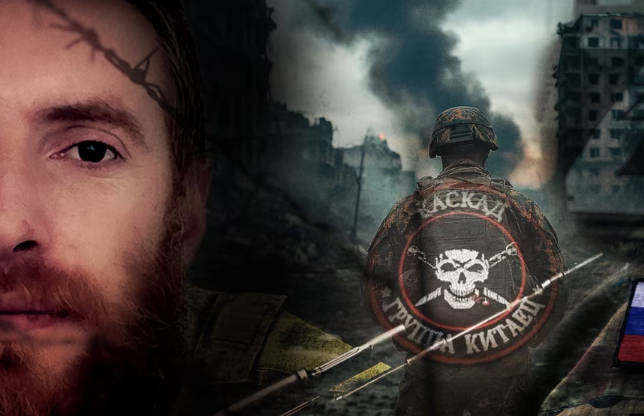
Recruited via Telegram: The Testimony of a Macedonian Who Fought in Ukraine

Express newspaper
11/09/2025 13:07
Ljupco Bojcevski, 37, from Skopje, is the only prisoner in North Macedonia convicted of “participation in a foreign army.”
He fought on the Russian side in the war in Ukraine.
He was sentenced to four years in prison, while the decision of the Criminal Court of North Macedonia states that he repented for the crime.
The Macedonian law banning citizens from participating in foreign armies was passed in 2014 to prevent them from going to conflicts in the Middle East.
So far, only people who joined the militant group, the Islamic State (ISIS), have been convicted.
Bojchevski is the first person in North Macedonia to be convicted for participating in the war in Ukraine, which began with its invasion by Russia in February 2022.
Despite Radio Free Europe’s request, authorities in North Macedonia did not provide accurate data on the number of citizens who have participated or continue to participate in the war in Ukraine.
However, REL managed to obtain information about another confirmed case, which ended with a suspended sentence rather than imprisonment.
The institutions deny that there were organized recruitments from North Macedonia, saying that these are individual cases that have come with help from abroad, via the internet.
Since the beginning of the conflict, Skopje has called the Russian attack a violation of Ukraine’s sovereignty and has joined international sanctions against Moscow.
The road to Mariupol
Boychevski was convicted on May 13, 2025, of participating in a foreign war, after being recruited through a closed Russian group on the Telegram app.
At trial, he admitted guilt and expressed remorse for the crime.
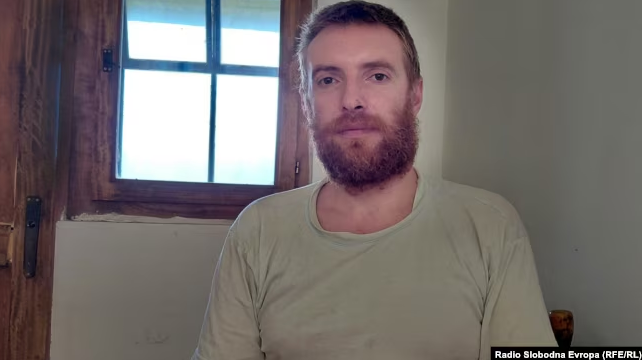
Boychevski tells Radio Free Europe that he had long followed developments in Ukraine through online channels and that he had applied to go there as early as 2021.
Two years later, a Russian recruiter offered him the opportunity to join as a soldier.
He traveled from Skopje to Belgrade, then to Istanbul and Moscow.
According to the court file, on September 18, 2023, he left North Macedonia and five days later signed a contract for military service.
He says that all the arrangements – tickets, hotel and transfer to Mariupol – were made by the recruiter known as “Musa”, whom he describes as a member of the Russian Federal Security Service (FSB).
Boychevski says that “Musa” passed through many checkpoints all the way to Mariupol without documents.
REL, however, was unable to verify these claims.
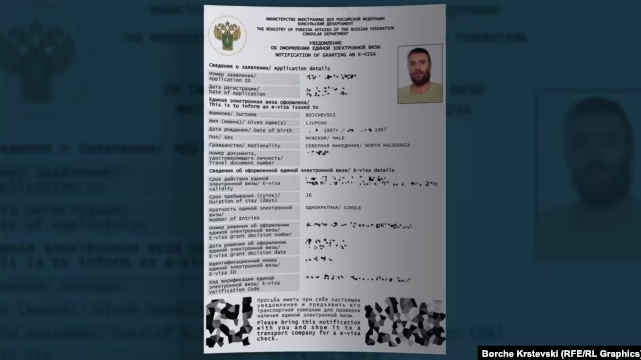
His court file also includes a Russian electronic visa from 2023, which would have allowed him to enter Russian territory.
Boychevski was not alone.
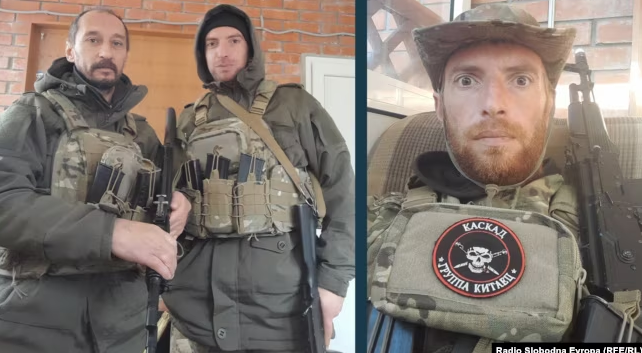
Bojčevski did not go to war alone. His friend from Skopje, Toni Šegmanovski, was also with him.
The court case used 57 photos as evidence, taken from Bojchevski’s phone.
One shows the wounded Shegmanovski, while two masked men stand over him.
Bojchevski tells REL that one of them was himself.
Shegmanovski died without facing justice.
He did not lose his life at the front, but was found dead after his return, in an abandoned house in the Aerodrom neighborhood of Skopje.
The event was recorded in the police bulletin on January 10, 2024.
According to the Macedonian Prosecutor’s Office, it is not a violent death, but the details of the autopsy have not been made public.
After this “mysterious death,” data was found on Shegmanovski’s personal devices and phone that also linked him to Bojchevski – which prompted the start of investigations against him.
Accelerated training and immediately on the front line
Key evidence was the contract found during the raid on Boychevski’s house, linked to the Ministry of Internal Affairs of the self-proclaimed “Donetsk People’s Republic.”
The contract provided for one-year military service, starting on September 23, 2023, with a three-month probationary period.
According to her, Bojchevski was supposed to be trained as a shooter’s assistant.
He fought on the Russian side for, as he says, his personal beliefs, “for the brotherly people.”
Bojcevski says he would receive 3.000 euros per month, although the contract does not mention specific figures.
“I went through accelerated training and we were immediately sent to the front,” he says.
Applied for Wagner, ended up at Kaskad
Items such as camouflage hats with symbols of the Kaskad formation and the inscription “Chinese Group” were found in Bojchevski’s house.
According to public data, Kaskad is a Russian operational-combat formation in the Donetsk region, which is occupied by the Russian army.
Bojchevski says he was stationed there, even though he had initially applied to be part of the Wagner group.
Together with Shegmanovski, they were the only Macedonians.
According to him, they did not want to accept other fighters from North Macedonia.
“It’s hard to publicly reveal what I saw. I saw psychopathic colleagues doing terrible things. Truly grave and unnecessary atrocities,” says Bojchevski.
Although the contract was for one year, the two Macedonians only stayed there for three months.
His contract was terminated after several medical examinations, where it was discovered that Bojchevski was suffering from thrombosis in his legs and swollen lymph nodes.
The contract was terminated on December 23, 2023, and he returned to North Macedonia along with Shegmanovski.
Second case: Suspended sentence
In addition to Bojchevski, another Macedonian citizen was given a suspended sentence for attempting to participate in the war on the side of Russia.
It concerns a young man from Kavadarci, who was temporarily working in Croatia.
He traveled to Russia, but after a few days he returned and requested assistance from the Ministry of Foreign Affairs of North Macedonia.
The court approved a deal with the prosecution and imposed a two-year suspended sentence.
Radio Free Europe contacted his lawyer, but he did not want to speak publicly.
According to sources from the investigation, the young man stated that he was manipulated and thought he was going to work on a platform.
When he realized what was happening, he immediately sought help from the Ministry of Foreign Affairs, which helped him return to North Macedonia.
Upon arriving at Skopje Airport, he was met by the police and arrested.
The ministry confirmed that, at the request of the family, it had mediated for the return of the Macedonian citizen.
Since the beginning of the Russian invasion of Ukraine, the Ministry of Foreign Affairs of North Macedonia warned that participation in war abroad on any side is a criminal offense, and called on Macedonian citizens not to get involved in it.
Was there organized recruitment?
The Prosecutor’s Office for the Prosecution of Organized Crime and Corruption says that they have no cases of organizers recruiting fighters for the war in Ukraine.
“This is an international crime and recruitment is carried out through social networks and applications,” the prosecutor’s office told Radio Free Europe.
Three and a half years after the start of the Russian invasion, the coordinator of the National Committee for the Prevention of Violent Extremism and the Fight against Terrorism in North Macedonia, Pavle Trajanov, admits that there has been interest from some individuals, even from the Macedonian army’s special forces unit “Wolf”, but adds that no one has gone in an organized manner.
“We have no information… However, we are following the situation and cooperating with the European Union and the Balkan countries,” says Trajanov.
The networks Russia uses to recruit its citizens for war
The North Macedonian Ministry of Interior, specifically the Office for Public Security, which is responsible for acts related to terrorism and the return of fighters from the front, told Radio Free Europe that, so far, no organized method of recruiting and sending people to the war front in Ukraine has been discovered.
According to the Public Safety Office, two cases have been detected, but they are isolated and individual.
“In these cases, the participants themselves agreed on the conditions of their trip, through social networks,” the response states.
A month after Radio Free Europe asked about Macedonian citizens who have taken part or are taking part in the war in Ukraine, the Ministry of Foreign Affairs responded curtly that it has no information. /REL/