
This week’s second annual AI Horizons summit brought together academics, politicians, and leaders from storied Pittsburgh institutions and upstart startups.
“We have to combine the forces and the resources of our old and new leaders in energy industry and AI to all row in the same direction,” said Joanna Doven, executive director of AI Strike Team, which hosted the gathering. “Now is the time to radically merge.”
The two-day event unfolded at Bakery Square, the anchor for a stretch of Penn Avenue that is home to more than a dozen technology and AI companies including Google and the Pittsburgh-based Duolingo. Developers and AI enthusiasts have termed the mile-long corridor “AI Avenue.”
It was the second AI-related summit held in Pittsburgh in as many months; U.S. Sen. Dave McCormick’s inaugural Pennsylvania Energy and Innovation Summit debuted at Carnegie Mellon University in July with high-profile guests including President Donald Trump. That event touted roughly $90 billion worth of energy- and AI-related investment in the state (though a sizable chunk of that spending was already in place).
This week’s AI Horizons summit seemingly sought to forge more immediate connections between the companies, venture capitalists, and researchers in attendance, albeit at a smaller scale. On Thursday, BNY and CMU jointly announced the financial services company will invest $10 million in an AI lab at the university over the next five years.
The investment aims to “make sure that we are going to be at the very forefront of the research of how AI can apply to our firm and our industry,” said BNY CEO Robin Vince.
“Artificial Intelligence has emerged as one of the single most important intellectual developments of our time, and it is rapidly expanding into every sector of our economy,” CMU president Farnam Jahanian said in a statement. “Carnegie Mellon University is thrilled to collaborate with BNY — a global financial services powerhouse — to responsibly develop and scale emerging AI technologies and democratize their impact for the benefit of industry and society at large.”
And speakers said western Pennsylvania is well positioned to facilitate the AI boom, thanks to the expertise and skilled labor force being created by local universities including CMU and the University of Pittsburgh. The region’s industrial history and proximity to open land and natural resources needed for massive AI data centers could also help.
“Power and the ability to consume it is going to be one of the biggest challenges we face” when expanding the use of AI, said Toby Rice, president and CEO of EQT Corporation, the largest natural gas producer in the U.S.
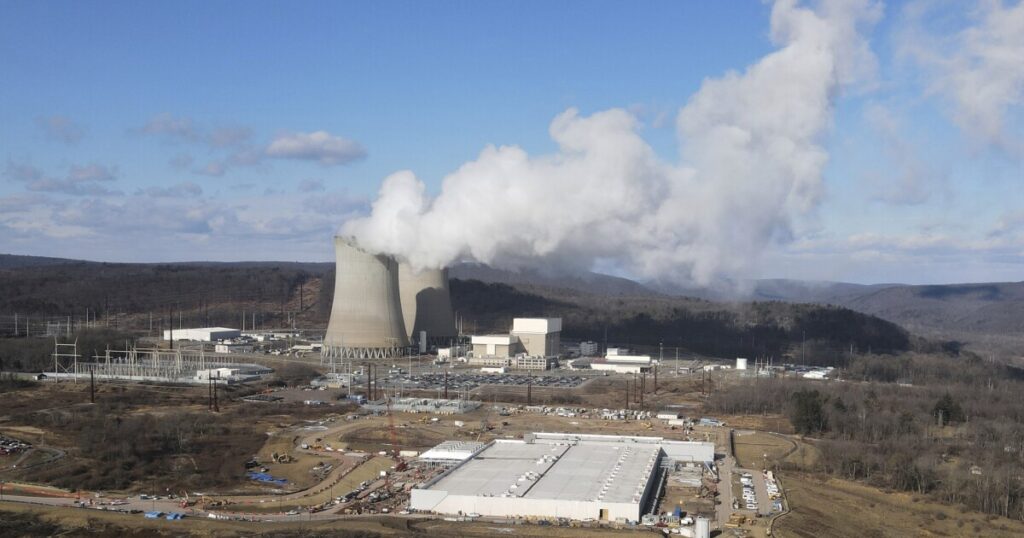
Data centers have, as one speaker put it, an “insatiable appetite for energy,” and need vast amounts of power both to run the computers and to keep them cool.
A recent analysis from the federal Energy Information Administration predicts electricity used for commercial computing will increase faster than any other use in buildings over the next 25 years, sparking fears that the added stress on the power grid could spike rates for everyday Pennsylvanians.
“The only way to keep those prices down,” said Republican state Sen. Devlin Robinson, “is to open up the gas fields, make sure that the nuclear power plants are online, make sure that we’re cultivating the renewable energy so that we have a full grid that is able to sustain all of the energy needs of the Commonwealth and especially the region where these data centers are gonna go up.”
Democratic state Senate leader Jay Costa too encouraged an “all-of-the-above approach” to energy generation, but cautioned that “ the costs cannot be solely borne by the ratepayers.
“We have to have some balance and some guardrails in place” to protect consumers, he said.
But the focus on natural gas at the summit drew criticism from local environmental groups who decried the absence of robust discussion about renewable energy like solar and wind.
The Clean Air Council’s Larisa Mednis said reliance on fossil fuels contributes to worsening climate change.
“If this technology and AI is a sign of progress or a sign of innovation, why are we relying on antiquated forms of energy use … that we know are not serving people and are not going to help sustain the planet?” Mednis asked.
Critics say investments in gas-powered data centers rarely generate long-term economic or job growth.
“Data centers are very automated, highly capital-intensive projects that can soak up billion-dollar investments like a sponge and leave next to nothing for surrounding communities,” said Joanne Kilgour, executive director of the Appalachian think tank Ohio River Valley Institute.
The environmental costs of AI drew little discussion at the summit.
Many of the conversations mirrored those that took place at the July event. Indeed, the two events shared a number of speakers, including Sen. McCormick and Pennsylvania Governor Josh Shapiro, and similar talking points.
Shapiro once again touted the state as a leader in the “AI revolution,” likening it to previous technological upheavals like the agricultural and industrial revolutions.
“ We were the epicenter of growth and development and revolution because of the coal under our ground, because of the steel that we’ve made here, because of the ingenuity of our farmers,” he said. “This is the next chapter in our innovative growth as a commonwealth, which is gonna fuel growth in this country, fuel growth around the globe. And it happens because of AI.”
During a panel discussion with BNY CEO Vince and Westinghouse interim CEO Dan Sumner moderated by CMU president Jahanian, Shapiro said his administration will expand a generative AI pilot program for state employees launched in 2024.
“ I view AI not as a job replacer, but a job enhancer,” he said. “ We can streamline our processes and make things work more effectively.”
“ We can do big things with these tools, and we are showing how to deploy them in a responsible way,” he added.
Still, leaders in government and business need to take bigger swings to get ahead in the AI arms race, said U.S. Senator Dave McCormick. Pennsylvania isn’t just competing with neighboring states to attract data centers and AI companies, he said, but also with countries that are AI powerhouses in their own right, like China.
“We’re not gonna win with incrementalism,” he said. “This has to be disruptive. We’re gonna get disrupted one way or the other. The question is whether we’re gonna be the disruptor or the disruptee.”
AI is already changing the ways people do business, McCormick added, and the amount of money being poured into the industry far exceeds that which was spent on past innovations.
“This is not something that we’re gonna be able to slow down. It is something we can guide,” McCormick said.
He urged officials in both parties to accelerate AI and energy production, and establish Pennsylvania as a leader in the industries.
“ I think we have a good hand to play, but we don’t have a royal flush,” he said. “So we gotta … make the effort to improve the things that are lacking.”