
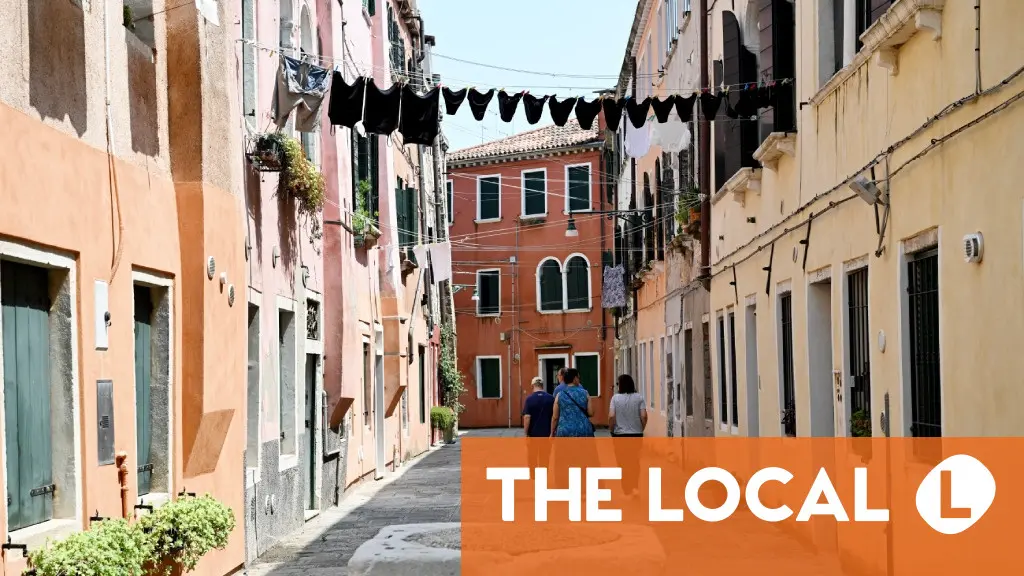
In this week’s Inside Italy review, we look at why mass tourism isn’t solely responsible for Venice’s population decline, as resident numbers hit a new record low.
Inside Italy is our weekly look at some of the news, talking points and gossip from Italy that you might not have heard about. It’s published each Saturday and members can receive it directly to their inbox, by going to their newsletter preferences or adding their email to the sign-up box in this article.
Venice made national headlines earlier this week after new figures revealed that its resident population had dropped below 48,000, hitting a new record low amid a decades-long decline.
“Happy extinction to everyone!” Venice-based activist group Venessia posted on its Facebook page alongside a screengrab of the latest figures.
“The worst is yet to come,” Venessia spokesperson Matteo Secchi told Il Gazzettino, warning that “at this rate, we’ll drop below 47,000 in a year and a half”.
Once the heart of a powerful maritime republic, Venice has lost more than 120,000 residents since the early 1950s.
Of those, over 30,000 left the city between 1975 and 1995.
Despite falling at a much slower pace since the mid-90s, resident numbers have continued to shrink in recent years, with the city currently counting fewer than 47,980 inhabitants.
Mass tourism has long been regarded as the main cause of Venice’s population decline, as the seemingly uncontrollable spread of holiday lets and tourist-oriented businesses continues to exacerbate a chronic lack of affordable housing and eye-watering living costs.
But is tourism solely responsible for the fall in resident numbers?
While there is irrefutable evidence that Venice’s housing crisis and high cost of living have pushed thousands of residents away from the city in recent decades, I believe that mass tourism is not the only problem.
As a born-and-bred Venetian currently living in Milan, Venice is a frequent topic of discussion in my conversations with family and friends back home.
Advertisement
And while my views on the city (and its administration) may not always match theirs, one of the very few things we can unfailingly agree on is that Venezia è ferma nel 900 – ‘Venice is stuck in the 1900s’.
From transport infrastructure to public services, present-day Venice is largely the same as it was before the turn of the century.
Granted, some things have changed in recent decades, including the construction of multi-billion-euro sea barriers designed to protect Venice from its famous high tides, but the city’s main features have overwhelmingly remained the same – and so have its flaws.
In particular, I would argue that transport and mobility issues continue to be one of, if not the, most significant challenge posed by life in Venice.
With its iconic vaporetti and floating stops, using the city’s public transport network can be an unforgettable experience in and of itself if you’re a visitor. But things are quite different if you’re a resident.
Depending on the exact starting point, commuters can take up to one and a half hours to travel from Venice’s historic centre to the Mestre mainland area – where the majority of offices and administrative buildings are located.
Advertisement
But the lack of a quick and efficient public transport network isn’t just a problem for people commuting to and from work.
Daily errands such as shopping for groceries or picking up a parcel are generally far more time-consuming in Venice than they would be in any other major city across the country, where land-based transport allows for much faster travel.
Plans to build an underwater metro network were first advanced in the mid-1950s as part of efforts to revolutionise city-wide transport. But the project has since been permanently scrapped due to practical construction challenges, as well as high costs.
Current plans to improve the city’s transport network involve the creation of additional water bus lines, as well as a higher journey frequency along some of the busiest routes.
These types of measures, however, are unlikely to meaningfully improve transport options for residents.
In fact, I would argue that anything other than a revolutionary project involving high-speed underground rail links would fall short of that goal.
Advertisement
An intricate maze of canals, bridges, squares and narrow alleyways is what makes Venice one of the most unique cities in the world.
But the same one-of-a-kind features have crystallised it in the past, making attempts to modernise its infrastructure harder than they would be elsewhere in the country.
Borrowing the title of a 1986 hit song by Gianna Nannini, Venice is bella e impossibile (‘beautiful and impossible’) – and that’s perhaps the main reason behind its timeless appeal.
Inside Italy is our weekly look at some of the news and talking points in Italy that you might not have heard about. It’s published each Saturday and members can receive it directly to their inbox by going to their newsletter preferences or adding their email to the sign-up box in this article.