
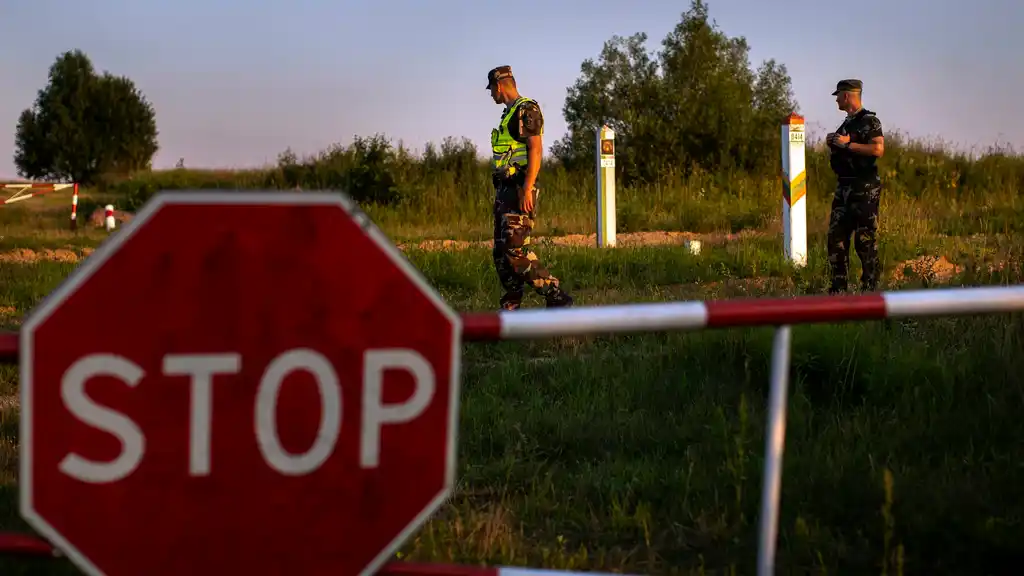
Officers of the State Border Guard Service of Lithuania patrol the border with Belarus near the village of Purvenai, Lithuania, on July 9, 2021. AP/Mindaugas Kulbis
In Belarus, joint Russian-Belarusian exercises “Zapad-2025” are under way, raising concerns in Lithuania and other Baltic states about possible escalation near Lithuanian borders. Lithuanian border guards warn of the risk of provocations, but assess the risk of a full-scale attack on Lithuania or NATO members as minimal. It is important to monitor developments, as the exercises place additional pressure on border lines and transport corridors.
According to a local broadcaster, Lithuania has not closed the Medininkai and Šalčininkai border checkpoints on the border with Belarus, but may impose restrictions if the situation escalates. At present, the situation is stable, and no provocations have been recorded.
Border Guards’ Position and Border Trends
The situation at the Lithuania-Belarus border has not changed. I can say that it is stable. On the section of the border on the Belarusian side, our staff record no activity. The border with Kaliningrad remains calm as well.
– Rustamas Liubaevas
After Poland temporarily closed its border, traffic through the Lithuania-Belarus direction did not increase. It is emphasized that flows of people from Belarus to Lithuania generally remain calm, and at the Šalčininkai checkpoint there is a slight decrease in the number of vehicles.
If we talk about flows of people arriving to the Republic of Lithuania from the Republic of Belarus, the overall situation is calm. There is even a slight decrease in the number of vehicles, especially at the Šalčininkai checkpoint
– Rustamas Liubaevas
The joint Russian-Belarusian exercises “Zapad-2025” began on September 12. According to the Lithuanian Armed Forces, about 30,000 service members are taking part in the exercises, and their aim is to demonstrate Western power and test the region’s readiness to respond to possible aggression. It is also known about the preparation and arrival of Russian units: on August 6, the first train with military equipment arrived, and the main stages are planned for September 12–16.
In terms of security, Lithuania has strengthened border protection with Belarus and Russia, as confirmed by the country’s border guard service. Such actions aim to reduce risks and support regional stability in the context of the exercises.