
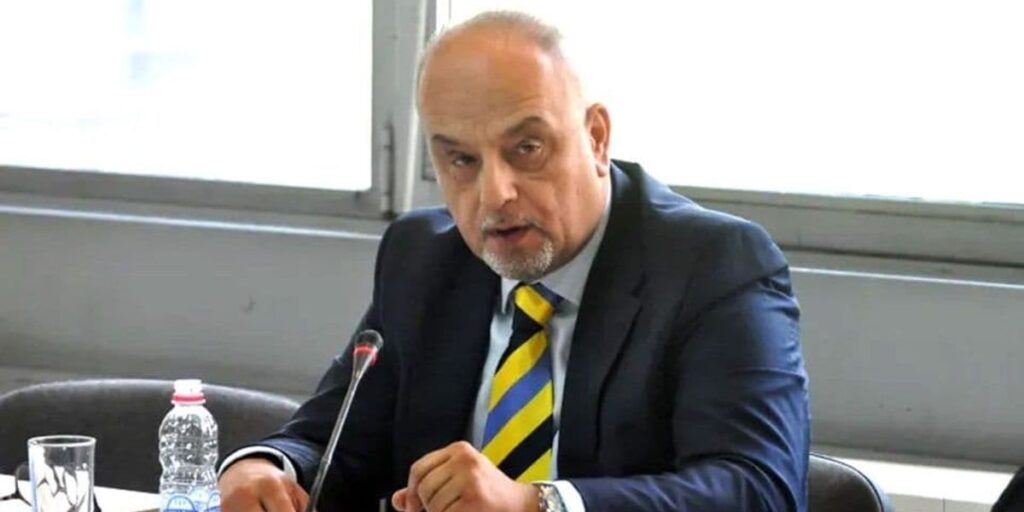
Ivan Videnović, a professor at the University of Belgrade, has stated that the grand Serbian-Russian project, the so-called “Serbian World”, remains a national frustration and a constant danger for Serbia’s neighboring states, Kosovo, Montenegro and Bosnia and Herzegovina.
Videnović has analyzed in detail the influence of the ideology of the “Serbian world” in Montenegro and the position of the Serbian opposition on the Kosovo issue, emphasizing the lack of commitment of Serbian political elites to reforms and European integration.
In an interview with the Montenegrin newspaper Pobjeda, Videnović says that one of the fundamental problems is that even parts of the opposition that claim to be pro-European, in fact hold irrational and anti-European positions, which are best manifested in the non-recognition of Kosovo’s independence.
He describes this as a rejection of the European Plan for Kosovo, which essentially means de facto recognition of its statehood.
“We also heard that the opposition that traveled to Strasbourg and Brussels also took with them its baggage of irrational and essentially anti-European positions: non-recognition of Kosovo, which is synonymous with rejection of the European Plan for Kosovo, which essentially means de facto recognition,” he says.
Regarding the “Serbian world”, Videnović emphasizes that its main representatives in Montenegro, such as Andrija Mandić and Milan Knežević, are already marginalized in Serbian public opinion and no longer represent a real power in the propaganda of the regime in Belgrade, unlike Milorad Dodik in Bosnia.
“The “Serbian world” project has lost ground also due to the decline in support for Aleksandar Vučić’s SNS (Serbian Progressive Party) and the ongoing protests of citizens in Serbia,” says the professor.
An important role in the efforts to influence Montenegro has also been played by the Serbian Orthodox Church (SPC), which, according to Videnović, has lost its previous influence after the death of Metropolitan Amfilohije.
“The current Metropolitan Joanikije, according to him, enjoys neither the authority nor the proper performance, which has led to the formal equalization of the Metropolis of Montenegro with other dioceses, diminishing its unique historical status.”
He also mentions the involvement of several church figures in low-level scandals, such as the case of the monument to Pavle Đurišić, which ended up hidden in a warehouse – a symbolic indicator of internal crisis and loss of direction.
Videnović calls this a key moment for the region, where Serbia must decide whether to follow a sincere path towards Europe, or remain hostage to nationalist myths, rejection of the reality of Kosovo, and failed hegemonic projects such as the “Serbian world.”