
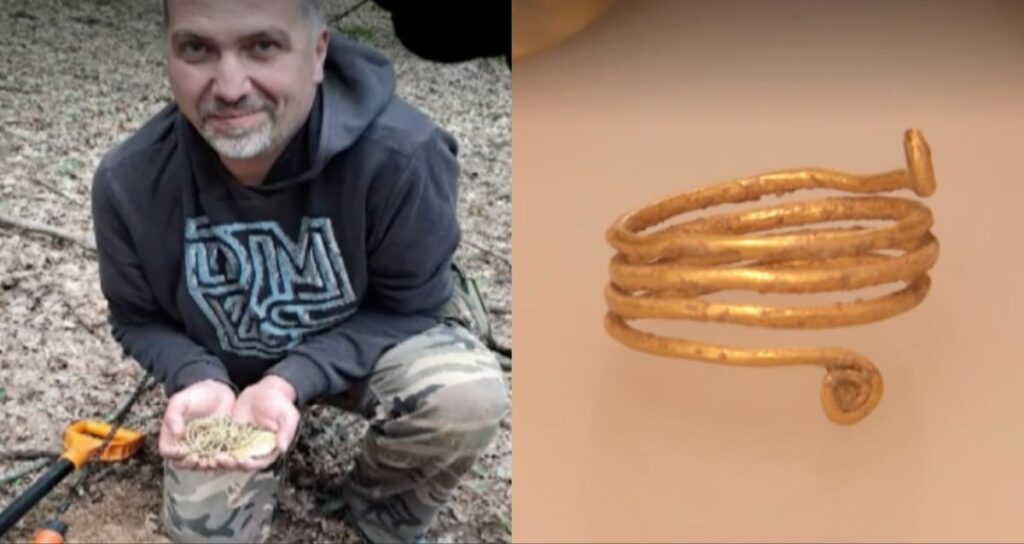
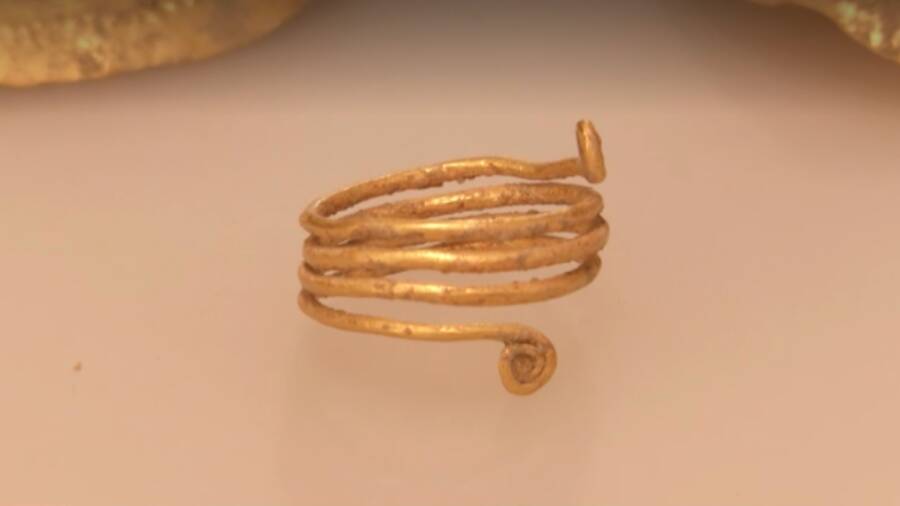
Știrile Pro-TVOne of the gold objects found by the metal detectorist.
While treasure-hunting in Cluj County, Romania, a metal detectorist stumbled upon a hoard of objects. To the delight of local historians, the metal detectorist had found more than 100 golden objects which are believed to date from the Bronze Age.
Shrouded in mystery, the objects are nevertheless a thrilling find. Historians called them “priceless [and] very, very important.”
The Hoard Of Bronze Age Objects In Romania
According to Romanian media, the Bronze Age objects were found completely by chance. They were detected by a treasure-hunter who happened to stumble across the hoard while out with their metal detector.

Știrile Pro-TVAn image used by Romanian media, seemingly of the metal detectorist and the hoard of gold objects.
The metal detectorist had found a hoard of 121 golden objects, which experts believe date to 1400-1200 B.C.E during the Bronze Age. The hoard was brought to the National Museum of Transylvania’s History, and historians and politicians have expressed awe at what the metal detectorist had found.
“The value is truly inestimable, considering both the age and the work itself,” Andras Demeter, Minister of Culture, remarked. “The national territory continues to present and show us such surprises.”
After examining the hoard, historians at the museum have come to believe that they’re mostly golden jewelry, largely what appears to be earrings. One of the most eye-catching objects is a golden spiral ring.
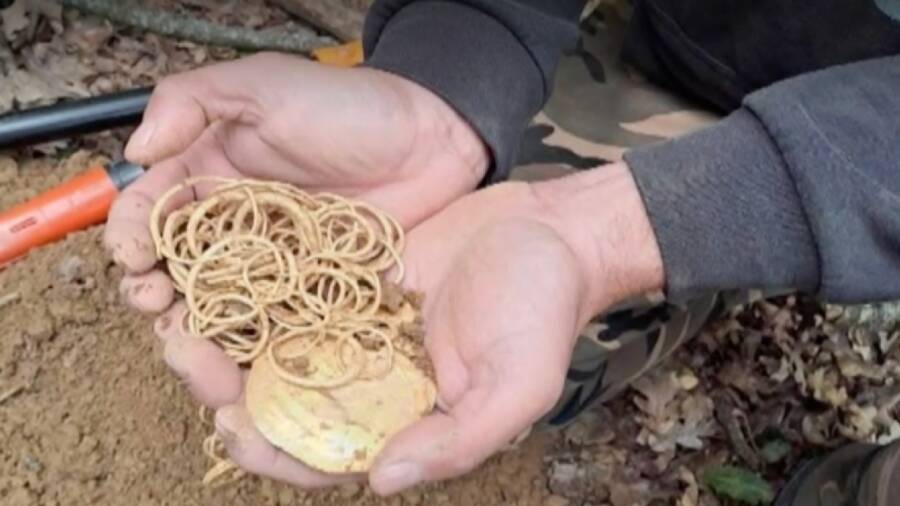
Știrile Pro-TVThe hoard contains 121 “priceless” objects.
“[The] ring… we still have no analogues in Romania,” museographer Malvinka Urak remarked. “It is made of a thicker gold wire, with spiral ends, 116 are small vertices decorated with incisions, they can be interpreted as earrings. We also have prehistoric gold pieces in the museum’s collection, but not such rich treasures. They are priceless, very, very important.”
The objects will next be restored at the National Museum of Transylvanian History. Then, they will be more closely examined by experts before they hopefully go on public display.
“Following research, the pieces will probably be included in the museum’s collection,” Victor Cubleșan, director of the Cluj County Department of Culture, stated. “They are pieces that the public should see, being both spectacular and beautiful.”
The Mystery Of The Bronze Age Hoard
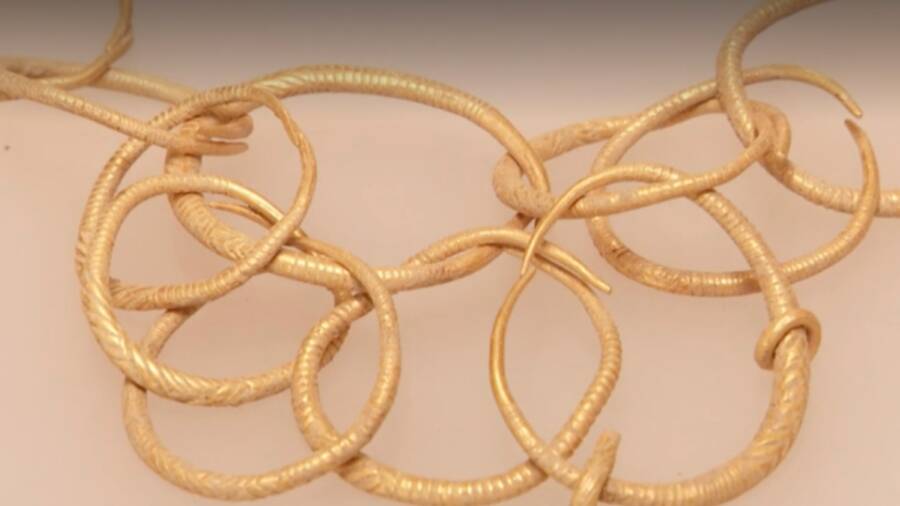
Știrile Pro-TVMost of the treasure hoard is round golden objects like these, which historians believe are possibly earrings.
By the time these gold pieces were created, the land that became present-day Romania was rapidly changing. Migratory Indo-Europeans had arrived in the area around 2000 B.C.E., where they coexisted with Neolithic people, likely leading to the formation of the Thracians. Their descendants would make contact with the Greeks in the 5th century B.C.E.
But given that little is known about the early settlers of Romania, and Cluj County specifically, it’s difficult to speculate about the owner of the gold pieces — and what happened to them. Why were these pieces created, and who did they belong to? Did they serve a ritualistic purpose, or were they merely aesthetic? And why were they buried? What caused their owner to abandon such wealth? Invaders? Or something else?
It’s possible that some of these questions will be answered once the gold pieces are more closely examined. For now, however, this remarkable Bronze Age hoard belong to a large contingent of treasures which have been found by metal detectorists in recent years.
Recently, metal detectorists in England have found Roman coins and Viking artifacts, and two metal detectorists in Belgium even came across a cache of World War II weapons.
Discoveries like this go to show that history — even very ancient history, from thousands of years ago — is not that far away. It might just take a metal detector, and a lucky walk, to dredge up some truly incredible artifacts from our shared human past.
After reading about the treasure hoard of Bronze Age gold objects found in Romania, discover the eerie story of Hoia-Baciu, the creepy “haunted” forest of Romania. Or, see how Bran Castle in Romania became the inspiration for Count Dracula’s creepy and iconic abode.