
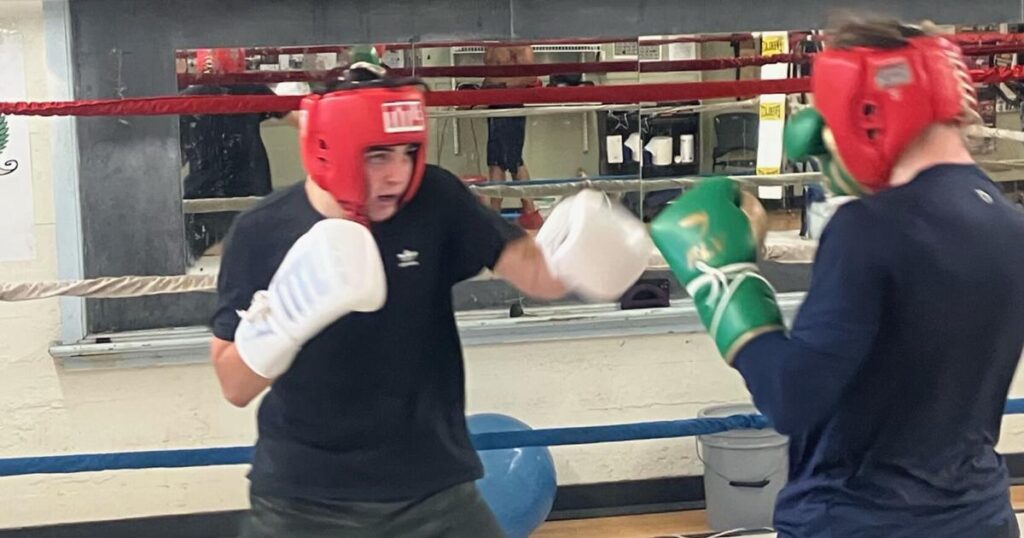
A visit to the boxing gym in the Greater Ithaca Activities Center is like a visit to a museum. The walls are adorned with posters from bouts that took place decades ago. So many familiar names and faces – some still with us, some not – and trainer Danny Akers himself, who has been around the gym for well over 40 years. Jesse Cortright – a local kid (now in his 40s) and a fine boxer in his youth – was there, encouraging the young guys, polite and welcoming, as always, still sporting that gleam in his eye that would discourage me from stepping through the ropes.
Danny looked around at the half dozen young men training there – some sparring, some hitting the heavy bag, some working on their footwork. I said to him, “That’s some standard boxing gym stuff.” I then pointed at the chess board set up next to the ring, and I said, “That’s not so standard, is it Danny?” He said, “No. That’s why I called you and told you that you’d love this story.”
The chess board was set up by Will MacLeod, who was doing his post-sparring work in the ring. Will is a senior at Cornell, a math major, and, for the past 3 years, an avid boxer at GIAC. Will had his first competitive bout in May, and he is on his way to Loznica, Serbia this month to compete in the World Championships of Chess Boxing. Yes, you read that correctly. Not Chess AND boxing. Chess Boxing.
In the Finals, there will be 4 rounds of chess, 3 rounds of boxing, 3 minutes each with a 1 minute break between rounds. Two combatants play alternating rounds of blitz chess until one wins by checkmate or knockout.” (There are 11 alternating rounds, 4 minutes for chess, 3 minutes for boxing, with a 1 minute break between rounds.)
Will told me, “The sport originated as an idea in a French comic book, and someone said, “Let’s make it a reality.’”
MaCleod had been playing chess since his dad sat him down at a board when he was 4 or 5, and for the past several years, he has been “playing in tournaments, trying to climb the ratings ladder.” When asked which rung her is presently on, he humbly conveyed the he “is currently rated somewhere around 1900, which is Class A, below Master but above about 95% of chess players.” (The Grandmasters – the game’s elite players – are, Will explained, rated in the 2500-2800 range.)
To an outside observer, the chess component makes sense when discussing the pastimes of an Ivy League math major, but what, I asked, drew Will to boxing? He offered, “Boxing is very different than anything I have ever done, and that’s part of why I specifically chose it. It’s a unique sport, it’s very real. You get hit in the head.” He added, “I have always been good at math, I learned guitar, and I find boxing – and combat sports in general – to be very helpful from a personal development standpoint. I don’t want to be a one-dimensional person. I want to develop an array of skills. Boxing was a new lane for me.”
Will is one of about a dozen members of Team USA headed to Serbia, and when asked how he merged the two lanes of boxing and chess, he said, “I saw a video clip of Chess Boxing on social media, and I followed up and went to a Showcase in Atlanta. I met the guy who is the main organizer, the ambassador, who is spearheading the growth of the sport.” MacLeod, being one to maximize opportunity to the greatest extent possible, kept following up and now wearing the Team USA colors.
While Will does admit to a degree of apprehension regarding the potential long term effects of combat sports, he said, “I do have some family members reminding me that effects add up over time, but I am drawn to the sport because it is so honest. You face the fact that there are people who are way better than you, and there’s nowhere to hide.”