
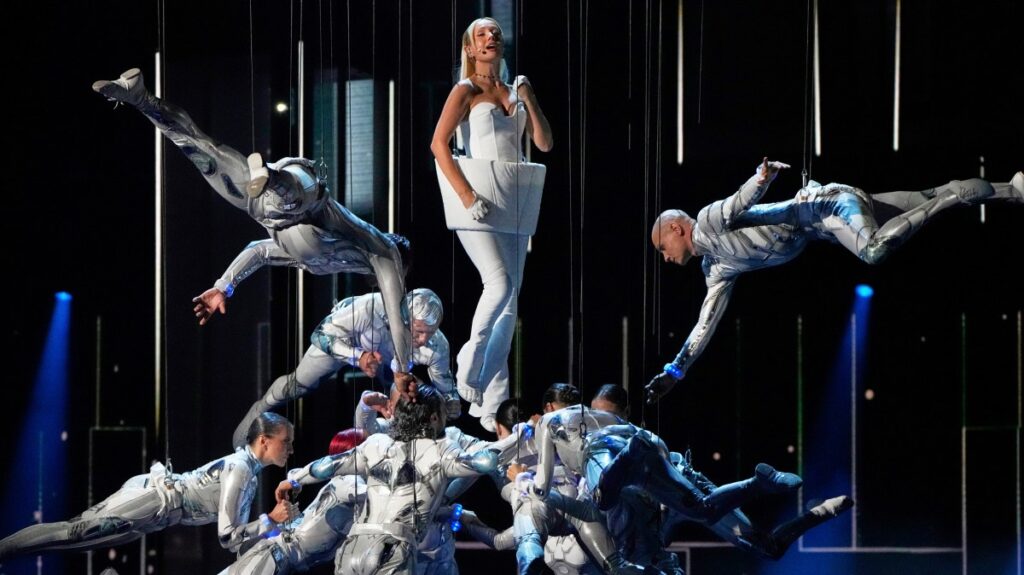
The sequinned dresses, the big hair, the platitudes of friendship between nations — in some ways Russia’s Intervision song contest seemed eerily similar to its western equivalent.
At Eurovision, however, it is unlikely that President Putin, a man who orchestrated a war on the continent that has left hundreds of thousands dead, would appear on screen flanked by Russian flags and met with applause.
Moscow was expelled from Eurovision in 2022 after Putin sent tanks into Ukraine. The Kremlin has revived the Intervision contest in direct opposition to Eurovision, an event that, according to a Russian government spokesman last year, “surpassed any orgy, coven or ritual sacrifice”.

President Putin was applauded as he addressed the auditorium via video link
ALEXANDER ZEMLIANICHENKO/AP
The organisers of Intervision claimed it would be a platform for cultural exchange and dialogue that would stimulate “unity through music”. Its political message was clear: that Russia is not isolated and still has friends around the world willing to share the same stage.
On Saturday night the Vietnamese singer Duc Phuc won with Phu Dong Thien Vuong, a mix of power ballad, rap and electronic dance beats.
The US entrant, Vassy, a Greek-Australian singer, withdrew at the last minute after she allegedly came under pressure from Australia.
The Vietnamese singer Duc Phuc wins Russia’s Intervision international song contest
President Putin addressed spectators in a video message as the event kicked off at Moscow’s Live Arena. He said he had revived the competition, originally held in the Eastern bloc between 1965 and 1980, in celebration of “trust between cultures” and of each nation’s “free development and preservation of their identity”.
In reality, most of the 22 countries that participated were already sympathetic to Putin and his brand of “traditional values”. They largely reject the LGBT-friendly Eurovision, seeing it as a symbol of western degeneracy.
Sergei Lavrov, Russia’s foreign minister, had promised in February that at Intervision there would be “no perversion or affronts to human nature, as we saw during the Olympics in Paris”.

Thais Nader and Luciano Calazans of Brazil
SEFA KARACAN/ANADOLU/GETTY IMAGES
Saturday’s contest was shown live on state television, one presenter being a previous host of Putin’s annual televised “direct line” with the Russian people. Some acts were also introduced in English and Chinese.
Kazakhstan’s entrant, Yernar Sadirbayev, performed a mournful ballad, Light of the Steppe, accompanied by a small girl holding a lantern, while Saif Alali from the United Arab Emirates, wearing a traditional kandura robe and ghutra headscarf, sang under a revolving planet.
The US entry was heralded by a computer simulation of a woman in a cropped cowboy outfit swinging a lasso. But the announcer then said that Vasiliki Karagiorgos, or Vassy, 42, a dual US-Australian citizen, would not appear because she had come under intense pressure to pull out from Australian officials.
“It’s sad when politics tries to interfere in the world that belongs to art,” the announcer added solemnly. Vassy has yet to comment.

Tajikistan’s Farrukh Hasanov performs Burn!
ALEXANDER ZEMLIANICHENKO/AP
Russia’s entry was Yaroslav Dronov, 33, also known as Shaman, a leather-clad ultra-patriotic pop singer with a shock of blond hair. Shaman’s best-known song, Ya Russki (I’m Russian), which contains the lines “I’m Russian, to spite the whole world,” has been adopted as the unofficial anthem of the ultra-nationalism that has swept Russia since Putin ordered the invasion of Ukraine.
“I’m Russian, my father’s blood flows in me,” reads another lyric. Another hit, We Will Rise, is dedicated to fallen Russian soldiers who “went to die for freedom, not for medals”.
After his performance of Straight By the Heart, Shaman asked the judges to withdraw him from consideration as the laws of hospitality meant it would be improper for him to vie for the trophy. “I represent Russia and Russia has already won by having you here as my guests,” he gushed.