
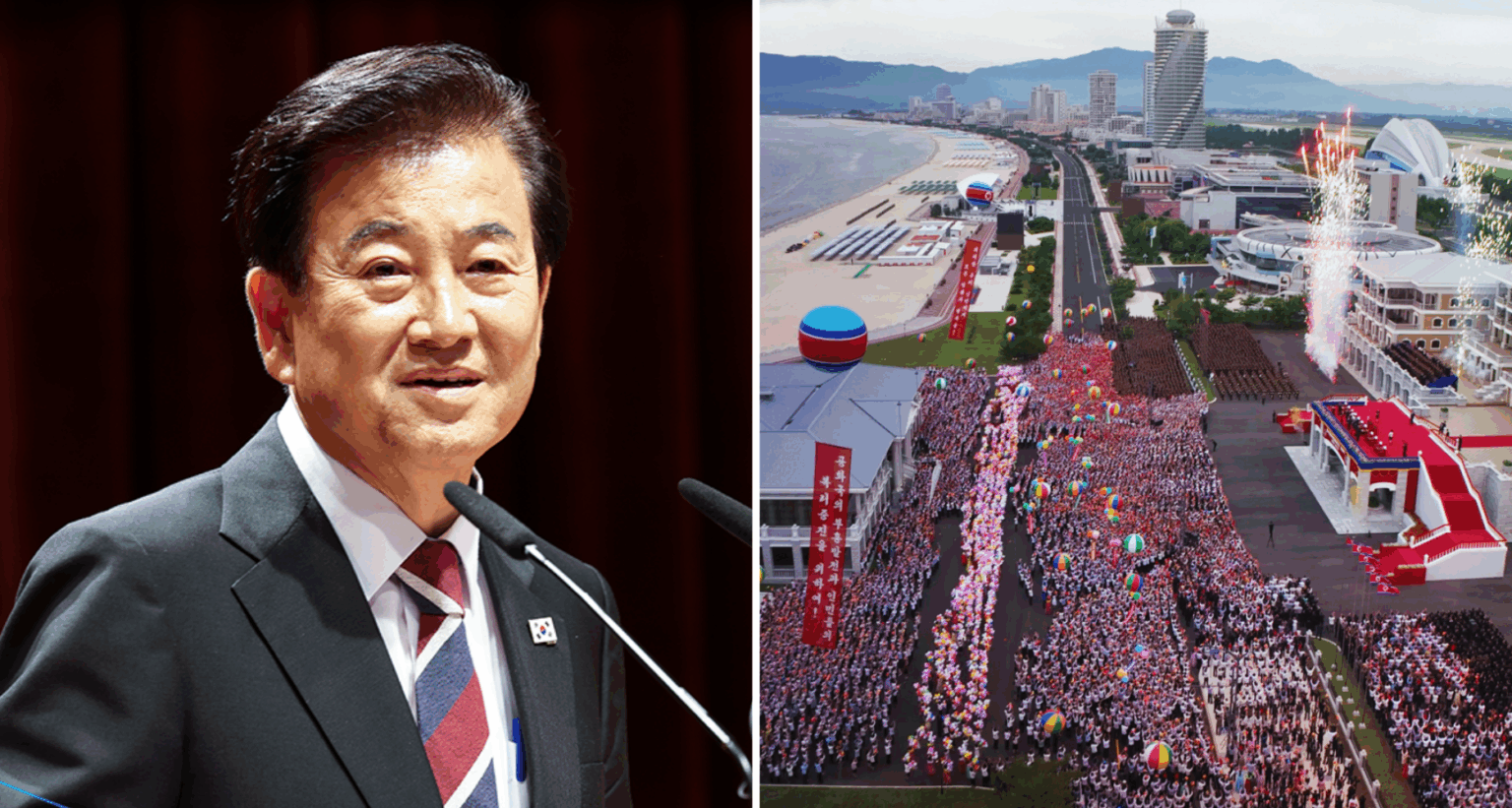
Seoul should push to revive joint tourism projects with North Korea that shut down nearly 20 years ago, South Korea’s unification minister said Monday, endorsing a proposal to link the DPRK’s Mount Kumgang resort and its new Wonsan Kalma Coastal Tourist Area.
But Chung Dong-young’s comments appear to fly in the face of Pyongyang’s repeated rejection of all inter-Korean engagement and its repudiation of unification as a policy goal, with North Korea dismantling key ROK tourism assets in recent years.
Chung made the remarks during a meeting with Hyundai Group Chairwoman Hyun Jeong-eun, where the two discussed prospects for cross-border cooperation and the future of inter-Korean tourism.
The unification minister recalled that inter-Korean engagement gained momentum in 1998, when the late Hyundai founder Chung Ju-yung sent 50 trucks carrying 500 head of cattle across the border at Panmunjom in a symbolic gesture moment widely seen as opening the door to civilian exchanges.
“That was the starting point of bold private-sector cooperation,” he said. “Now, nearly 30 years later, I believe it is time to inherit the spirit of generosity and vision demonstrated by Chairman Chung Ju-yung.”
Hyundai managed the Mount Kumgang tourism program, which saw around a million South Koreans visit the scenic North Korean area, until its suspension in 2008, and Hyun said she hoped to revive the project in tandem with tours to the DPRK’s newly opened Wonsan Kalma beach resort.
Seoul halted tours to Mount Kumgang after North Korean soldiers shot and killed South Korean tourist Park Wang-ja, who strayed into a restricted military zone in July that year.
“Even after the shutdown, we visited Mount Kumgang for commemorative events, and the North expressed regret and a strong desire for the tours to resume,” Hyun said.
She added that Hyundai has already prepared programs and secured cruise ships capable of reaching Wonsan, noting that sea routes would likely be the only option since North Korea demolished cross-border roads on the east coast.
Chung welcomed the idea, noting that North Korea itself has described the Wonsan project as “a long-cherished wish of the people.”
“For the zone to fully operate, linking tourism with Kumgang is the most realistic option. I hope the day will soon come when this becomes a reality,” the minister said.
Despite Chung’s optimism, the prospects for any revival of inter-Korean tourism remain bleak.
Pyongyang declared South Korea a “hostile state” in Dec. 2023 and has cut off nearly all channels of inter-Korean exchange. At Sunday’s session of the DPRK Supreme People’s Assembly, Kim Jong Un said the North would codify into law that the two Koreas are separate states, resoundingly rejecting any future dialogue with Seoul.
A more concrete obstacle is that the DPRK has systematically dismantled ROK-built tourism infrastructure in recent years, including a floating hotel and other resort facilities owned by Hyundai Asan and a $75 million golf resort built by the South Korean company Anati.
More recently, North Korea began tearing down an ROK-government owned hotel used for inter-Korean family unions at Mount Kumgang.
Edited by Bryan Betts
Seoul should push to revive joint tourism projects with North Korea that shut down nearly 20 years ago, South Korea’s unification minister said Monday, endorsing a proposal to link the DPRK’s Mount Kumgang resort and its new Wonsan Kalma Coastal Tourist Area.
But Chung Dong-young’s comments appear to fly in the face of Pyongyang’s repeated rejection of all inter-Korean engagement and its repudiation of unification as a policy goal, with North Korea dismantling key ROK tourism assets in recent years.