
Some things fly underneath the radar, both figuratively and literally.
A Canadian expert on Russian warfare says he believes a direct line can be drawn between Moscow’s repeated testing of the airspace belonging to NATO allies in Eastern Europe and the Pentagon’s recent, quietly announced plan to cut security assistance to the Baltic states.
Sean Maloney, a Royal Military College history professor, said he believes what we’ve witnessed in Eastern Europe over the last couple of weeks is ripped straight out of the old Cold War playbook.
“This is part of the ongoing information war directed at us, designed to undermine our will … to understand our will to resist Russian objectives throughout Europe and elsewhere,” Maloney said.
It’s been generally accepted by defence analysts that Moscow’s recent actions in Estonia, Poland and Romania — and possibly Latvia as well — are all part of a pattern to probe allied air defences, but Maloney said it’s important to take in the wider political context.
In a decision that garnered little notice at the end of August, U.S. defence officials announced a plan to eliminate funding for the Baltic Security Initiative, which began during the first Trump administration.
“I’m more concerned about what it means as a message, as opposed to the specifics of what equipment is provided,” Maloney said of the program’s demise in Washington’s next fiscal year.
“In terms of conveying a message, I think it’s a bad one, especially when we’re dealing with the adversaries that we’re dealing with right now. Any form of weakness will be exploited in the information sphere.”
According to Reuters, Pentagon officials — at a meeting with European counterparts in late August — said they intended to cut off funding in order to bolster domestic programs.
The news agency, citing American and European sources, said U.S. officials also indicated they planned to eliminate security assistance funds administered by the entire U.S. European Command.
Less than two weeks later, 19 Russian drones violated Polish airspace, and three days after that Romania reported its border had been pierced by an unmanned object.
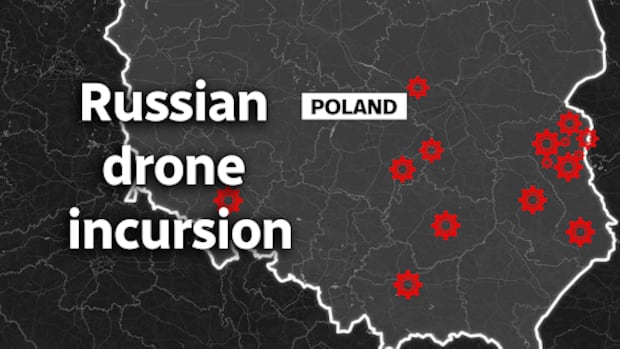
Poland says it shot down multiple Russian drones in its airspace, the first time a NATO country is known to have directly fired on Russia since it invaded Ukraine. While this isn’t the first time a Russian attack has crossed into another country’s airspace, Andrew Chang explains why this time is different — and examines why the escalation is of particular global concern.
Images provided by Getty Images, The Canadian Press and Reuters.
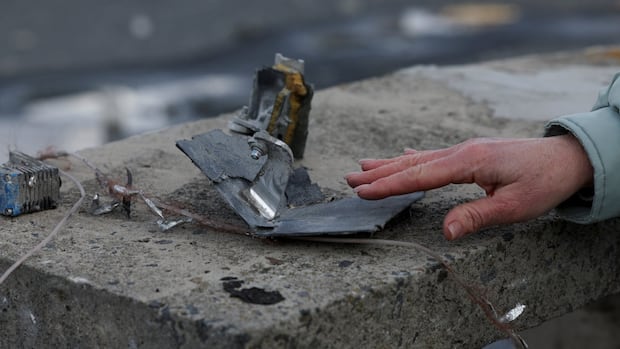
There have been a number of unconfirmed reports of drone activity in the Baltic region, including the discovery last Thursday of a smashed Russian drone in western Latvia, where Canada has 2,200 troops stationed as part of a NATO mission in the region to deter further Russian aggression.
Latvian military sources, quoted by local media, said the discovery of parts of the Geran drone, which is Russian-manufactured based on the Iranian Shahed design, washed up on a beach near Varve and appear to be debris thought to have come from an incursion over Poland.
Also, in the unconfirmed category, was the Sept. 10 report of two unidentified flying objects that allegedly entered Lithuanian airspace. Local outlets report that NATO air-policing jets scrambled that day, but “no targets” were detected on radar or visually.
Over the last few days, Germany scrambled fighter jets, as did Sweden to track a Russian IL‑20 reconnaissance aircraft over the Baltic Sea after it flew through neutral airspace.
The most militarily significant incursion, though, apparently took place last week and was the subject of condemnation in New York.
Estonia — with the support of allies — took the case of the alleged violation of its airspace by three Russian MiG‑31s last Friday — over Vaindloo Island in the Gulf of Finland — to the United Nations.
The warplanes reportedly flew without flight plans and with their transponders turned off.
There is a legal distinction between warplane and drone incursions.
Estonian officials presented radar data to back up their case. An Italian F-35 was scrambled on Friday to intercept the Russian planes.
Moscow denies it was in Estonian airspace.
UN Assistant Secretary General for Europe, Central Asia and the Americas Miroslav Jenča warned that the increasing violations represent escalating risks to European security.
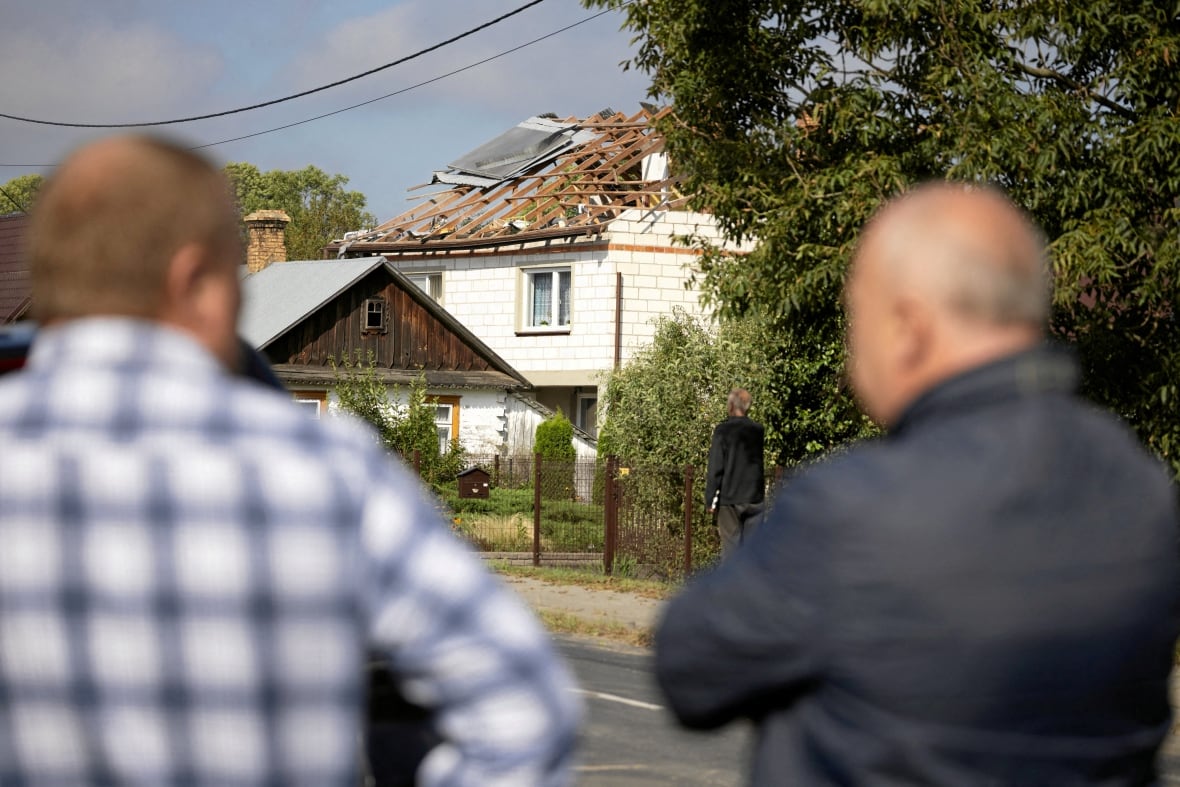
At least 19 Russian drones entered Polish airspace earlier this month, the country reported to NATO. (Agencja Wyborcza.pl/Jakub Orzechowski/Reuters)
“This outrageous violation of the territorial integrity of Estonia was preceded by Russian drones violating the airspace of Poland and Romania a short while ago,” Jenča said.
“It is part of the wider pattern of Russian provocations against its neighbours. While a permanent member of the security council continues its full-scale invasion of Ukraine.”
Many defence analysts see the incursions as deliberate probes aimed at testing how NATO responds and warn that the repeated incidents raise the risk of accident, misinterpretation or escalation into a more serious military confrontation.
In response to the Poland and Romanian drone incidents, NATO launched Operation Eastern Sentry and beefed up air defences along the borders with Russia and its ally Belarus.
Torrey Taussig, director of the Transatlantic Security Initiative at the Atlantic Council think-tank, wrote recently that the Russian tactics are deliberate.
“Nineteen drones — and it may have been more — is not a mistake. It is an intentional barrage intended to provoke Poland and test the solidarity of the NATO alliance,” Taussig said.
“If the West doesn’t respond forcefully to this attack, Putin will have achieved a strategic double hit. He aims to create a crisis of confidence that could cripple NATO’s unity and the credibility of its deterrence posture.”
Following the drone incursion into Polish airspace, U.S. President Donald Trump appeared at first to be downplaying the incident.
When asked, he said it might have been “a mistake.”
Poland’s prime minister, Donald Tusk, rejected Trump’s suggestion.
“We would also wish that the drone attack on Poland was a mistake, but it wasn’t. And we know it,” Tusk said.
When asked about the situation over Estonia, Trump said: “I don’t love it. I don’t like when that happens. Could be big trouble.”
Asked whether the U.S. would defend its NATO allies in Eastern Europe, he responded: “Yeah, I would. I would.”