
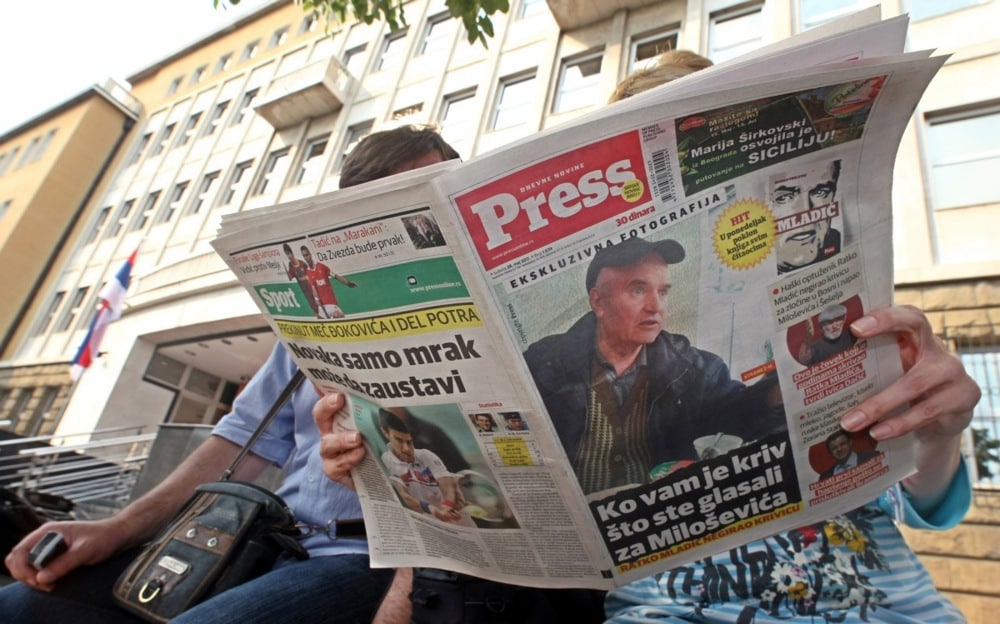
Generally, Bosniak victims and survivors of Mladic-led military actions were less euphoric about the arrest than their political representatives – and this coolness was reflected in the reactions published by the media in the Federation.
Many declared that the arrest had come too late because Mladic was now sick and old. For all that, they hoped that he would live to face justice.
Many of those interviewed were survivors of the Srebrenica massacre of July 1995, who recalled the appalling events they had experienced.
Reactions also came from victims of the war in Sarajevo, Prijedor, Sanski Most, Foca, in eastern Bosnia, and from other areas where crimes for which Mladic has been indicted took place.
Haris Halilovic, who was born in Srebrenica and lost several members of his family in 1995, when the Republika Srpska Army under Mladic overran the town, wrote in the weekly Dani that he had learned of the arrest on the other side of the world in Australia.
“That name, that face, these images and these infamous words that Mladic said 16 years ago were too long associated with the tragedy of my family for us ever to associate it with anything cheerful – even in the context of the arrest of the creator of this tragedy,” he wrote in the magazine’s June 17, 2011 edition.
Mevludin Oric, from Srebrenica, recalled for Dnevni Avaz on June 4, 2011 that he had been one of four survivors of a mass shooting in Orahovac, in the municipality of Zvornik in eastern Bosnia, in July 1995. “After Mladic left, they started to execute us,” Oric said.
Senad Hasanovic, chairman of the board of the football club Jadar, told the June 6, 2011 edition of the daily Oslobodjenje that it was not easy for the team to play in the stadium at Nova Kasaba, in Bratunac municipality, where a massacre of Bosniaks had taken place in 1995.
“In 1995, that stadium was full of people who were later taken to the scaffold and executed,” he was reported as saying.
“That remains in our memory and we will never forget it. We will try to convey that to young people, so they don’t forget it either,” he said.
In most cases, journalists whose media outlets had their head offices in the Federation closely followed Mladic’s plea and the opening of his trial on May 16, 2012.
“We urge the Hague Tribunal that the trial of Ratko Mladic be fair, quick and efficient, so that all victims of the war may welcome the verdict,” Fikret Grabovica, president of the Parents of Children Killed in Besieged Sarajevo association was quoted as saying in Dnevni list, on July 4, 2011.
The weekly Slobodna Bosna, in its May 17, 2011 edition, covered the presence at the start of the trial of Jasmina Mujkanovic, from Prijedor, who lost her father in the Bosnian Serb-run detention camp at Omarska.
“I am glad to see him there in the accused’s chair,” the newspaper reported her as saying. “I am pleased to be here today, and that he saw me and all of us who survived,” she added.
Dnevni Avaz carried the reactions of victims from a rally held in Sarajevo on the occasion of a hearing at which Mladic appeared.
“The executioner laughed when he was killing our children…. You got what you deserve, butcher … Why doesn’t he clearly admit that he is guilty?” Dnevni Avaz, in its edition of July 5, 2011, reported some of the protesters as shouting: “He learned to be strong with an army and weapons, why isn’t he brave now?”
Republika Srpska media – focusing on Mladic’s defence