
Three years ago, my husband Michael and I spent a month living in Ohrid on Lake Ohrid, North Macedonia.
Three and a half years ago, I wouldn’t have known where that was either.
Why We Went There 🧳 🗺️ 🤔
We’d been living on the Balkan Peninsula for much of the year, visiting various countries: Croatia, Serbia, and Bosnia and Herzegovina (which is one country with two names).
But everyone kept saying, “You need to go to Ohrid on Lake Ohrid in North Macedonia!”
And so we did, and we loved it.
But once we were in Ohrid, everyone kept saying, “You need to take one of the tour boats down the lake to see Saint Naum Monastery and Springs!”
And we did, and we loved that too.
Even better, two truly interesting things happened along the way.
The Naum Quickstart 🏃♂️🚀⚡
Lake Ohrid is a “rift valley” lake, which means it’s old and deep, on the border between Albania and Macedonia, and shared by both countries.
(Macedonia is technically called “North Macedonia” because of a name dispute with Greece, which also has an area called “Macedonia.” But the locals always refer to their country as just Macedonia.)
Lake Ohrid and the town of Ohrid are both UNESCO World Heritage Sites.
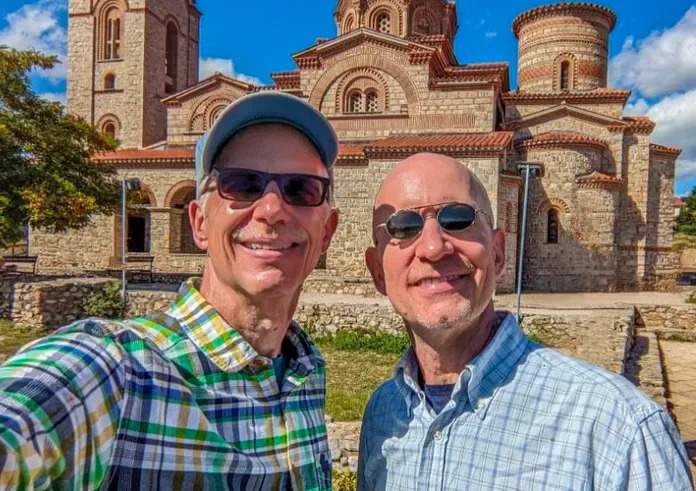
The Monastery of Saint Naum is a historical site at the southern end of the lake — an old Macedonian Orthodox Church complex first established in AD 905 by, yes, Saint Naum of Ohrid, who is buried on the site.
In fact, legend says that if you put your ear up to his stone coffin, you can still hear his heart beating — which, frankly, I find more alarming than inspirational.
Fortunately, I didn’t hear him trapped inside trying to claw his way out.
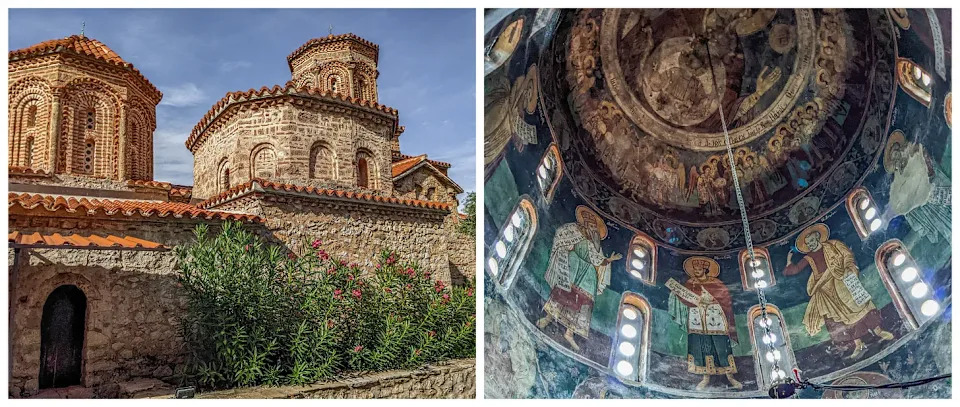
The monastery outside and inside.
(Michael Jensen)
The monastery was nice, but the real attraction here is Naum Springs, located next to the monastery. It — they? — ended up being one of the most beautiful places I’d ever seen.
But more on that in a bit, along with pictures of the springs.
And, of course, details on the two interesting things that happened along the way.
What We Did 🏰🎭🚶♂️📸
In the Ohrid harbor, Michael and I caught one of the tour boats with our New Zealander friend, Chris, who happened to be in town for the day.
Our all-day tour stopped at several spots along the lake, including something called the Bay of Bones, and this is where the first interesting thing happened.
The Bay of Bones
This is a pretty little bay that now includes the 2005 recreation of a Bronze Age settlement dating back to 1200 BC. The “bones” are the remains of animals hunted by the prehistoric occupants that were found on the bottom of the bay. Some of the bones are on display.
Before disembarking, the captain of our ship warned the people on the boat: “We are leaving in exactly forty-five minutes. And if you’re not back on the boat by then, we’ll leave without you.”
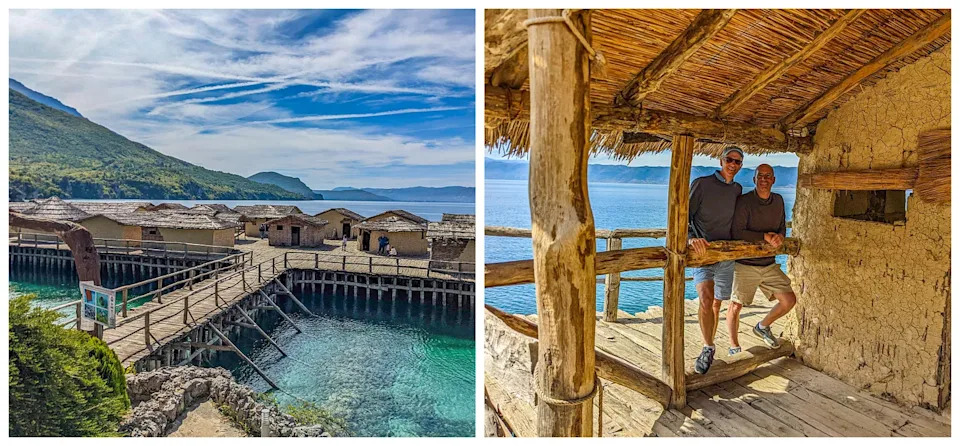
Michael, Chris, and I looked around the site, which was fine, nothing exceptional, and forty-three minutes later, the three of us were back on the boat.
But not everyone was. There were even people walking on the dock toward the boat.
The boat pushed off and left anyway.
Regular readers know that one of my pet peeves is guests on group tours who are not considerate of others. They don’t listen to the guide, they don’t return on time (screwing up the overall schedule), and they always expect that, because they’re paying money, they should get special treatment.
But I still couldn’t believe the boat actually left with seven or eight people standing at the end of the dock, waving furiously!
In truth, the boat did finally turn around and went back to pick up those “late” passengers, who climbed back on board displaying an interesting mix of embarrassment and indignation.
That night, that particular tour company probably took a hit on their Yelp and Google reviews (partially counteracted by my rave review).
I don’t know if this was a particular strategy on the part of the captain to keep us on schedule, but if it was, it worked: when it came time to leave each stop after this, every single person was back on the boat well before we were scheduled to leave.
Naum Springs
The Monastery of Saint Naum is a fine destination that includes a lovely garden famous for its many peacocks.
But the real attraction here is a little waterway next to the monastery — the springs.
Lake Ohrid actually has a sister lake higher in the mountains, Lake Prespa, which North Macedonia, Albania, and Greece share. And this lake — which is technically a network of two lakes — has no outlet.
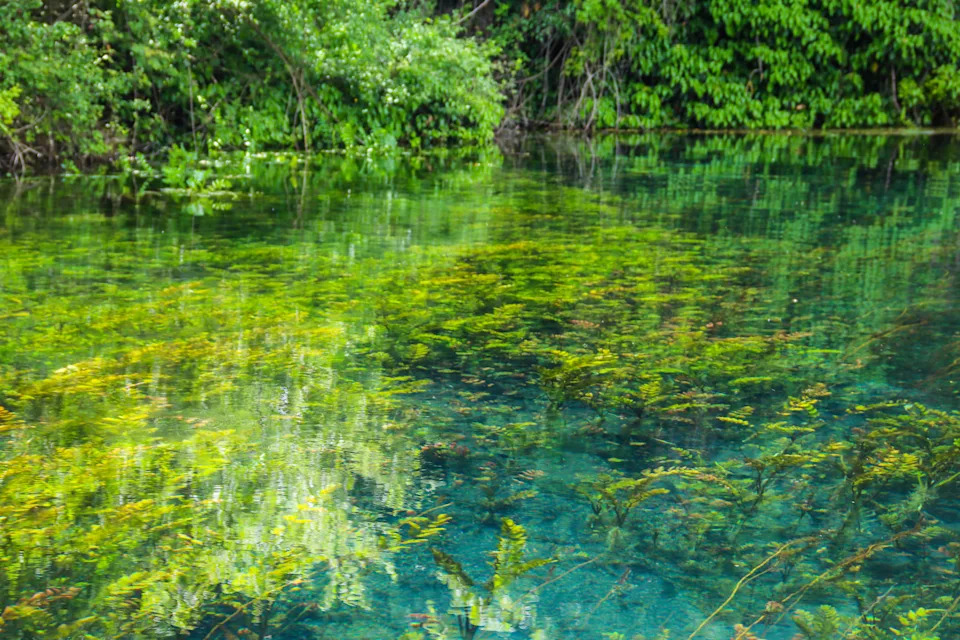
All of the water from these upper lakes filters down through the limestone of the mountains and emerges exceptionally pure at, yes, Naum Springs, and it then feeds into Lake Ohrid.
The waterway — and the swath of primordial wilderness surrounding it — are extraordinarily beautiful. It’s a river of water and grass.
And this is also where the second interesting thing of the day happened.
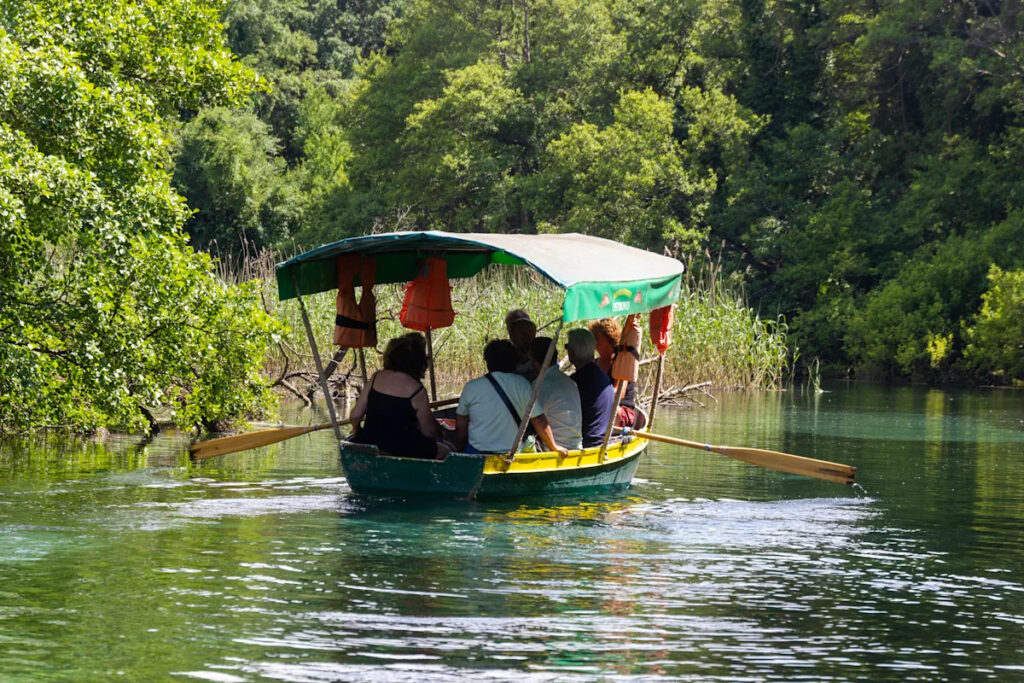
The area around the springs is protected, and in order to see these waters up close, you need to hire a local boatman to row you around, which we happily did ($3 USD a person).
And they literally row you since engines are not allowed in the springs.
It’s a bit like the Jungle Cruise ride at Disneyland, except there are no terrible jokes or animatronic animals.
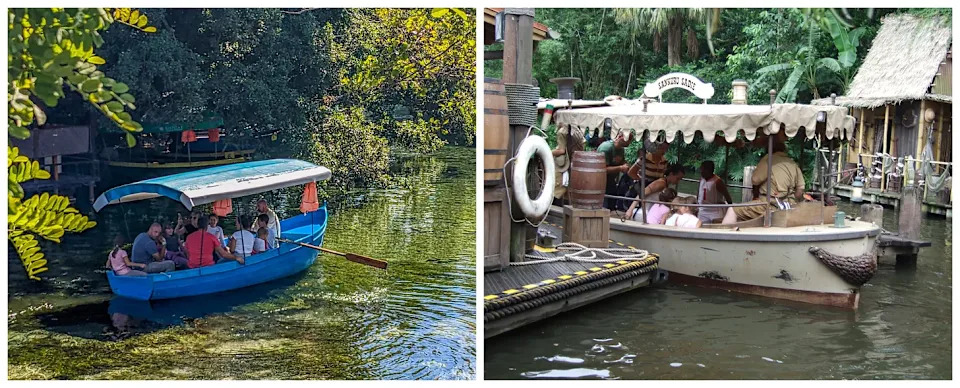
Naum Springs, left, and Disney’s Jungle Cruise.
(Michael Jensen/DearCatastropheWaitress)
And, oh yeah, it’s incredibly serene.
Our boatman explained how the springs worked — where the water came from and how unbelievably pure it was. He even demonstrated that it was safe to drink — and supposedly delicious — though no one else in our boat joined him in partaking.
Then he showed us fields of underwater plants gently undulating in the water, and also the spots where the water in the springs bubbles up through the sand.
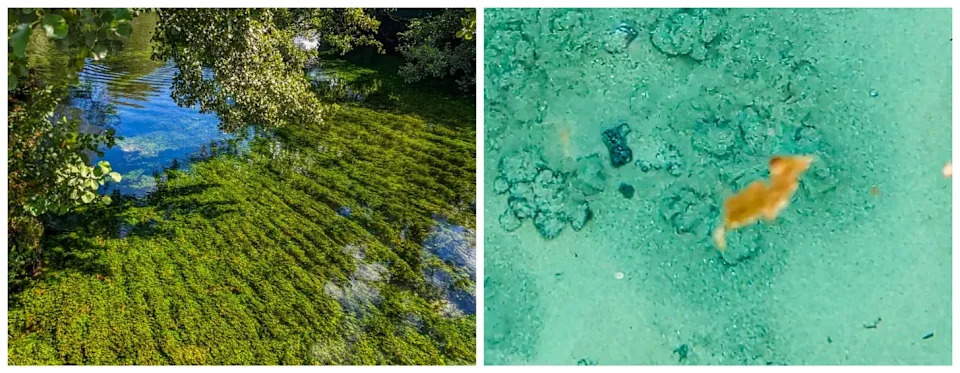
Underwater plants, left, and bubbling springs.
(Michael Jensen)
As we plied our way through the springs, we got to chatting with our fellow passengers, including two Macedonians who both happened to be young doctors.
They admitted they were both hoping to soon get jobs in Western Europe — Germany, maybe. Life was hard in Macedonia, they explained, and they were desperate to leave. It was part of the reason why they’d both been studying so hard for so long.
A bit warily, they also asked us what we thought of Lake Ohrid and these springs, which they had already visited many times.
Now it must be said: when it comes to travel, expectations are everything, and my expectations for Naum Springs had been modest.
But I still answered these two young men truthfully: I loved Lake Ohrid, and even after traveling all over the world, these springs were easily one of the most beautiful and enchanting places I’d ever been.
Michael and Chris emphatically agreed.
The two Macedonian doctors were flabbergasted by our enthusiasm — and, I think, rather proud of their homeland, suddenly seeing at least one small part of it through different eyes.
Before Michael and I left America to travel the world as digital nomads, we both thought we were lucky to have been born Americans.
But it didn’t take long for us to meet local people like these two doctors, in countries like Macedonia, and to come to understand just how unbelievably lucky we are.
Macedonia is a small, poor, landlocked country. If you want to go to “the big city,” you have exactly one option: Skopje, the nation’s capital (population 550,000). And your ambitions are limited to whatever is available there.
And, sure, technically, you can travel to other countries or even emigrate. But Macedonia is very poor. You can work your ass off, and you’ll still be making a fraction of the wealth you could make in Western Europe — not to mention America.
It’s hard enough to emigrate. Now imagine trying to do it from a country where you’d need to have worked for a year just to have saved enough to afford a single month’s rent.
And unless your family is wealthy, you’re not vacationing in other countries either.
Many Macedonians lead rich, wonderful lives.
But in many ways, life is more difficult — and your options are more limited. And that can be frustrating enough that it’s apparently sometimes hard to see even the great beauty in your homeland.
None of which is to say that I necessarily gave these two Macedonian doctors a new perspective, or even that I deserve any credit for gaining a different perspective myself.
But this was the second interesting thing that happened that day.
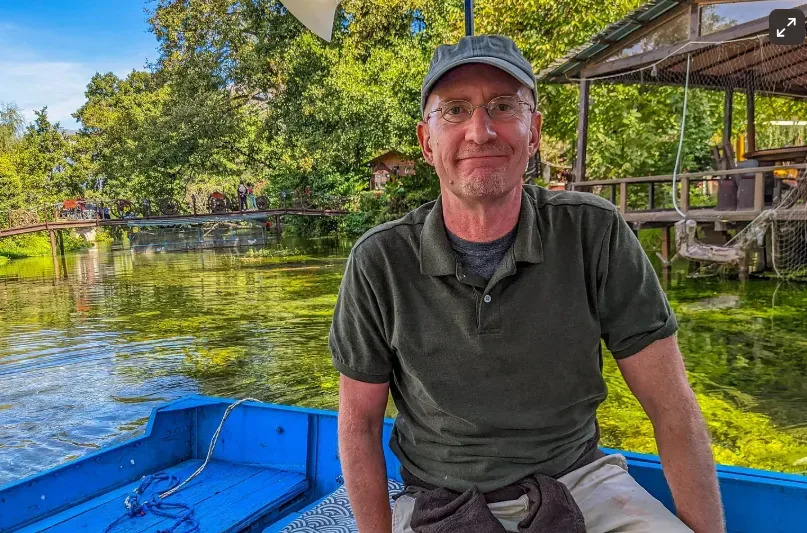
The author.
(Michael Jensen)
How to Get There 🚗🧭🛣️
Ohrid has a small airport with limited service. Most people fly into the Macedonian capital, Skopje, 250 kilometers away.
To get to Ohrid from Skopje by bus, take a shuttle or taxi from the airport to the Skopje bus station. Two different lines provide bus service ($8-35 USD), and the ride takes nearly five hours (due to many stops).
Airport transfers are also available ($120-$140 USD, regardless of how many people), and the drive is about two-and-a-half hours.
To get to Saint Naum Monastery and Springs, there are large ($10-15 USD) and small ($25 USD) tour boats available in the harbor; due to the distance, this is an all-day tour.
And if your boat captain says you’re leaving at a specific time, listen.