
Artists differ from the rest of us due to an inherent creative ambition, a heightened sensitivity and openness to experience, and a distinct way of perceiving the world through a lens of possibility, curiosity, aesthetics and intuition. While everyone possesses creative potential, practicing artists cultivate and prioritize these traits, seeing patterns, colors and contours in ways others might miss, and they are driven by a compulsion or interest to create something new and expressive.
In honor of Art for Art’s Sake, celebrating its 45th year on Saturday, Oct. 4, with gallery openings throughout the city, we look at the lives of three visual artists who live and work in New Orleans, each at a different stage in their careers.

The living room Zana Brown shares with her family is comfortable and filled with natural light. At left is Brown’s painting ‘Jelena.’ The wall on the right bears an installation of hollow, broken acrylic eggs, their interiors coated with gold leaf. The sofa is vintage; the chairs were sourced from a boutique hotel in the French Quarter and reupholstered. The chandelier is from Julie Neill Designs.
PHOTO BY Jeff Strout
Zana Ranđelović BrownFigurative painter
A native of eastern Serbia, where she grew up during an extended series of wars, Brown’s ethereal, feminine style of painting was informed by her background studies in landscape architecture, interior design, and fine art.
She landed in New Orleans on a whim 18 years ago with school friends after completing a student exchange program in landscape architecture in South Carolina. “The first time I saw New Orleans, I felt like I had finally found the place where I belonged in this country.”
Artist Zana Brown at work in her studio.
PHOTO BY Jeff Strout
She continued her studies on a student visa at Delgado Community College, earning degrees in interior design and fine art.
“I have always been a painter. It was always an outlet, but I got serious about it following a divorce when my son was very young,” Brown said. “I had no idea I could support myself solely as an artist until I was working part-time for (interior and lighting designer) Julie Neill, and a co-worker suggested I bring in some of my paintings to sell.
“They were so dark and angry. The women in them had no faces, but all three of them sold within a week. That’s when I realized people respond to emotion in artwork. That is what they are seeking. People are looking for something they can relate to.”
Brown’s home is filled with items from a variety of sources. The dining table is from West Elm, the rug is from Uttermost. The painting on the rear wall, by Brown, is entitled “Apollo,” his head is crowned in laurel leaves, finished with gold leaf. Brown made the chandelier over the table.
PHOTO BY Jeff Strout
Brown began a spiritual exploration of feminine mystique, drawing on pagan traditions and imagery still prevalent in Serbia, the flora and fauna of her training as a landscape architect, the color theory of her training as an interior designer, and the sense of welcome and place she found in New Orleans.
As her confidence grew and her style became defined, the audience for her work expanded to an international level, and her work is collected and displayed in museums and galleries worldwide.
Her signature style includes “Flowerhead” paintings, and she is represented by Zana Brown Studio (3908 Magazine St., 504-355-7527, zanabrownstudio.com), where she has an opening of new works from 6 p.m. to 9 p.m. Saturday, Oct. 4.
Brown works from a small shed-turned-studio behind her Old Metairie home. Follow her on Instagram, @zanabrownstudio.
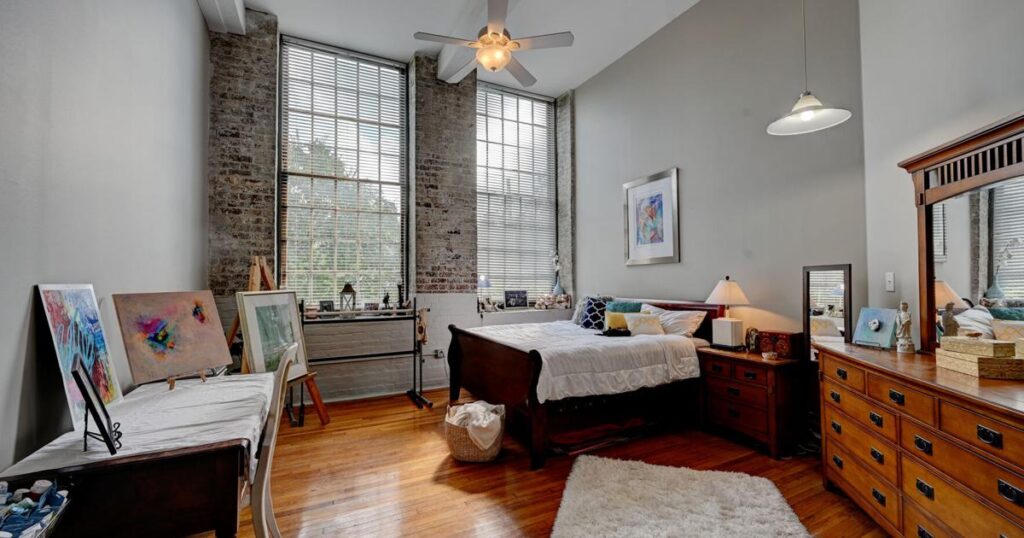
Aubrey Morgan’s studio apartment is awash in natural light and furnished with vintage finds.
PHOTO BY Jeff Strout
Aubrey MorganAbstract painter
Aubrey Morgan created a life as a visual artist in her 40s after her decadeslong career as a professional ballerina was cut short by COVID-19.
A Slidell native, Morgan moved to New York City at 14 to attend the School of American Ballet while also pursuing a traditional high school education at the Professional Children’s School. At 16, she was dancing professionally with the New York City Ballet. She later performed in “The Phantom of the Opera” on Broadway.
In 2020, while working as a dancer and instructor and living the life of an athlete, she contracted COVID-19, which evolved into long COVID, forcing her to retire from the stage. Her journey with abstract art began when friends visited her, bringing art supplies to help alleviate her boredom while she was largely confined to her home for two years.
Artist and ballerina Aubrey Morgan in her home studio.
PHOTO BY Jeff Strout
“At first it was paint by numbers,” Morgan said, “but that quickly grew boring, and I started moving beyond the lines.”
Long COVID eventually gave way to the chronic fatigue syndrome that Morgan lives with today as she teaches ballet at the Schramel Conservatory with the New Orleans Ballet Theatre and Main Street Dance in Hammond. “I demonstrate, then rest for five minutes while my students repeat the demonstration,” Morgan said.
Morgan’s abstract style is characterized by bold, exuberant colors and a dramatic sense of movement. The walls and surfaces of her studio apartment are covered with her paintings. Shown here, are from left, ‘Pirouetting’, ‘Soutenu,’ and ‘Waltz En Tournant.’
PHOTO BY Jeff Strout
Morgan’s abstract style, still in development, is characterized by bold, exuberant colors and a dramatic sense of movement. The walls and surfaces of the sun-splashed 750-square-foot studio apartment in the Cotton Mill that she shares with her cat, Mango, are covered with the paintings she seems to produce compulsively as she refines her work through classes at the New Orleans Academy of Fine Art. She sells her work privately. Follow her on Instagram, @canvasballet.
“Art represents a survival story for me,” she said. “I had to reinvent myself. My art is representative of my life in theater — lights, color, action. It brought me freedom, hope and faith that I could get past the darkness and build a new life.”
Antonia Zennaro in her Lower Garden District Studio, after formerly working in her 7th Ward home. She prints her photographs on fabric, as can be seen in the window treatments behind her.
PHOTO BY Jeff Strout
Antonia ZennaroDocumentary photographer
Earlier this year, the prolific nature of her art drove Italian documentary photographer and social artist Antonia Zennaro from working in her home in the 7th Ward to a 500-square-foot studio space in the back of The Good Shop, an artists’ co-op and gallery in the Lower Garden District.
Zennaro works on long-term projects in conflict zones and their aftermath by exploring memory, traditions and the human condition. Through her photography, she strives to bring the realities of different cultures into public spaces. Her work is exhibited in solo and group shows in Europe and the United States.
While in Colombia, Zennaro spent nine years learning to print or burn photographic images on fabric. She ships her printed works on fabric to native women in Guatemala and pays them a fair wage to embroider their own corresponding images.
PHOTO BY Jeff Strout
She was born in Hamburg, Germany, and grew up in Bolzano, Italy. After living, studying, and working in Paris, Barcelona, Rome and Hamburg from 1999 to 2013, she moved to Bogotá, Colombia, and now calls New Orleans her home. After spending 15 years traveling the world, she said of her life in New Orleans, “The community embraced me, and I never left.”
While in Colombia, she spent nine years learning to print or burn photographic images on fabric.
Antonia Zennaro prints her photographs on fabric. This collection of images is part of her ‘Human/Nature’ installation, which explores the juxtaposition of elements found in nature against images of people or man-made elements.
PHOTO BY Jeff Strout
She built relationships with Indigenous women in Guatemala, with whom she continues to collaborate. She ships her printed works on fabric to them and pays them a fair wage to embroider their own corresponding images on the works before sending them back to Zennaro.
Her installation “Banana Land Mobile” is composed of a network of textiles and photographs burned onto a series of embroidered hoops that tell the story of the foreign multinationals, notably the United Fruit Co., operating in Central America and the Caribbean during the mid-20th century, with little regard for the native populations.
This panel is part of a mobile from the ‘Human/Nature’ series of photography printed onto sheer fabric embellished with corn stalks and glass beads. It is part of a current group exhibition at Scale New Orleans, 612 Andrew Higgins Blvd.
PHOTO BY Jeff Strout
“My work is storytelling, which is always tricky,” Zennaro said. “I’m motivated to tell someone’s story in a way that is accurate and retains the subject’s voice while sharing my own perspective.”
Zennaro’s mobile “Human/Nature,” hand-printed photography on sheer fabric embellished with corn stalks and glass beads, is part of a current group exhibition, “Naturally Inclined,” at Scale New Orleans, 612 Andrew Higgins Blvd.
She is also hosting a Holistic Art Pop-up from 5 p.m. to 9 p.m. Saturday, Oct. 4, in her studio and at The Good Shop, 1114 Josephine St., during Arts for Art’s Sake. Follow her at antoniazennaro.com and on Instagram, @antonia.zennaro.
ART FOR ART’S SAKE
What: The annual opening of the fall arts season celebrates its 45th anniversary with gallery openings and a street party. Many shops and galleries offer complimentary libations, snacks and live music.
When: 6 p.m. to 9 p.m. Saturday, Oct. 4
Where: Across the city, including the Warehouse Arts District, where it was founded; 5 miles of Magazine Street; and throughout the French Quarter.