
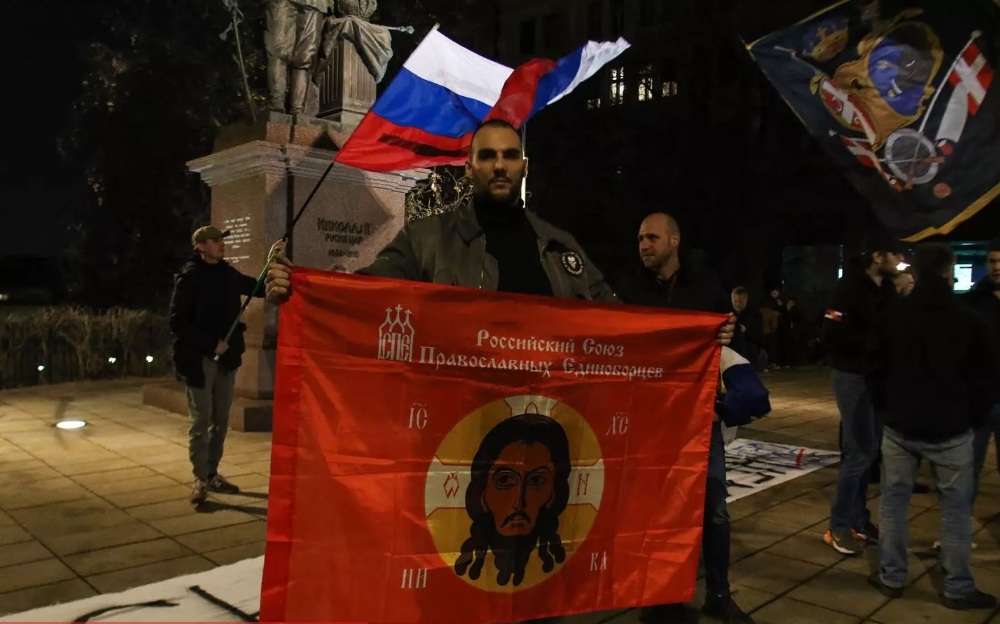
Far-right organizations from several different countries, including two from Serbia, gathered in mid-September in Saint Petersburg at a conference with the main theme – fighting against the arrival of migrants.
People’s Patrol, known for its anti-migrant actions, and the clerofascist Serbian Action had their representatives at the founding conference of the International League of Anti-globalists Paladini, organized by Russian oligarch Konstantin Malofeyev, who is under sanctions from Western countries.
Russian far-right ideologue Alexsandr Dugin also spoke at the event.
Upon returning to Serbia, People’s Patrol announced an anti-migrant protest in October in Belgrade.
“This conference shows that Russia still believes some of these far-right groups and movements can be useful to it in further pursuing geopolitical and other goals, including by openly sowing discord in societies,” journalist Michael Colborne from the investigative portal Bellingcat, who has been studying the far-right for years, told Radio Free Europe (RFE).
Who participated in the gathering?
On his official Telegram channel, Konstantin Malofeyev wrote that “more than 50 delegates from three continents, from 15 right-wing patriotic organizations,” arrived in Saint Petersburg.
According to him, the event began with a minute of silence in honour of American conservative commentator Charlie Kirk, who was assassinated in September on a university campus in Utah.
Among the participants identified by RFE was Boór Tamás, a representative of the radical right-wing Youth Movement of 64 Counties from Hungary.
The 64 Counties Movement advocates for the unification of all ethnic Hungarians living outside Hungary and for the return of territories taken away by the Treaty of Trianon. Among those territories is Vojvodina, an autonomous province within Serbia.
Serbia’s Ministry of Interior placed the 64 Counties Movement on the list of extremist groups, and its founder, László Toroczkai, was at one point banned from entering the country.
Also present at the Saint Petersburg conference was Yvan Benedetti, president of the far-right French party Les Nationalistes. Benedetti has been an active member or leader of several far-right and ultranationalist movements, including L’Œuvre Française, an organization banned by the French government in 2013 for racist and antisemitic activities.
He visited Serbia in July 2023, when he was one of the speakers at a conference in Belgrade organized by the right-wing party Serbian Right, led by Miša Vacić.
Research by RFE’s Russian service also showed that Robert Risch, a member of the Hamburg city assembly from Germany’s Alternative for Germany (AfD) party, attended the conference.
In May, Germany’s domestic intelligence service classified this party as an extremist organization posing a threat to democracy, and the party is currently trying to overturn that decision.
Representatives of the Falange Española de las JONS, followers of the far-right Spanish Falange party founded by Spanish dictator Primo de Rivera (1870–1930), also attended.
The Mexican organization UNR (Unity, Nation, Revolution) confirmed its participation as well. The Global Project Against Hate and Extremism has accused UNR of ties to neo-fascists and of organizing concerts by neo-Nazi music groups.
The conference was held in Mariinsky Palace, the seat of the Legislative Assembly of Saint Petersburg, which Michael Colborne sees as an indication that the groups present were mostly those that adopt a pro-Russian stance in their activities and rhetoric.
“It’s all very ironic, given that Russia has for years promoted propaganda that it is fighting against the far right in Ukraine. It certainly exists there, but as we can see, the Kremlin has no problem criticizing the far right when it suits its purpose, but also embracing it and pretending it’s not contradictory,” says Michael Colborne.
Theories of “population replacement”
Information about the far-right gathering in Saint Petersburg was published on September 23 on Telegram by Konstantin Malofeyev’s organization Two-Headed Eagles.
However, Damjan Knežević, one of the founders of the informal group People’s Patrol and its representative at the Saint Petersburg event, told RFE that the meeting was actually held on September 12, and that the information was released later so that some delegates from Western countries “wouldn’t face problems” upon returning home.
He said the main theme of the conference was “the fight not only against illegal migration, but against migrants in general.” According to him, the participants adopted a “declaration on joint work and mutual assistance” among the organizations.
“I see the greatest benefit from this forum for our organizations in Serbia as presenting a real picture of what is happening in EU countries, while from our Russian friends – Two-Headed Eagles and Brotherhood of Academics – we expect help in the media and more attention to what is happening here,” Knežević said.
Damjan Knežević had been charged before the Higher Court in Belgrade with violently attempting to overthrow the constitutional order, but in November 2024 he was acquitted in the first-instance verdict.
The organization he leads came into the public spotlight in early 2020, when activists from this informal group intercepted migrants on the streets of Belgrade and handed them pamphlets stating that they were “forbidden to move outside migrant centers between 10 p.m. and 6 a.m., and to walk in groups of more than three during the day.”
Shortly after returning from Saint Petersburg, People’s Patrol announced a protest in Belgrade against “population replacement.”
This is a phrase often used by far-right groups, who claim – without evidence – that interest groups are working to force the native population to leave the country and replace them with migrants from the Middle East, Africa, and Asia.
Can the authorities ban the anti-migrant rally?
Milena Vasić, a lawyer with the Lawyers’ Committee for Human Rights (YUCOM), told RFE that the right to peaceful assembly is guaranteed by the Constitution of Serbia, but added that there are limitations, which, among other things, concern the protection of the rights of others.
“An assembly can be restricted in the case of protecting public health, morality, the rights of others or the security of the state. In this particular case, a gathering that directly calls for hatred and the expulsion of foreign nationals should not be permitted,” Vasić noted.
She added that such an assessment is made by the Ministry of Internal Affairs.
In recent years, People’s Patrol has organised a number of anti-migrant protests, not only in the Serbian capital, but also in towns where refugee and migrant reception centres are located.
Links with Russia
For years, People’s Patrol has maintained ties with ideologically aligned groups in Russia. After the beginning of the Russian invasion of Ukraine, they organised several rallies in Belgrade in support of the Russian Federation.
In February 2023, the police banned a rally that People’s Patrol planned to hold on the first anniversary of Russia’s invasion of Ukraine. The authorities cited as their reason a protest organised by People’s Patrol a week earlier, when incidents and clashes broke out between the demonstrators and the police, after which Knežević was arrested.
In November 2022, Damjan Knežević boasted on the Telegram channel of his informal organisation about visiting the centre of the paramilitary group Wagner in Saint Petersburg. On that occasion, he was accompanied by Aleksandr Lisov, head of the organisation Russian-Serbian Centre Eagles from Saint Petersburg.
Lisov’s organisation has repeatedly issued threats on its Telegram channel against Russian anti-war activists who had fled to Serbia after the invasion began. Because of this, the Serbian Prosecutor’s Office for High-Tech Crime opened a case, but it is not known what stage the proceedings are currently in.
Serbian Action, another group whose representatives attended the conference in Saint Petersburg, also maintains links with Russia.
Activists of this unregistered group, which claims to stand for “militant Orthodoxy, the preservation of the national essence and racial identity,” visited in 2022 the training ground of the Imperial Legion in Saint Petersburg.
This is the militant wing of the Russian Imperial Movement (RIM), a far-right ultranationalist organisation from Russia, which the US State Department designated in 2020 as a global terrorist threat.
Michael Colborne, journalist with Bellingcat, believes that the ties these organisations maintain with Russia could have a significant impact on events in Serbia.
“People think those connections with Russia mean a large influx of money. I don’t believe that is the case, but I wouldn’t be surprised if there was some small financial support from Russian actors. However, I think such conferences can serve as a ‘wind in the sails’ for these far-right actors, to motivate them,” Colborne said.
He pointed out that the rally announced by People’s Patrol is precisely an example of this.
“That networking gives them the opportunity to exchange ideas and experiences, to gain new contacts and potentially new footholds of support – whether ideological or financial,” Colborne added.
(Radio Free Europe, 03.10.2025)
https://www.slobodnaevropa.org/a/ultradesnicari-narodna-partola-srbija-rusija/33546201.html