
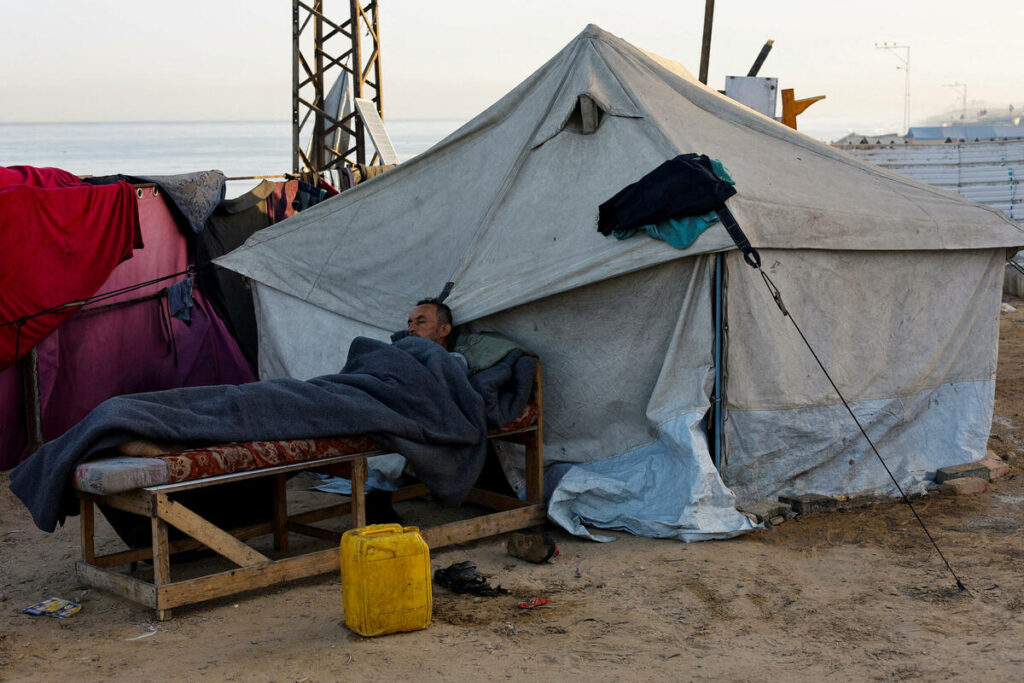
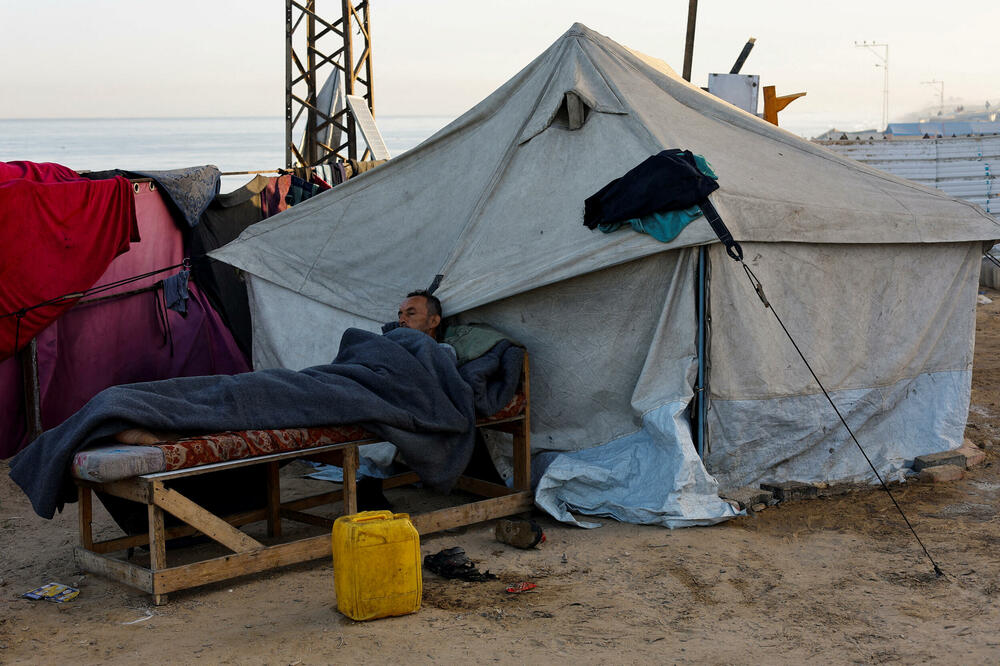
A displaced Palestinian in a tent by the roadside in central Gaza, Photo: Reuters
President Donald Trump’s plan to end the war in Gaza offers something rare: a way forward for the people of both Gaza and Israel. The 20-point proposal requires further elaboration and further negotiations, but it addresses the short-term imperative of stopping the bombing and killing, returning Israeli hostages, and releasing Palestinian prisoners. Crucially, it also provides a medium-term formula for an interim administration that can usher in a new era of peace for both Palestinians and Israelis.
A key element of the plan envisions Gaza being governed by an “interim transitional administration of a technocratic, apolitical Palestinian commission,” made up of “qualified Palestinians and international experts,” overseen by an international transitional body, the “Peace Board,” chaired by Trump and with former British Prime Minister Sir Tony Blair playing a central role.
This type of transitional government is not a mere illusion. Nor is it, as some suggest, a relic of the colonial past. It can work. The example of my own country, Kosovo – a state twice the size of the Palestinian territories and with a population slightly smaller than that of Gaza – shows why Trump’s initiative deserves support.
When Kosovo faced destruction at the hands of Slobodan Milosevic’s regime in the late 1990s, sparked by NATO bombing of the Serbian military machine, many doubted that peace would last or that reconciliation could occur in that part of the Balkans after so much bloodshed.
Kosovo emerged from chaos to build democratic institutions that enabled its people to decide their own destiny.
However, Western powers reacted quickly and established an interim administration under a United Nations mandate. It was led by credible international officials such as Sergio Vieira de Mello, an experienced Brazilian diplomat, and Bernard Kouchner, a former French foreign minister.
The Interim Mission in Kosovo (UNMIK) quickly proved its worth. The Kosovo Albanian leadership seized the opportunity and agreed to the demilitarization of the pro-Western guerrillas. But it was the interim international administration that led the reconstruction, opened the territory to global engagement and, most importantly, prepared the ground for free and fair elections.
Out of chaos, Kosovo began to build democratic institutions that allowed its people to decide their own destiny. Various countries contributed their expertise: Norwegian diplomat Kai Eide helped create a professional police force; America helped build a modern banking and judicial system (in addition to providing troops for NATO’s KFOR mission); the European Union financed physical reconstruction and economic support; the OSCE organized free and fair elections; and KFOR provided overall security.
While the parallels are not perfect – Kosovo sits on the fringes of the European Union, whose rich, peaceful and democratic countries want it to succeed – Trump’s plan for Gaza echoes this tried-and-tested model. Encouragingly, the plan appears to strike a delicate balance between local leadership and international expertise. By providing key roles for figures like Sir Tony, who has extensive, if controversial, experience in the Middle East – as well as hero status in predominantly Muslim Kosovo for his role in the 1999 NATO bombing – alongside credible Palestinian representatives, the peace proposal could avoid the perception that it is dominated by outsiders. The broader the coalition of actors, the less likely it is that the project will fall victim to the machinations of the UN Security Council or be drawn into the complicated realities of Palestinian politics.
The key will be to view the interim administration and its Peace Committee as a process, not a goal. That means organizing democratic elections, putting governance in proper Palestinian hands, and providing solid guarantees for Israel’s security.
There are other elements of the Kosovo precedent that explain why Sir Tony is inclined to draw on that experience in drawing up plans for a transitional administration in Gaza. The interim mission in Kosovo quickly combined the legitimacy of international officials and organizations with the knowledge and involvement of local leaders of all political persuasions. An attempt was made to ensure gender, ethnic and religious balance.
In Gaza, such a hybrid body should begin to rebuild the devastated economy, channeling resources for reconstruction while respecting political realities and cultural sensitivities. Sir Tony brings a reputation and experience on the world stage; Palestinian leaders bring the life experience and local credibility necessary to connect with and represent the people of Gaza.
The ultimate strength of the Trump plan lies in its promise of a path to peace, although it is not yet fully clear. The plan includes an agreement with Arab countries that the people of Gaza will not be left in limbo and have the right to remain on their land. The key will be to view the interim administration and its Peace Committee as a process, not a goal. This means organizing democratic elections, putting governance in the rightful hands of the Palestinians, and providing firm guarantees for Israel’s security.
Kosovo teaches us that such clarity is vital. UNMIK succeeded in the immediate aftermath of the war only because its mission was transparent: to stabilize existing institutions and build new ones where needed. But Kosovars grew impatient when the transition began to slow down and the interim UN bureaucracy began to take on a permanent air. A process was devised and negotiations began on final status—and Kosovo did not disintegrate after the interim mission ceased to exist. It became independent under a plan led by the then President of Finland, Martti Ahtisaari, for which he won the Nobel Peace Prize. Interestingly, Kosovo is now one of the safest destinations in Europe, according to Gallup research.
The war in Gaza is terrible. True reconciliation may never come. But Trump’s plan is pragmatic and based on precedent. It is exactly what the people of Gaza need.
The author is a former Minister of Foreign Affairs of Kosovo. He is a fellow at the Center for Public Diplomacy at the University of Southern California.
The comment was published in “The Economist”
Prepared by: A. Š.

News