
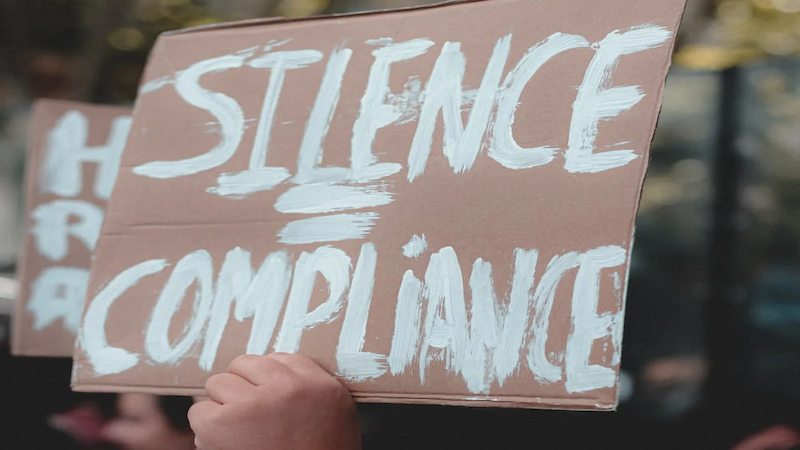
Genocide does not happen in a vacuum. It requires weapons, orders, and ideology—but it also requires silence.
From the death camps of Auschwitz to the mass graves of Bosnia and the shattered neighborhoods of Gaza, the mechanics of annihilation have always depended on the quiet of those who could speak but do not. Each atrocity follows a grimly familiar pattern: the dehumanisation of a people, the escalation of violence, the bureaucratic justifications—and the world’s refusal to act until the killing is nearly complete.
A History of Knowing and Doing Nothing
In 1944, Hungarian Jews were marched through their own towns on the way to Auschwitz. Neighbours closed their curtains, teachers identified families for deportation, and the smoke from crematoria drifted over villages that chose not to see. Adolf Hitler, preparing to invade Poland in 1939, captured the dynamic perfectly when he asked, “Who, after all, speaks today of the annihilation of the Armenians?” He understood that genocide succeeds when the world forgets the last massacre and averts its eyes from the next.
Half a century later, in the heart of Europe, Bosnia exposed the same weakness. Sarajevo endured a siege that lasted 1,425 days, its bombardment broadcast nightly across the world. In Srebrenica—declared a United Nations “safe area”—Bosnian Serb forces executed more than 8,000 Muslim men and boys in a single weekend. UN peacekeepers, sent to protect civilians, stood by as the killings unfolded. International leaders debated definitions and weighed military risks while mass graves filled. Visibility did not lead to rescue. The evening news delivered images of slaughter, but outrage remained carefully contained by diplomacy.
The Gaza Test
Today, Gaza presents the same moral challenge with unprecedented immediacy. Over months of bombardment, tens of thousands of Palestinians have been killed, many of them children. Entire neighbourhoods lie in ruins. Hospitals, schools, and refugee camps have been reduced to rubble. Unlike Auschwitz or Srebrenica, Gaza is not hidden behind barbed wire or distant battlefields. Its victims broadcast their own suffering in real time. Families livestream missile strikes and mass burials. Children upload videos from basements as bombs fall.
This digital immediacy was once unthinkable. During the Holocaust, information arrived slowly, muffled by censorship and disbelief. In the 1990s, Bosnia’s massacres reached television screens but were still mediated by journalists and editors. Gaza’s reality streams directly to anyone with a phone. The cries of the besieged reach millions within seconds. And yet the killings continue.
Visibility Without Action
The paradox of our age is that knowing more does not automatically mean doing more. Social media delivers a flood of atrocity images, but this very abundance can numb the senses. Psychologists call it “compassion fatigue”: as the death toll rises, empathy paradoxically declines. Each new statistic blurs into the next, making inaction easier to justify. The infinite scroll becomes a digital curtain behind which the powerful manoeuvre and the vulnerable die.
States exploit this paralysis. Western governments debate whether the assault on Gaza legally qualifies as “genocide,” as if the dead must reach a precise threshold before their suffering counts. Strategic interests—arms sales, intelligence sharing, regional alliances—blunt calls for ceasefire. The United Nations, paralysed by the veto powers of major states, struggles to enforce even the most basic humanitarian protections. Legal arguments and diplomatic caution become shields for moral failure.
The Politics of Silence
For much of the Global South, Gaza’s devastation is not merely another conflict. It is a confirmation that the international order remains tilted toward the powerful. Arab nations demand accountability while Washington ships weapons to Israel. South Africa has invoked the Genocide Convention at the International Court of Justice, highlighting a double standard: Western governments that once swore “Never Again” now calibrate their outrage to protect strategic alliances. The hierarchy of whose lives matter remains stubbornly intact.
Glimpses of Courage
And yet, history reminds us that silence is not inevitable. Even in the darkest hours, individuals have chosen courage over complicity. A German engineer risked execution to smuggle food to a starving prisoner in Auschwitz. A Serb neighbour rescued a Muslim family from a Bosnian camp. During the Bosnian war, activists in Melbourne plastered city walls with posters declaring “Silence is Consent”, rallying strangers to protest killings half a world away. Today, weekly demonstrations for Gaza—from Cape Town to Kuala Lumpur to London—carry the same message. Civil society flotillas attempt to breach the blockade with food and medicine, embodying the belief that witness must become intervention.
These acts of resistance rarely end wars on their own. But they disrupt the narrative of inevitability. They remind perpetrators that the world is watching, and they offer survivors proof that not everyone is indifferent. The smallest gesture—an aid convoy, a protest sign, a vote cast against a complicit government—can carry moral weight far beyond its immediate impact.
Lessons We Refuse to Learn
Genocide is not a sudden catastrophe. It is a process: dehumanisation, segregation, blockade, bombardment. Each stage offers opportunities for interruption if states are willing to sacrifice convenience for principle. Yet the global record shows a consistent failure to act until it is too late. Bosnia forced NATO to intervene only after years of bloodshed. Rwanda’s genocide was acknowledged only after hundreds of thousands were dead. Gaza now tests whether the world has learned anything from these failures.
The structural reforms needed to prevent future atrocities are well known. Limiting Security Council vetoes in cases of mass atrocity would prevent a handful of powerful states from blocking life-saving action. Strengthening early-warning systems and funding humanitarian corridors could disrupt the escalation toward genocide. But these reforms demand political courage that is often absent until the killing has already run its course.
Memory as Obligation
To remember Auschwitz or Srebrenica is not simply to mourn the dead. It is to accept a living obligation. Commemoration without action is hypocrisy. “Never Again” must mean more than memorial speeches and annual days of reflection. It must mean confronting allies when they commit atrocities, enforcing international law even when it is inconvenient, and refusing to let strategic calculations outweigh human life.
Governments may stall, but individuals still have agency. Protest, boycott, vote, donate: these are tools that ordinary people can wield even when their leaders fail. Each act of engagement chips away at the comfort of indifference.
A Question That Will Not Go Away
History’s verdict will not be written only about those who pull triggers or drop bombs. It will also record the choices of those who scrolled past a livestream, changed the channel, or called for patience while civilians starved. The ghosts of Auschwitz, the bones of Srebrenica, and the cries from Gaza converge into a single, unrelenting question: when the victims called, where were you?
The answer will not come from presidents or prime ministers alone. It will be written by all of us—in the streets we march, the pressure we apply, the silences we keep. Gaza’s agony is not only a tragedy; it is a test of what humanity has learned. If the world once said “Never Again,” the time to prove it is always now.