
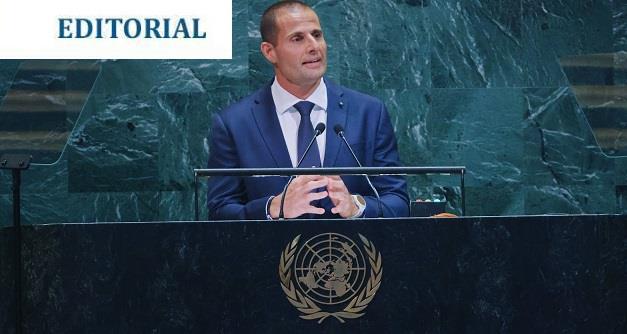

When Malta’s Prime Minister Robert Abela took the podium at the United Nations General Assembly in New York, he made the following statement. “Tear down these walls,” he said. “Let us stop erecting new barriers. Let us knock down those existing walls – physical and metaphorical – that are standing in the way of progress.”
It was the kind of phrase that travels well in the halls of diplomacy. Lofty, bold, and seemingly universal. And indeed, there is power in the call for humanity to stop building barriers between nations and peoples. We owe it, as Abela said, “to those who had the vision 80 years ago” when the United Nations was founded.
Yet words sound insincere when they echo loudly on the international stage but are drowned out at home by a reality that betrays them. If the Prime Minister truly believes that walls must be torn down, then the first place to start is Malta itself.
Malta’s most entrenched wall is one of our own making: the political divide that slices the country into red and blue camps, “us” and “them”. Politicians, including Abela, do little to dismantle it. Instead, their rhetoric often fuels it. Each election cycle, and often in between, the discourse does not unite but divides, entrenching suspicion and hostility. Too often, government actions are viewed not through the lens of national good but partisan benefit.
The Prime Minister speaks of partnership, but the Maltese people see political posturing. In this climate, tearing down walls is not just unlikely – it is actively resisted by those who profit from division.
Another wall is financial. Malta has seen economic growth, yes, but that prosperity is not shared equally. There are those who enjoy lucrative government appointments, who are ushered into comfortable posts with generous salaries, while many ordinary citizens scrape by on “peanuts” in tax refunds, social services or hand-outs. This inequity builds a wall between the privileged and the struggling – a wall reinforced by government policies that too often favour the well-connected rather than the hardworking.
The Prime Minister speaks of owing a duty to those who put their trust in leaders. But how can trust endure when people see that success depends less on effort and merit, and more on proximity to power?
Corruption is another barrier. Ordinary Maltese, people of goodwill, look around and see scandals brushed aside, accountability evaded, justice delayed. They see individuals getting away with wrongdoing, while the government itself implements legislation which gives them better protection. This perception – that there are two sets of rules, one for the powerful and another for everyone else – builds a wall of cynicism and distrust.
Our environment, too, reveals the walls that divide. On one side are developers, emboldened by government bills and policies that consistently tilt in their favour. On the other are citizens who mourn the loss of open spaces, heritage, and the character of their towns, who protest against relentless overdevelopment and the steady creep of a concrete jungle.
The wall here is not metaphorical alone – it is poured in cement, brick by brick, project by project. Each construction site, each favour to developers, each policy drafted without genuine consultation, is a barrier separating those who profit from those who must live in the shadow of new towers.
There are also social walls – between Maltese born and bred, and the foreign workers who now make up nearly a third of the country’s residents. These newcomers contribute to our economy, fill critical roles in health, construction, and hospitality, and bring cultural diversity. Yet, too often, they are viewed with suspicion or resentment, sometimes stoked by the very language of political leaders.
If Abela calls for walls to be torn down globally, he must also work to ensure Maltese society does not erect new ones internally, by failing to integrate, by neglecting fair treatment, or by allowing tensions to fester.
Even in matters of tradition and identity, we see division. The clash between those who shoot birds and those who defend them is emblematic of a deeper divide: between old practices described as heritage and new values driven by conservation and sustainability. Here too, government often sides with the louder lobby rather than fostering true dialogue.
Abela’s UN address asked the world to imagine a future without barriers, a community of nations working in partnership. It was a noble sentiment. But before Malta can credibly preach this vision abroad, it must embody it at home.
The Prime Minister should listen to his own words. “Let us stop erecting new barriers.” In practice, his government has too often been the architect of walls – between rich and poor, insider and outsider, citizen and migrant, developer and resident, politician and people.
“Tear down these walls,” he told the world. Malta is waiting for him to begin here.
For only when the walls within our own borders are dismantled can Malta’s message of partnership and progress resonate beyond them. Until then, the Prime Minister’s call at the UN risks being remembered not as a vision, but as a contradiction.