
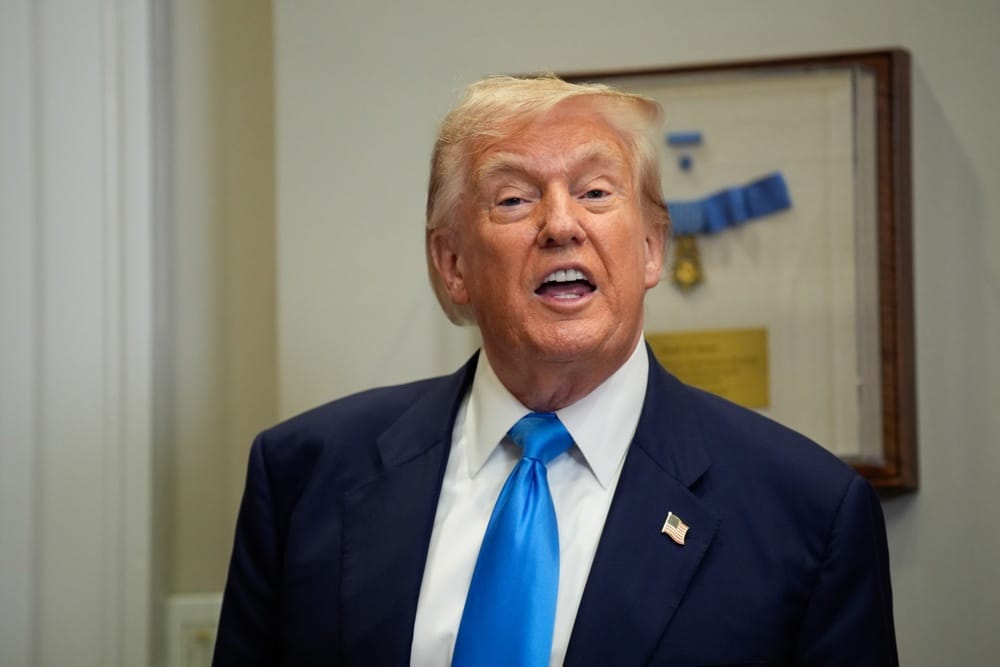
US President Donald Trump. Photo: EPA/YURI GRIPAS.
US President Donald Trump confirmed that Serbia and Bosnia and Herzegovina will be the two hardest-hit states in the Balkans when he signed an executive order on Thursday imposing higher tariffs on dozens of countries around the world.
In his latest executive order, Trump stuck to his decision from earlier in July to slap 35-per-cent tariffs on imports of goods from Serbia.
Serbian President Aleksandar Vucic said on Wednesday that Serbia had “submitted a proposal” for a tariff agreement to the US. “We have submitted our proposal, we are waiting for an answer and I believe we will receive it soon,” Vucic said.
For imports from Bosnia and Herzegovina, the US also kept to the same decision from earlier in July – 30-per-cent tariffs.
In an interview, the Serb member of Bosnia’s presidency, Zeljka Cvijanovic, said she had acted “in time” to launch procedures to regulate tariffs with the United States.
“After the announcement of reciprocal tariffs on Bosnia and Herzegovina, institutions and representatives from Republika Srpska at the state level made it clear that this issue must be addressed through negotiations,” Cvijanovic said.
In April, Cvijanovic sent a letter to the state Minister of Foreign Trade, Stasa Kosarac, proposing a zero tariff rate on goods imported from the US. No action followed, however.
The US accounts for just 1 per cent of Bosnia’s total foreign trade and the impact is significant only for the defence industry. Trade between the two countries has grown by 71 per cent over the past decade.
The most exported goods from Serbia to the US were tyres, arms, machine parts, animal feed, fruits and copper. Imports from the US amounted to $739.4 million [631.2 million euros] in 2024, up from $588 million [502 million euros] in 2023.
According to the latest data, Serbia’s exports to the US from January to May 2025 accounted for 2.2 per cent of its total exports. In 2024, it exported goods to the US worth $670.1 million [572.6 million euros], up from $556.9 million [476 million euros] in 2023.
Under Trump’s order, the tariff on imports from North Macedonia has been reduced from 33 to 15 per cent. Imports from Turkey will also be tariffed at 15 per cent. Kosovo, Albania and Montenegro face tariffs of 10 per cent.
The tariffs are set to operate from August 7. But Trump told NBC News on Thursday that although they have been set, he is still open to potential agreements with individual countries: “[The executive order] doesn’t mean that somebody doesn’t come along in four weeks and say we can make some kind of a deal,” he said.
On Friday, Kosovo’s caretaker Prime Minister, Albin Kurti, announced that the country is taking the decision to remove its 10 per cent tariffs on US goods.
“Any import from the US will have a zero tariff,” Kurti told his cabinet.
“Kosovo welcomes US products in its market and we strongly believe that this will have an impact in the increase of trade exchange and an increase in investments,” he added.
Kurti also said that the decision shows Kosovo’s commitment “to have a free trade agreement with the US”.
In April this year, when Trump initially imposed tariffs on other countries, Kosovo’s President Vjosa Osmani criticised her country’s government for not removing the tariffs on US goods.