
Top Chinese diplomat Wang Yi will visit Italy and Switzerland from October 7 to 12, according to China’s foreign ministry.
Wang would attend the 12th joint meeting of the China-Italy government committee and the fourth round of the China-Switzerland foreign ministers’ strategic dialogue, the ministry said in a statement on Sunday.
His trip follows the extension of an olive branch by Rome to state-backed Chinese group Sinochem International Corp, the main shareholder in Italian tyremaker Pirelli.
Do you have questions about the biggest topics and trends from around the world? Get the answers with SCMP Knowledge, our new platform of curated content with explainers, FAQs, analyses and infographics brought to you by our award-winning team.
Pirelli said last Monday that Italian Prime Minister Giorgia Meloni’s office had dismissed an administrative case involving Sinochem, after finding no evidence that either the Chinese company or its appointees had compromised management independence. The investigation involved a unit of Sinochem.

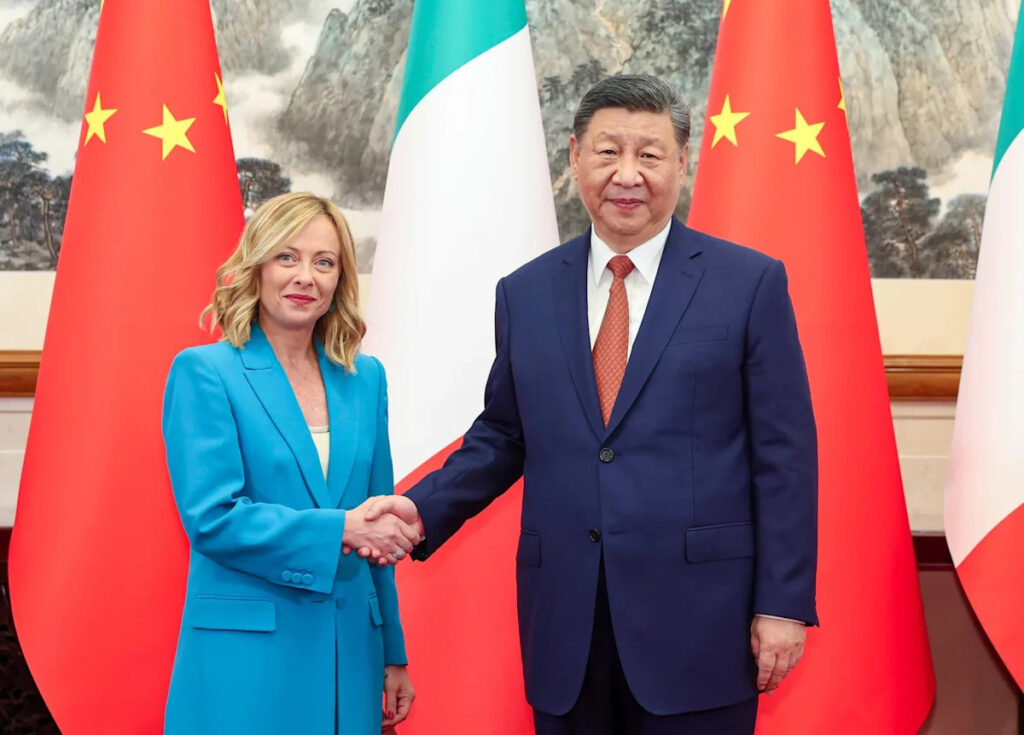
Italian Prime Minister Giorgia Meloni with Chinese President Xi Jinping during her visit to Beijing in July 2024. Photo: Xinhua alt=Italian Prime Minister Giorgia Meloni with Chinese President Xi Jinping during her visit to Beijing in July 2024. Photo: Xinhua>
The decision lowers the odds that Italy would sanction Sinochem under the country’s so-called “golden power” law.
Two years ago, Rome invoked the legislation meant to shield Italian companies deemed of strategic national importance, as it sought to curb Sinochem’s influence inside Pirelli and protect Pirelli’s managerial autonomy. The investigation was launched last year.
Meloni visited Beijing in July last year, her first trip to China since taking office in 2022. The trip was widely seen as a relaunch of bilateral relations months after Italy exited the Belt and Road Initiative, Beijing’s China-centred trade and infrastructure network.
The main outcome of the Italian leader’s trip was the signing of a three-year action plan to increase cooperation in areas ranging from trade to green development.
For its part, Beijing called on Rome to help promote its relations with the European Union. But observers said there was little sign that Meloni, long a staunch critic of China, had the interest or wherewithal to do so.
During her visit, Meloni said she sought “fairer” trade relations and a narrower trade deficit with China. She added that Italy would welcome additional Chinese investment, espousing a stance largely consistent with that of the EU.
The EU is trying to find ways to address its €300 billion (US$352 billion) trade deficit with China amid US tariff threats. The bloc is also increasingly nervous about competition from Chinese electric vehicle imports and Beijing’s alleged support for Russia’s war in Ukraine.
Still, Rome has taken a friendlier tack towards Beijing of late, consistently highlighting the merits of Chinese companies and investment in Europe despite voting in favour of the European Commission’s 2024 decision to impose tariffs on Chinese EVs.
In an interview with Chinese state media in September, Matteo Salvini, Italy’s deputy prime minister, touted car industry cooperation with Beijing, saying the two sides “enjoy broad prospects for cooperation in automobiles, smart roads and other transport areas”.
Meanwhile, Ignazio Cassis, Switzerland’s foreign minister, has called for a “coalition” of countries to deal with the tariff war waged by US President Donald Trump. During his trip to China in April, Cassis praised Beijing as an important advocate for a multilateral world.
Switzerland’s top diplomat further stated that Trump’s reciprocal tariffs had “created uncertainty everywhere, for everyone”, including countries viewed as close to the United States.
China and Switzerland marked 75 years of diplomatic relations last month, the ministry statement noted, adding that Switzerland was “one of the first Western countries to recognise the People’s Republic of China in 1950”.
In a social media post during his visit to Beijing, Cassis described China as a “key strategic player”. He called the 75-year diplomatic milestone a “crucial step in strengthening our foreign policy ties”.
Chinese President Xi Jinping and his Swiss counterpart, Karin Keller-Sutter, exchanged congratulatory messages on September 14.
This will be Foreign Minister Wang’s second trip to Europe in as many months. He visited Austria, Slovenia and Poland from September 12 to 16.
China has sought to boost its engagement in Europe, as Beijing and Brussels recalibrate their relations amid multidimensional changes, including upheaval in transatlantic ties, growing Russian belligerence towards Nato and continuing bilateral trade tensions.
This article originally appeared in the South China Morning Post (SCMP), the most authoritative voice reporting on China and Asia for more than a century. For more SCMP stories, please explore the SCMP app or visit the SCMP’s Facebook and Twitter pages. Copyright © 2025 South China Morning Post Publishers Ltd. All rights reserved.
Copyright (c) 2025. South China Morning Post Publishers Ltd. All rights reserved.